







Few technological transformations have touched the lives of Indians as profoundly as the evolution of the Passenger Reservation System (PRS) of Indian Railways. What began in 1986 as an effort to replace manual reservation registers and long queues at booking counters has today evolved into one of the world’s largest public reservation platforms, serving millions of passengers every day through digital channels.
Over nearly four decades, the Passenger Reservation System has grown alongside India’s railway network and its digital revolution. Today, as Indian Railways embarks on the next phase of modernising the PRS, the focus is on creating a faster, smarter and more resilient reservation ecosystem capable of meeting the demands of a rapidly expanding digital economy.
The Technology Behind Every Reserved Ticket
Every day, millions of passengers rely on Indian Railways for travel related to work, education, healthcare, business and family commitments. Behind every reserved railway ticket lies the Passenger Reservation System – the technology platform that manages bookings, cancellations, seat allocation, waitlists, Reservation Against Cancellation (RAC), reservation charts and passenger enquiries across the country.
Introduced in 1986, the PRS marked the beginning of computerised railway reservations in India. It replaced the cumbersome manual reservation process with an electronic system that brought greater efficiency, transparency and accessibility.
As the railway network expanded, the system evolved into a nationwide reservation platform through the Country-wide Network for Computerised Enhanced Reservation and Ticketing (CONCERT). This enabled passengers to reserve tickets for trains anywhere in the country from any connected reservation centre, irrespective of where the train originated or terminated.
Today, reservations can be made through railway reservation counters, the Indian Railway Catering and Tourism Corporation (IRCTC) website and mobile applications, allowing passengers to book tickets from virtually anywhere.
Four Decades of Continuous Evolution
The journey of the Passenger Reservation System mirrors the technological evolution of Indian Railways itself.
The first major milestone came in 1986, when computerised railway reservations were introduced.
During the 1990s, the PRS network expanded across railway zones, creating an interconnected nationwide reservation network.
A significant breakthrough came in 2002, when internet-based ticket booking was introduced, allowing passengers to reserve tickets online instead of visiting reservation counters.
In 2014, Indian Railways launched the Next Generation e-Ticketing (NGeT) system to improve online booking capacity and enhance the passenger experience.
The digital transformation accelerated further in 2025 with the launch of the RailOne mobile application. During the same year, the government announced the development of a next-generation Passenger Reservation System with significantly higher booking and enquiry capacities.
In August 2026, Indian Railways began the phased migration of trains to the upgraded PRS, marking a new chapter in railway digitalisation.
One of the World’s Largest Railway Reservation Platforms
The scale at which the Passenger Reservation System now operates is enormous.
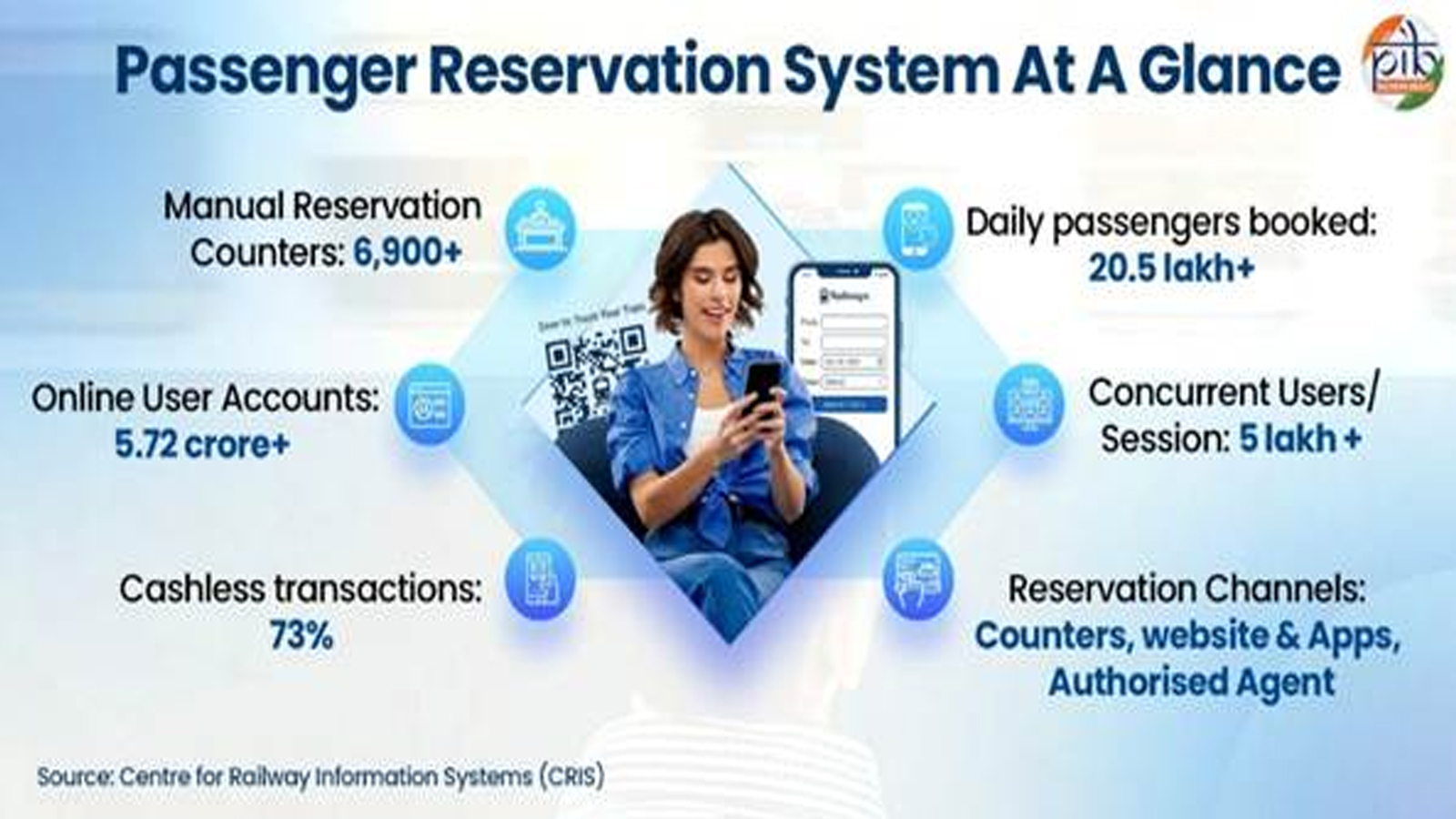
Between June 2025 and June 2026, passengers booked 65.08 crore reserved tickets through the PRS. Of these, 57.90 crore tickets, or 89 per cent, were booked online, reflecting the rapid adoption of digital ticketing among railway passengers.
Developed and maintained by the Centre for Railway Information Systems (CRIS), the PRS currently serves more than 20.5 lakh passengers every day through multiple booking channels.
Nearly 73 per cent of all PRS transactions are cashless, highlighting the increasing preference for digital payments.
The platform has emerged as one of India’s largest public-facing digital services.
Why the Reservation System Needed an Upgrade
While the existing Passenger Reservation System has served millions of passengers successfully, changing travel patterns and rapid digital adoption have significantly increased demand.
Peak booking periods, particularly during Tatkal reservations, generate enormous traffic on the reservation system. The existing PRS, deployed in 2010 using Itanium servers and the OpenVMS platform, was designed for a different era of digital demand.
To meet current and future requirements, Indian Railways is upgrading the system to a cloud-enabled, next-generation reservation platform capable of handling substantially higher transaction volumes.
Passenger-Centric Reforms
Alongside technological upgrades, Indian Railways has introduced several reforms aimed at improving transparency, fairness and passenger convenience.
The Advance Reservation Period (ARP) has been reduced from 120 days to 60 days, bringing reservation timelines closer to actual travel requirements.
To improve fairness in Tatkal bookings, Aadhaar-authenticated Tatkal booking was introduced in July 2025.
Subsequently, OTP-based verification was implemented to prevent misuse by automated software bots and unauthorised booking agents.
These measures are intended to ensure that genuine passengers receive better access to Tatkal tickets.
What the Next-Generation PRS Will Deliver
The upgraded Passenger Reservation System represents a significant leap in capacity and performance.
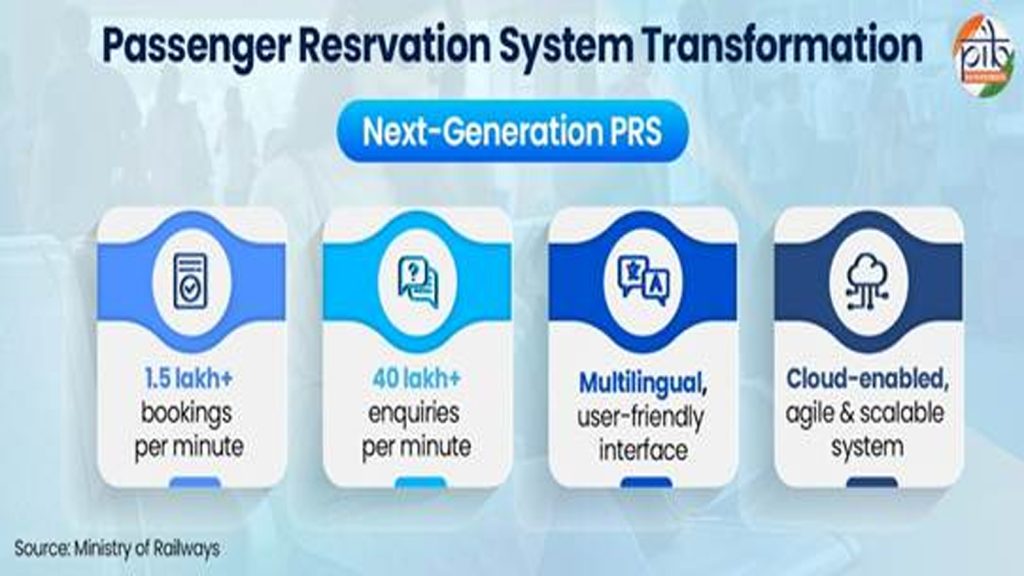
The new platform will be capable of processing more than 1.5 lakh ticket bookings every minute, compared with approximately 32,000 bookings per minute under the existing system.
Similarly, enquiry handling capacity will increase from around 4 lakh enquiries per minute to more than 40 lakh enquiries per minute.
Passengers will also benefit from a multilingual, user-friendly interface for bookings and enquiries.
The cloud-enabled architecture will provide greater scalability, flexibility and reliability, ensuring that the system remains capable of supporting growing passenger demand in the years ahead.
Redesigned IRCTC Portal
The upgraded PRS will work alongside a redesigned IRCTC website.
A beta version of the new portal was launched in July 2026 with a simplified interface, fewer booking steps and seat availability information across all classes.
Once fully integrated with the next-generation PRS, the redesigned website is expected to offer a faster and smoother booking experience.
Beyond ticketing, the IRCTC platform also provides hotel bookings, retiring rooms, lounge bookings, tour packages, flight tickets and bus ticket services.
CRIS: The Technology Backbone of Indian Railways
The Centre for Railway Information Systems (CRIS), established in 1986, has played a central role in digitising Indian Railways.
Initially focused on computerising reservations, CRIS has since developed an extensive range of digital platforms supporting both passengers and railway operations.
Its technology now supports millions of passengers and railway personnel every day.
Digital Services for Passengers
CRIS has developed multiple digital platforms to improve passenger convenience.
The Unreserved Ticketing System (UTS) enables paperless and mobile ticketing for unreserved journeys.
The National Train Enquiry System (NTES) provides real-time information on train schedules, arrivals, departures and running status.
The RailConnect mobile application, launched in 2017, brought PRS services to smartphones by enabling ticket booking, cancellations and PNR enquiries.
The RailOne application, launched in July 2025, integrates multiple railway services into a single platform.
By 22 July 2026, RailOne had recorded more than 4.55 crore downloads across Android and iOS devices.
The application currently facilitates around 9.65 lakh ticket bookings every day.
One of RailOne’s latest features is an Artificial Intelligence-based waitlist confirmation prediction system, which estimates the likelihood of a waitlisted ticket being confirmed before the journey.
According to Ministry of Railways, prediction accuracy has improved from 53 per cent to 94 per cent, enabling passengers to make better-informed travel decisions.
RailMadad: Digital Grievance Redressal
CRIS has also strengthened passenger grievance management through RailMadad, an integrated platform accessible via website, mobile application, SMS and Railway Helpline 139.
The system uses automated complaint assignment and auto-escalation mechanisms to ensure timely resolution.
Its performance over the last three financial years has remained consistently high:
* 2023–24: 99.98% grievances resolved
* 2024–25: 99.99% grievances resolved
* 2025–26: 99.98% grievances resolved
Other Passenger Services
Several other digital platforms developed by CRIS support passengers during their journeys.
CoachMitra enables passengers to request onboard housekeeping and assistance.
Rail Sugam provides information related to passenger and freight services.
Rail Rajbhasha promotes the use of Hindi in railway administration through digital tools.
Technology Beyond Passenger Reservations
CRIS has also modernised railway operations through several specialised digital platforms.
The Freight Operations Information System (FOIS) manages freight movement, wagon operations and logistics planning.
The Crew Management System (CMS) supports crew scheduling, deployment and monitoring.
eDrishti provides operational dashboards for railway performance monitoring.
Aapoorti digitises procurement and tender management.
Digital tools such as Chalak Dal and Hand-Held Terminals support inspections, field operations and real-time monitoring.
Embracing Emerging Technologies
Indian Railways is increasingly integrating advanced digital technologies into its operations.
CRIS is adopting Artificial Intelligence (AI), Machine Learning (ML), Big Data Analytics, Cloud Computing, Blockchain, the Internet of Things (IoT) and Augmented and Virtual Reality (AR/VR) across railway applications.
These technologies are being used to predict train delays, estimate waitlist confirmations, optimise train schedules and routes, forecast energy consumption, enable predictive maintenance of railway assets and improve operational planning.
The next-generation Passenger Reservation System builds upon this technological foundation by combining cloud-enabled infrastructure with advanced digital capabilities to create a reservation platform that is faster, smarter and more scalable.
Building a Future-Ready Reservation Ecosystem
The Passenger Reservation System represents one of the most significant digital transformations undertaken by Indian Railways.
From replacing handwritten reservation registers in 1986 to supporting one of the world’s largest online railway reservation systems today, the PRS has fundamentally changed how millions of Indians plan their journeys.
With the rollout of the next-generation PRS, Indian Railways aims to further improve booking speed, reliability and user experience while ensuring that the reservation system remains capable of serving the country’s growing passenger base.
As passenger expectations continue to evolve in the Digital India era, Indian Railways is positioning the Passenger Reservation System as the foundation of a future-ready, technology-driven reservation ecosystem designed to make railway travel more seamless, efficient and accessible for millions of travellers across the country.


