







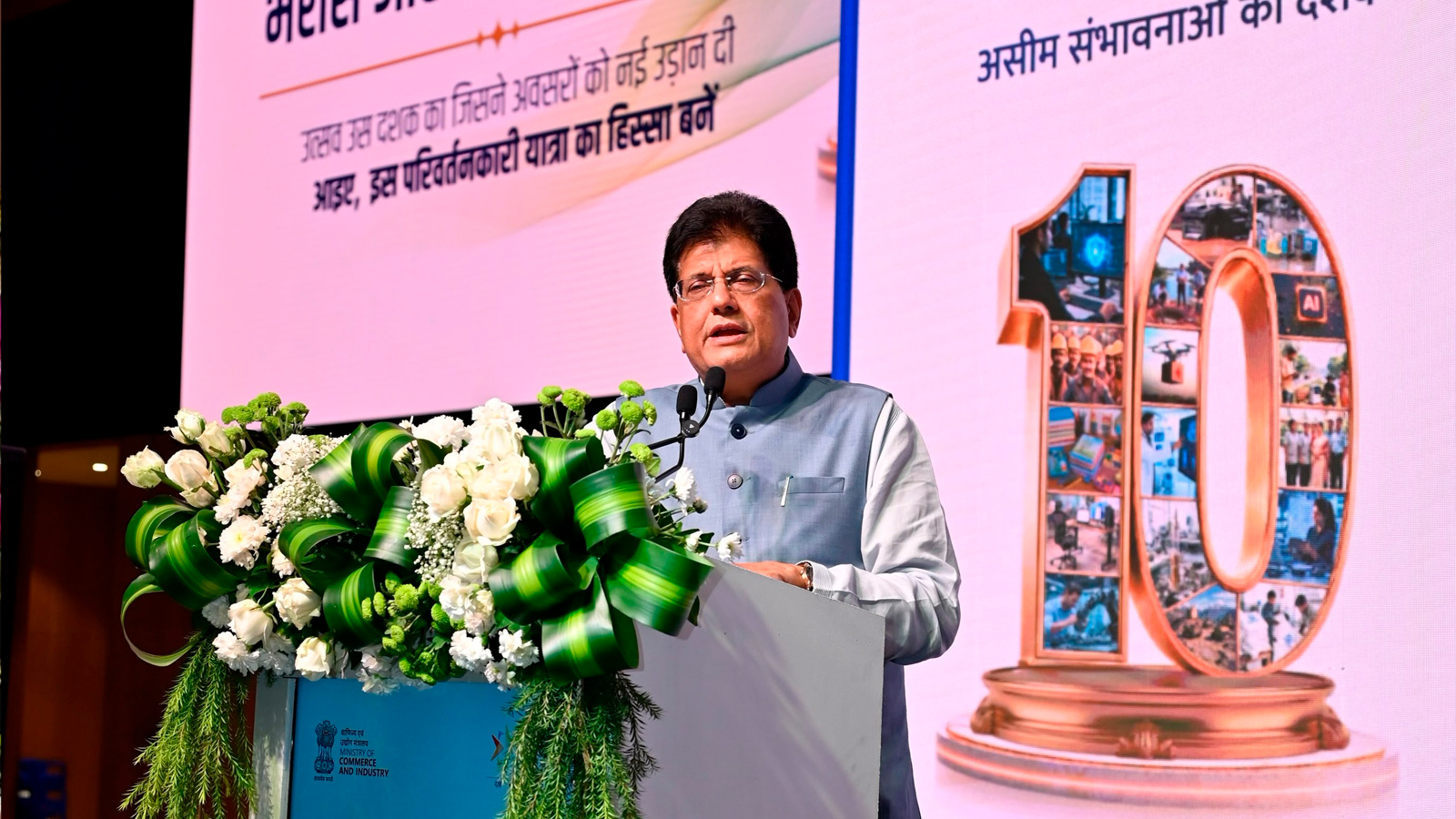
Union Commerce and Industry Minister Piyush Goyal on Monday called for a more user-friendly and artificial intelligence-enabled Government e-Marketplace (GeM) to make public procurement more efficient, transparent, cost-effective and competitive as the platform entered its second decade.
Addressing GeM’s 10th Foundation Day celebrations at Bharat Mandapam in New Delhi, Goyal outlined five key priorities for the platform’s next decade – expanding last-mile access, greater use of AI, deeper integration with government entities, improved access to credit and sustainable procurement, and stronger outreach to universities.
Goyal said GeM’s next phase should focus on using technology to help buyers and sellers make more informed decisions and improve the overall procurement experience.
He stressed the need to expand GeM’s Suvidha Kendras across districts to provide registration, cataloguing, training and grievance redressal services, particularly for enterprises that have limited access to digital platforms.
The minister also called for greater use of AI for price intelligence, price validation and maintaining marketplace integrity.
Another priority will be integrating states, public sector enterprises, panchayats and cooperatives into a seamless national public procurement ecosystem.
Goyal also emphasised scaling up credit-related initiatives such as GeM Sahay and linkages with the Trade Receivables Discounting System (TReDS), along with mainstreaming sustainable procurement practices.
He said universities should also be brought into the GeM ecosystem to encourage young innovators and attract new buyers and enterprises to the platform.
GeM records over ₹20 lakh crore in procurement
Launched on August 9, 2016, under the Ministry of Commerce and Industry, GeM has evolved from a digital marketplace into a nationwide public procurement platform connecting government buyers with enterprises across the country.
The platform currently has more than 25 lakh sellers and over 1.37 lakh buyer organisations. It has facilitated cumulative procurement exceeding ₹20 lakh crore through more than 3.78 crore orders, according to the government.
Micro and Small Enterprises (MSEs) account for a significant share of procurement through the platform. More than 12.28 lakh MSEs have fulfilled orders worth over ₹9 lakh crore, representing 45.6 per cent of GeM’s cumulative gross merchandise value.
More than 2.24 lakh women-led MSEs have fulfilled over 50 lakh orders valued at more than ₹1 lakh crore. The platform has also enabled 42,242 startups to secure government orders worth more than ₹65,633 crore.
New helpdesk number launched
As part of its 10th anniversary celebrations, GeM launched a nationwide five-digit short code, 14550, for its helpdesk services.
The new number is mapped to GeM’s existing helpdesk infrastructure and is intended to provide buyers, sellers and other stakeholders with an easily recognisable channel for support and official communication.
A customised ‘My Stamp’ was also launched to mark GeM’s 10th Foundation Day. The commemorative stamp highlights the platform’s contribution to digital governance, ease of doing business and the participation of Indian enterprises in public procurement.
Top buyers and sellers felicitated
The Foundation Day event brought together government buyers, sellers, entrepreneurs, policymakers and other stakeholders involved in GeM’s development since its launch.
Exemplary buyers from Central ministries and departments and State government departments, along with leading sellers, were felicitated for their contribution to strengthening the public procurement ecosystem.
The event also featured the screening of a film documenting GeM’s 10-year journey and its expansion across the country.
GeM CEO Mihir Kumar said the platform’s growth was not only reflected in its scale but also in its continuing efforts to respond to the needs of buyers and sellers.
As GeM begins its second decade, the government said the focus will shift from simply expanding the platform to increasing its impact through technology adoption, wider participation, procurement intelligence, faster processes and greater ease of doing business.
The broader objective is to make government procurement a more accessible and predictable market for Indian enterprises while providing buyers with a smarter, increasingly data-driven procurement system.


