







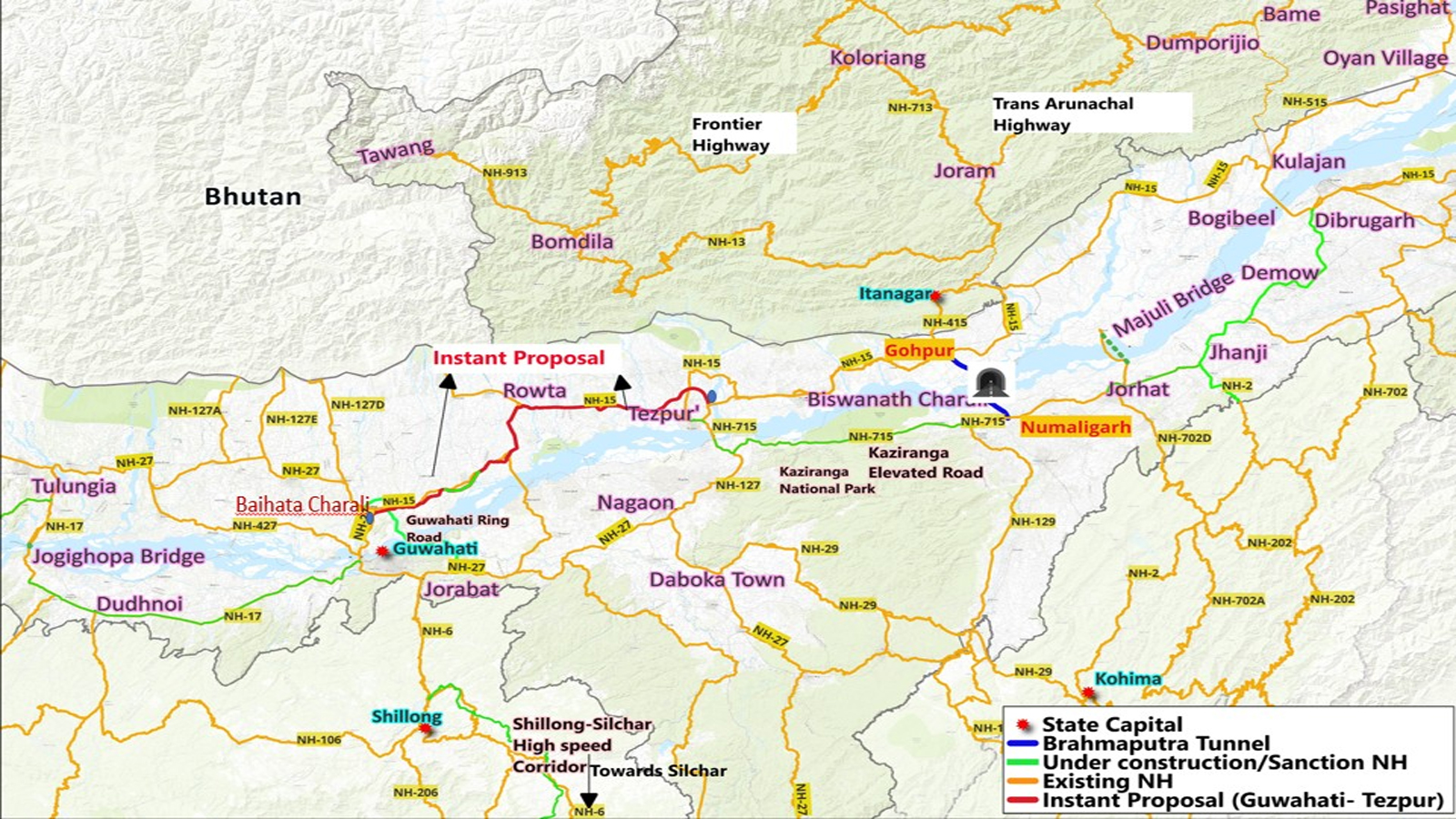
The proposed 135.87-km four-lane, access-controlled Guwahati–Tezpur Corridor in Assam is set to strengthen the movement of passengers and freight while giving a major push to the state’s tea industry, tourism, trade and regional connectivity.
The Cabinet Committee on Economic Affairs (CCEA) earlier this month approved the Ministry of Road Transport and Highways’ proposal for the corridor, which will connect Baihata Chariali near Guwahati with Tezpur, excluding the 15.11-km Mangaldoi Bypass. The project will be developed under the Built-Operate-Transfer (BOT) Toll mode) at a total capital cost of ₹8,970.20 crore.
The corridor is expected to increase average travel speeds by 100 per cent, cut travel time by half, improve fuel efficiency and reduce vehicle operating costs. It will also strengthen connectivity between Assam and Arunachal Pradesh, forming an important link in the highway network connecting Guwahati with Itanagar and Pasighat.
Five bypasses to ease congestion
A key feature of the project is the construction of five major bypasses covering a combined 58.7 km. These bypasses will divert through traffic away from densely populated areas of Baihata Chariali, Sipajhar, Kharupetia, Dekiajuli and Tezpur.
The move is expected to reduce congestion in these towns, improve road safety and facilitate smoother movement of long-distance traffic.
The corridor will also include 15 major bridges, 30 minor bridges, 19 flyovers, 46 underpasses and 210 km of service roads. An elephant underpass is also planned as part of the Tezpur Bypass.
A 4.9-km Emergency Landing Facility (ELF) is proposed on the Tezpur Bypass in coordination with the Indian Air Force.
Better connectivity for Assam’s tea economy
The highway is expected to play an important role in strengthening the logistics chain supporting Assam’s tea industry.
Tea moves through several stages from plantations and processing units to traders and markets. Improved highway connectivity can make the movement of tea and other goods more predictable by reducing delays, lowering vehicle operating costs and improving freight efficiency.
Guwahati already plays an important role in Assam’s tea trade, with Tea Board India maintaining auction infrastructure in the city and publishing weekly auction data for the centre.
The new corridor is expected to provide faster and safer movement between production areas, processing centres, markets and other economic nodes, strengthening the wider logistics network.
Push for tourism
The project is also expected to improve access to important tourist destinations in Assam.
The corridor will improve connectivity to tourist nodes including Maa Kamakhya Temple, Kaziranga National Park and Orang National Park. Better road connectivity could facilitate tourism circuits linking Guwahati, Tezpur and the wider North Assam region.
The improved access could also support the development of tourism around Assam’s tea landscapes, plantations, processing facilities and associated cultural heritage.
Link to economic and logistics hubs
The Guwahati–Tezpur Corridor has been planned as more than a road link between two cities. It will connect eight PM GatiShakti economic nodes, two social nodes, three tourist nodes and seven logistics nodes.
Among the logistics infrastructure linked to the project are three major railway stations, two airports and two waterway terminals.
The corridor is therefore expected to improve connections between road, rail, air and inland waterway infrastructure, strengthening the movement of goods and people across the region.
Strengthening Northeast connectivity
The corridor will form an important component of the wider highway network linking Guwahati with Itanagar and Pasighat in Arunachal Pradesh.
By improving connectivity between Assam and Arunachal Pradesh, the project is expected to facilitate access to economic and social centres and strengthen regional integration across the Northeast.
The project will also help decongest the existing NH-27 East-West Corridor along the southern bank of the Brahmaputra, according to the government.
With faster travel, reduced congestion and improved access to economic, tourism and logistics centres, the Guwahati–Tezpur Corridor is envisaged as a major infrastructure intervention aimed at strengthening Assam’s economic connectivity while improving mobility for local communities.


