







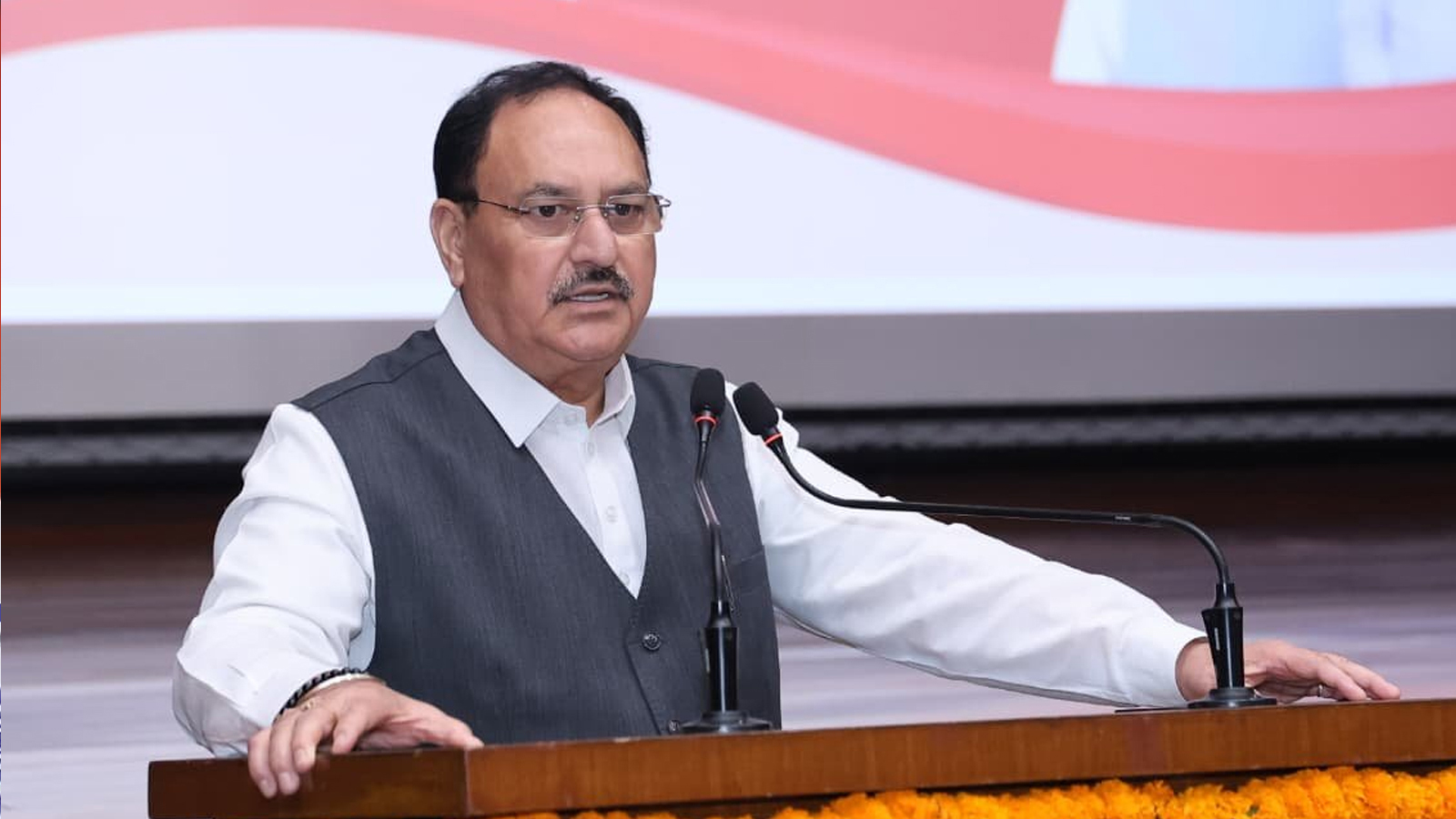
Union Health Minister Jagat Prakash Nadda on Tuesday called upon Members of Parliament from Karnataka and Kerala to step up efforts to eliminate tuberculosis (TB), urging them to strengthen public awareness, administrative oversight and community mobilisation in their constituencies.
Nadda held a discussion with Lok Sabha and Rajya Sabha MPs from the two states on the sidelines of the Monsoon Session of Parliament as part of the government’s broader efforts to engage parliamentarians in the TB Mukt Bharat Abhiyaan. The meeting, titled “Parliamentarians Championing a TB Mukt Bharat”, was attended by Union ministers, MPs and senior health officials.
Union Minister Pralhad Joshi, Minister of State for Health and Family Welfare Anupriya Patel, Minister of State Suresh Gopi and Minister of State Shobha Karandlaje were among those present.
The meeting reviewed the progress of the 100-Day TB Mukt Bharat Abhiyaan and discussed strategies to sustain the momentum generated by the campaign. The first phase of the initiative was launched on December 7, 2024, initially covering 347 high-priority districts before being expanded nationwide. The second phase, launched on March 24, 2026, focused on nearly 1.58 lakh high-risk villages and urban wards across the country.
Nadda said India had made significant progress in its fight against TB, noting that TB incidence in the country declined by 21 per cent between 2015 and 2024, nearly twice the global pace. He also cited a 92 per cent treatment coverage rate, based on the WHO Global TB Report 2025.
He highlighted the recently concluded 100-day campaign, which ran from March 24 to July 4, 2026. During the campaign, more than 2.02 crore vulnerable people were screened, resulting in the detection of over 7 lakh new TB cases. Of these, around 1.97 lakh were asymptomatic cases, which could otherwise have remained undetected.
Calling for sustained political leadership, Nadda urged MPs to work closely with District Collectors and health facilities and monitor the delivery of TB services at the grassroots level. He stressed that the fight against TB was not merely a government health programme but a people’s movement requiring collective ownership.
The Health Minister also emphasised innovative case-finding strategies, early diagnosis, patient-centric treatment and nutritional and psychosocial support as key pillars of India’s TB elimination strategy.
Health Secretary Punya Salila Srivastava pointed out that Karnataka and Kerala face several factors that contribute to their TB burden. These include urbanisation, migrant populations, slums, undernutrition, alcohol and tobacco use, HIV and diabetes, an ageing population with comorbidities, construction and industrial workers, hilly and tribal areas, stone quarries, silk weaving and workers in coffee and tea plantations.
Additional Secretary, Health and Family Welfare, Aradhana Patnaik, highlighted the technological expansion of India’s TB detection infrastructure. She said molecular testing capacity had expanded from a few hundred machines a decade ago to more than 11,000 machines, while nearly 3,000 AI-enabled handheld X-ray units have been deployed in the field.
She also highlighted initiatives undertaken by Karnataka and Kerala during the 100-day campaign, including taking Ayushman Arogya Shivirs to urban slums, construction sites and migrant clusters to bring screening and treatment closer to vulnerable populations.
MPs from both states reaffirmed their commitment to intensifying awareness and stigma-reduction campaigns and expanding Ni-kshay Shivirs to promote early TB detection, including among people who may not show symptoms.
The parliamentarians also committed to strengthening oversight of TB services at district and block levels to ensure access to quality diagnostics and patient-centric care. They will further work to mobilise communities under a Jan Andolan to provide nutritional, psychosocial and livelihood support to people affected by TB.
Nadda said the conclusion of the 100-day campaign should not be viewed as the end of the effort but as the beginning of sustained action, with progress ultimately measured by consistent improvements in TB elimination outcomes across every district.


