







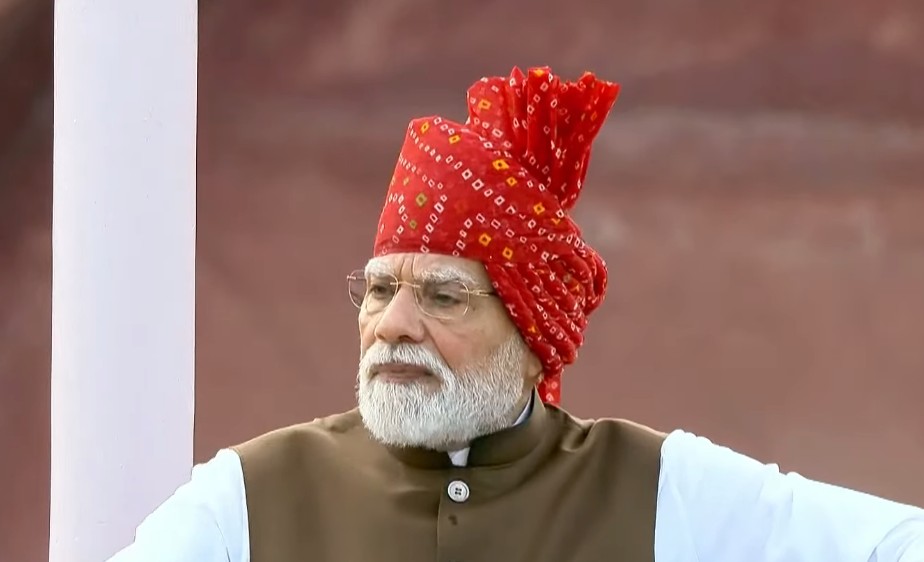
Prime Minister Narendra Modi on Saturday said India aims to operationalise five new nuclear reactors during this decade as part of efforts to strengthen the country’s energy security and achieve a nuclear power capacity of 100 GW.
Addressing the nation from the ramparts of the Red Fort on the occasion of the 80th Independence Day, PM Modi said the SHANTI Act had created a framework to advance India’s nuclear energy ambitions.
“Energy security is the demand of the time. With the SHANTI Act passed in Parliament, we have created the framework to achieve our goal. Our goal is to achieve 100 gigawatts of nuclear power capacity. We aim to start five new nuclear reactors in this decade,” he said.
The Prime Minister stressed the need for India to reduce dependence on other countries and strengthen domestic capabilities in line with the vision of an Atmanirbhar Bharat.
“It is our conviction that India must not be dependent on other countries. We must become self-reliant. We have to strengthen our capabilities and protect our national interests,” he said.
PM Modi also highlighted India’s progress in railway electrification, saying the country had achieved 100 per cent electrification of its railway network.
“Railway electrification in India began in 1925. Yet, over nearly 90 years, only 30 per cent of the railway network had been electrified. In just the last decade, India has achieved 100 per cent railway electrification,” he said.
He said the achievement had reduced dependence on imported diesel while contributing to a cleaner environment. He also highlighted the launch of India’s first hydrogen-powered train.
Highlighting India’s progress in digital technology, innovation and manufacturing, PM Modi said defence production had increased nearly fourfold over the past 12 years, while Khadi and village industries output had grown almost fivefold.
He said electronics manufacturing had expanded nearly sevenfold, production of modern railway coaches had risen 21-fold and mobile phone production had increased 33-fold.
“The number of internet users has nearly quadrupled, patent grants have increased fourfold, and digital transactions have grown a hundredfold,” PM Modi said.
The Prime Minister also highlighted the expansion of basic amenities and improvements in governance, saying tap-water connections were being provided at an average annual rate 15 times faster than before.
He said gas connections had been provided at six times the previous annual pace, toilets for the poor had been constructed at four times the earlier rate and housing for the underprivileged had been provided at three times the previous rate.
“One cannot march into the 21st century relying on laws from the last century. We expanded metro networks to build modern infrastructure and strengthened public transport,” he said.
PM Modi said thousands of compliance requirements had been eliminated and hundreds of archaic laws repealed as part of efforts to transform governance.
He also acknowledged the contribution of citizens from different sections of society to India’s development journey, saying they had worked with determination and dedication to take the country to new heights.
“Over the past 12 years, countless citizens–whether Dalits, the downtrodden, the marginalized, or tribals; whether rural or urban dwellers; the poor or the middle class; youth or the elderly; women or men; from the North, South, East, or West–have all strived in every possible way, with unwavering resolve and dedication, to propel the nation to new heights. I respectfully acknowledge these efforts,” the Prime Minister said.
Earlier, PM Modi hoisted the National Flag at the Red Fort. The flag hoisting was synchronised with a 21-gun salute by the 1721 Field Battery (Ceremonial), which used indigenous 105 mm Light Field Guns.
The ceremonial battery was commanded by Major Pawan Singh Shekhawat, while Naib Subedar (Assistant Instructor in Gunnery) Anuthosh Sarkar served as the Gun Position Officer.
-ANI


