







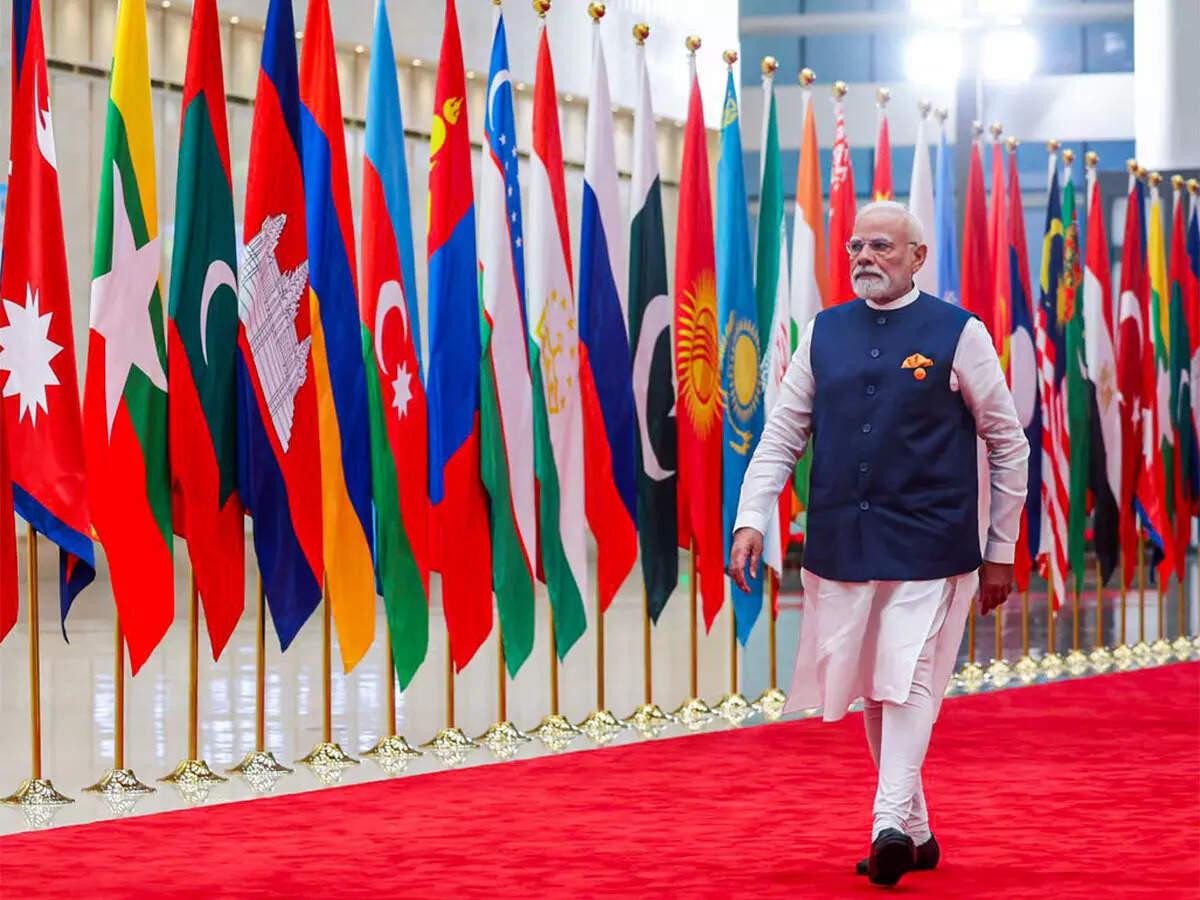
Prime Minister Narendra Modi’s participation in the Shanghai Cooperation Organisation (SCO) Summit in Tianjin in September 2025, followed by India’s continued high-level participation in the grouping’s meetings in 2026, underlines New Delhi’s sustained engagement with one of Eurasia’s key multilateral platforms.
SCO at 25: A Growing Eurasian Grouping
The SCO, which is marking its 25th anniversary, was founded in 2001 by China, Russia, Kazakhstan, Kyrgyzstan, Tajikistan and Uzbekistan. India and Pakistan joined the organisation as full members in 2017, followed by Iran in 2023 and Belarus in 2024, further expanding its geographical reach.
From Observer Status to Full Membership
India’s engagement with the SCO goes back much further. New Delhi became an Observer in 2005 and a full member in 2017, marking a gradual expansion of its role in the grouping.
India’s relationship with SCO countries is rooted in longstanding ties based on mutual trust and goodwill. Its more than two-decade-long association with the organisation — first as an Observer and later as a full member — has provided New Delhi with a platform to participate in discussions and initiatives spanning regional security, economic cooperation, connectivity and cultural exchanges.
A Wider Role in the SCO
Following its accession as a full member, India has actively participated in the SCO’s various mechanisms while also putting forward proposals aimed at strengthening cooperation among member states, observers and dialogue partners.
India has ensured representation at an appropriate level across the organisation’s meetings. While the Council of Heads of State is attended by the Prime Minister, the Council of Heads of Government is generally represented by the External Affairs Minister.
India has also maintained participation in ministerial meetings and other dialogue formats covering security, defence, economy and other areas of cooperation. To strengthen its contribution to the SCO’s day-to-day functioning, India has deputed two officers each to the SCO Secretariat in Beijing and the SCO Regional Anti-Terrorist Structure in Tashkent.
India’s First SCO Presidency
India’s engagement with the grouping entered a new phase when it assumed the rotating SCO Chairmanship in September 2022.
India’s first-ever chairmanship culminated in the 23rd SCO Council of Heads of State Summit, chaired by Prime Minister Narendra Modi in virtual format on July 4, 2023.
The theme of India’s presidency was “Towards a SECURE SCO”, with SECURE standing for Security; Economy and Trade; Connectivity; Unity; Respect for Sovereignty and Territorial Integrity; and Environment.
Expanding the SCO Agenda
During its presidency, India introduced new areas of cooperation covering Startups and Innovation, Traditional Medicine, Digital Inclusion, Youth Empowerment and Shared Buddhist Heritage.
India also focused on strengthening people-to-people ties and highlighting the historical and civilisational links shared by SCO countries.
Varanasi was designated the first-ever SCO Cultural and Tourist Capital for 2022-23, hosting a series of socio-cultural events under the SCO framework.
The chairmanship was marked by intensive diplomatic activity, with India hosting more than 140 meetings and events, including 14 ministerial-level meetings.
Sustaining the Momentum After the Presidency
India’s engagement with the SCO continued after its chairmanship ended.
In 2025, Prime Minister Narendra Modi participated in the SCO Council of Heads of State Summit in Tianjin, while External Affairs Minister S Jaishankar led the Indian delegation at the SCO Council of Heads of Government meeting in Moscow.
India also participated at the ministerial and senior-official levels in meetings covering defence, security, health, sports, finance, science and technology and other areas.
Continued Engagement in 2026
Under the Kyrgyz Republic’s presidency of the SCO in 2026, India has maintained high-level participation across the grouping’s different mechanisms.
Indian ministers and senior officials have participated in meetings dealing with defence, transport, security, industry, internal affairs, culture and regional development.
Central Asia at the Core
India’s SCO engagement also forms part of its broader outreach to Central Asia, a region of growing strategic importance for New Delhi.
The recent strengthening of India-Uzbekistan ties adds another dimension to this engagement. Prime Minister Narendra Modi’s state visit to Tashkent resulted in an agreement with President Shavkat Mirziyoyev to elevate bilateral relations to a Comprehensive Strategic Partnership.
The two sides signed 11 agreements covering critical minerals, uranium, trade, defence, digital payments and education, alongside cooperation in Hindi and Sanskrit, sports and heritage conservation.
India and Uzbekistan have also set a USD 5 billion trade target, while seeking to deepen long-term energy cooperation and engagement at the state and city levels.
A Broader Eurasian Footprint
India’s evolution within the SCO — from Observer to full member and eventually chair — reflects the growing importance it attaches to engagement with Eurasia.
The grouping has provided New Delhi with a platform to pursue cooperation not only on traditional areas such as regional security and counter-terrorism, but also on connectivity, trade, innovation, digital inclusion, health, culture and people-to-people exchanges.
Prime Minister Modi’s emphasis on Security, Connectivity and Opportunity at the 2025 Tianjin Summit, along with his proposal for a Civilizational Dialogue Forum, reflects India’s effort to further widen the scope of its engagement within the SCO.


