







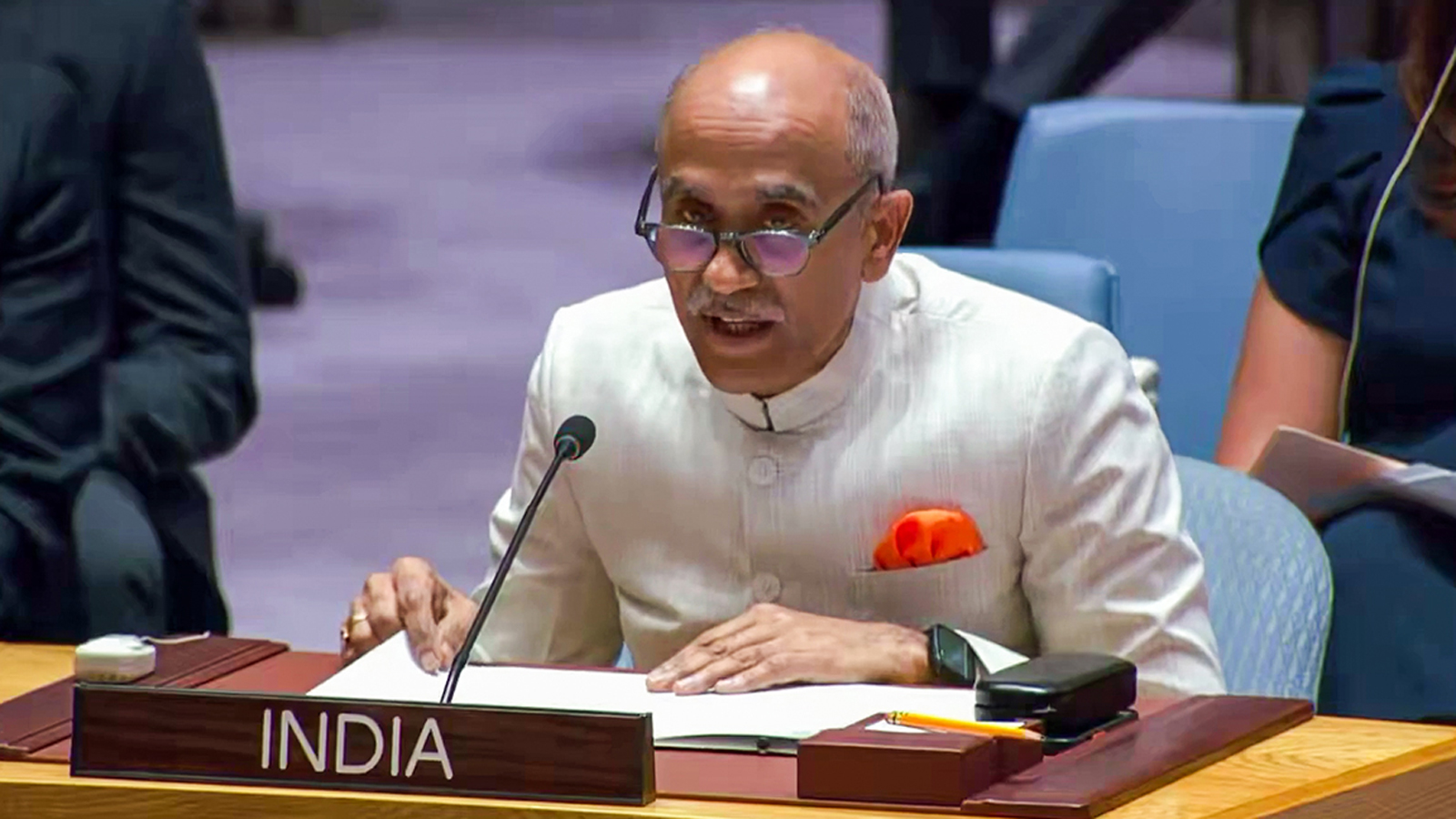
India has called for stronger international action to mitigate the impact of armed conflicts on global food security, stressing that food insecurity is primarily a consequence of conflict, political instability and underdevelopment rather than their root cause.
Addressing a UN Security Council high-level open debate on “Food Under Fire: The Security Council’s Role in Mitigating Global and Local Food Crises” on August 25, India’s Permanent Representative to the United Nations, Ambassador Parvathaneni Harish, said conflicts increasingly have consequences far beyond the immediate areas of fighting.
He pointed to disruptions in energy markets, fertiliser supplies, maritime transport, humanitarian logistics and agricultural trade, saying such disruptions can threaten food security worldwide, with developing countries that depend heavily on imports facing the greatest burden.
Harish said the Security Council has an important role in responding to threats to international peace and security, but building resilient and food-secure societies remains primarily the responsibility of national governments, with support from the UN development system and the Rome-based agencies.
Referring to UN Security Council Resolution 2417, which recognises the link between armed conflict and hunger, he called for early-warning systems to go beyond monitoring humanitarian conditions and also assess disruptions to critical supply chains for food, fertilisers, fuel and humanitarian logistics.
Such assessments, he said, should draw on the expertise of agencies including the Food and Agriculture Organization (FAO) and the World Food Programme (WFP) and remain objective, evidence-based and free from politicisation.
India calls for unhindered humanitarian access
India said the immediate priority for the Security Council should be mitigating the humanitarian consequences of conflicts by facilitating safe, rapid and unimpeded humanitarian access and supporting de-confliction arrangements where necessary.
Harish also urged the Council to ensure that its measures, including sanctions regimes, do not inadvertently obstruct humanitarian assistance or legitimate food and agricultural trade.
He stressed the importance of protecting civilian infrastructure critical to food security, including agricultural land, irrigation systems, storage facilities, transport corridors and ports.
India also called for safeguarding commercial shipping and freedom of navigation in accordance with international law. The envoy said secure and predictable maritime routes are essential for the movement of food, fertilisers, fuel and other commodities.
Disruptions to shipping during conflicts, he warned, can have cascading consequences well beyond the affected region, particularly for food-importing developing countries and humanitarian operations.
Focus on resilient and climate-ready agriculture
India emphasised that humanitarian assistance alone cannot provide long-term food security. Member States, international financial institutions, regional organisations and development partners, it said, need to work together to strengthen domestic agricultural production, diversify supply chains, improve storage and logistics and promote climate-resilient agriculture.
Predictable and affordable access to fertilisers, quality seeds, technology and concessional finance remains particularly important for developing countries, India said, while stressing the importance of open, transparent and rules-based trade in food and agricultural inputs.
Highlighting India’s own experience, Harish cited the National Food Security Act, which provides statutory entitlements to subsidised foodgrains, and PM-KISAN, under which direct benefit transfers have reached more than 110 million farming households, as measures that have strengthened food-system and farmer resilience.
He also highlighted India’s advocacy of the International Year of Millets in 2023, saying it has helped draw global attention to climate-resilient and nutrient-rich crops as a pathway to diversified food security.
India’s investments in food systems, supported by digital public infrastructure and climate-adaptive agricultural practices, have helped the country remain food-secure while contributing to global food supplies, he said. India is ready to share these experiences through South-South cooperation and development partnerships.
India warns against over-reliance on single production models
The Indian envoy also highlighted the vulnerability created by climate variability, including phenomena such as El Niño, which can disrupt monsoon patterns, reduce agricultural yields and put additional pressure on water resources.
He called for greater international cooperation to address these risks and strengthen climate resilience.
India further cautioned against excessive reliance on any single model of food production, saying such dependence can leave countries vulnerable to geopolitical disruptions, economic coercion and the weaponisation of food supplies.
Harish called for greater support for small and marginal farmers in developing countries and urged the international community to promote climate-resilient crops such as millets rather than defining food security primarily around major staple grains such as rice, wheat and corn.
He said the UN Secretary-General’s good offices could help facilitate dialogue, reduce tensions and support humanitarian access where appropriate, while the wider UN system should use scientific expertise, operational capabilities and timely data to support decision-making.
India maintained that the Security Council should focus on its core mandate of addressing conflict, facilitating humanitarian access and creating conditions for peace, while the General Assembly, ECOSOC, the UN development system and Rome-based agencies should continue to lead long-term efforts to tackle food insecurity.
“Peace, development and food security are mutually reinforcing,” India said, stressing that genuine multilateral cooperation and respect for respective institutional mandates can help the UN system better prevent and respond to food crises.


