







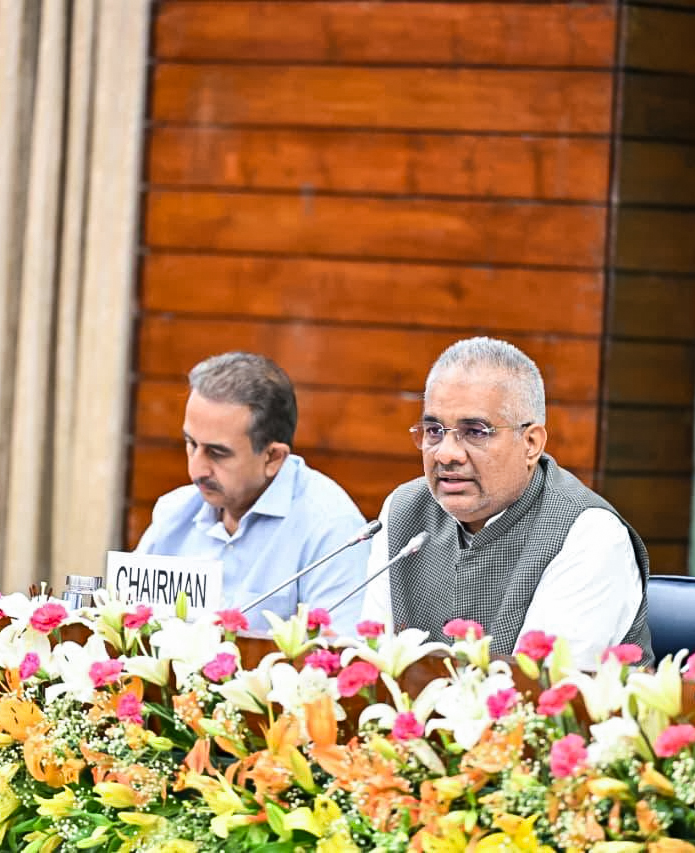
India has called for diversified, adequate, predictable and sustained international finance for land restoration and drought resilience, with Union Environment Minister Bhupender Yadav highlighting the country’s innovative financing mechanisms at the 17th Conference of Parties (CoP17) of the UN Convention to Combat Desertification (UNCCD) in Ulaanbaatar.
Addressing a Ministerial Dialogue on ‘Innovative Financial Mechanisms for Healthy Land and Drought Resilience’, Yadav said land restoration should be viewed as an investment rather than a cost, given its contribution to food and water security, biodiversity, livelihoods and long-term resilience.
“Land restoration is not a cost, but an investment in food, water, biodiversity, livelihoods and long-term resilience,” Yadav said.
He stressed that addressing desertification, land degradation and drought at scale would require diversified, predictable and sustained sources of finance beyond public budgets, along with stronger public-private partnerships.
Yadav highlighted India’s blended green-finance framework, which facilitates financing for climate adaptation, sustainable land use, forestry and agriculture, afforestation and biodiversity conservation.
He also highlighted Sovereign Green Bonds as an avenue to mobilise capital for land restoration, drought resilience, sustainable forestry and other environmental and climate priorities.
The Minister outlined India’s Green Credit Programme, which enables public and private entities to finance the restoration of degraded forest land. Under the programme, credits are issued after five years of restoration and upon achieving at least 40 per cent canopy density. These credits can be used once for compensatory afforestation, statutory plantation or corporate social responsibility obligations.
Yadav also highlighted India’s compensatory conservation framework, under which payments received for forest diversion are channelled towards compensatory afforestation and ecosystem restoration.
Underscoring the importance of convergence, he said bringing public and private finance together through mechanisms such as the Green Credit Programme and compensatory afforestation funds, along with citizen participation, reflects a “Whole-of-Government and Whole-of-Society” approach.
“Finance must be continuous, verifiable and connected to local communities,” Yadav said.
He noted that India’s experience demonstrates what committed domestic resources can achieve, but stressed that domestic efforts cannot substitute for additional, adequate and predictable international finance for land restoration and drought resilience.
Concluding his address, Yadav reaffirmed India’s commitment to sharing its experience, safeguards, institutional arrangements and lessons learned, while also acknowledging areas requiring course correction.


