







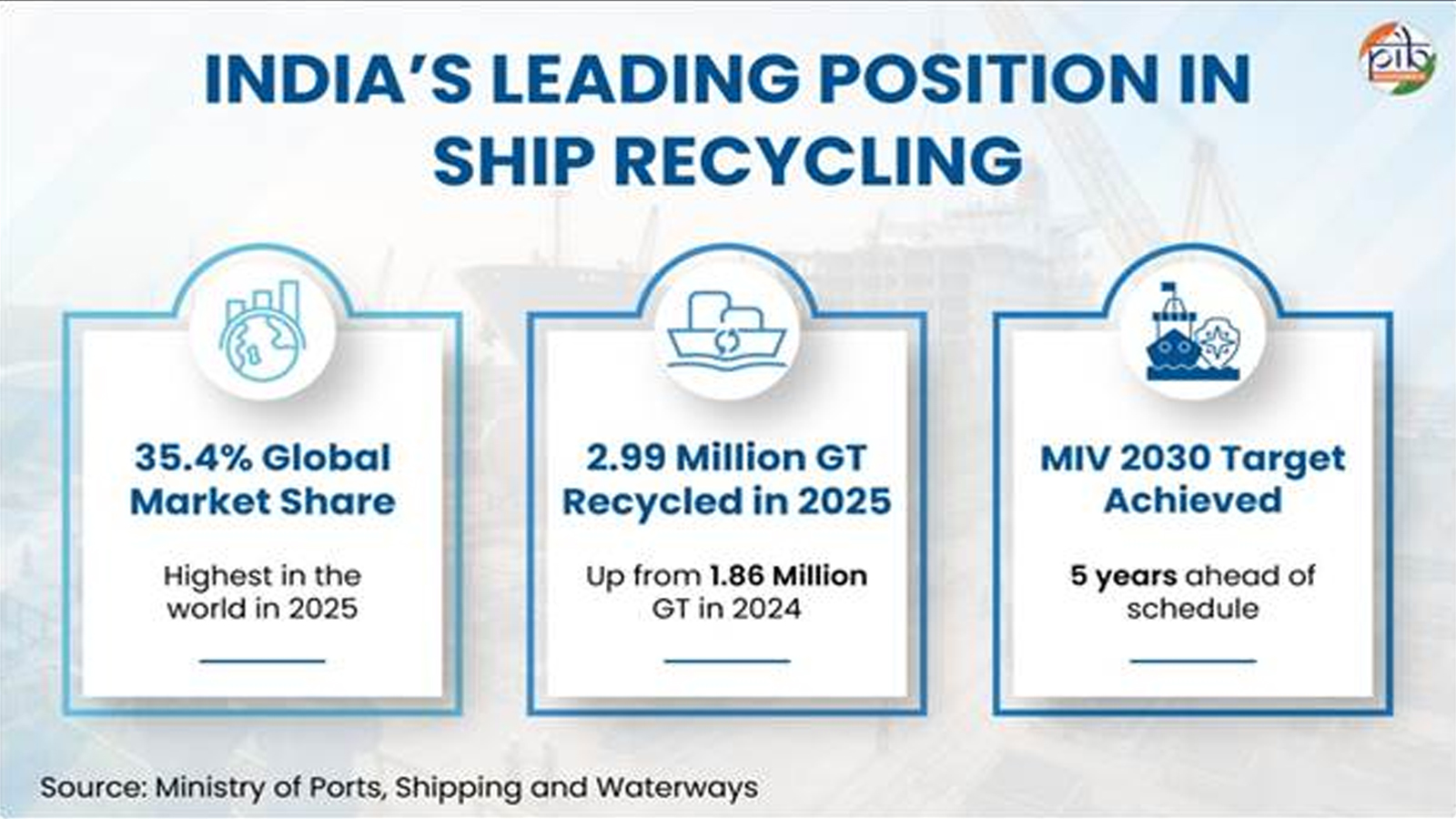
India has emerged as the world’s leading ship recycling nation, with its share of the global market rising from 30.1 per cent in 2024 to 35.4 per cent in 2025, marking a significant transformation of a sector that is increasingly aligned with international safety and environmental standards.
According to the latest data cited by the government from the United Nations Conference on Trade and Development (UNCTAD), India recycled 2.99 million Gross Tonnes (GT) of ships in 2025, up from 1.86 million GT in 2024. The increase represents nearly 60 per cent growth in recycling volume.
The achievement also means that India has met the target set under the Maritime India Vision 2030 of becoming the world’s leading ship recycling nation, five years ahead of schedule.
From ship-breaking to a regulated industry
Ship recycling is an important part of the maritime lifecycle, allowing vessels at the end of their operational life to be dismantled safely while recovering steel and other reusable materials. The sector also contributes to the circular economy by reducing the need for primary resources and supporting the reuse of materials.
The government has increasingly placed environmental protection, worker safety, regulatory compliance and resource efficiency at the centre of India’s ship recycling framework. These measures have helped transform the industry from conventional ship dismantling practices into a more modern and internationally aligned activity.
For India, the sector has significance beyond maritime operations. Recycled steel provides an important source of ferrous scrap for the domestic steel industry, reducing dependence on imported raw materials. Reusing steel also requires substantially less energy than primary steel production and results in lower greenhouse gas emissions.
The industry additionally supports a network of ancillary activities, including transportation, steel re-rolling, equipment supply and waste management, generating employment and supporting industrial production.
Alang-Sosiya remains the backbone
The Alang-Sosiya ship recycling cluster in Gujarat continues to dominate India’s recycling industry, accounting for approximately 98 per cent of the country’s ship recycling activity.
Described as the world’s largest ship recycling hub, the cluster has an annual recycling capacity of around 6 million GT and produces approximately 3.50 million metric tonnes of steel annually without exploiting natural resources.
The cluster is supported by authorised recycling yards, downstream steel re-rolling mills and waste management infrastructure. Over the years, its facilities have undergone extensive modernisation to improve safety, environmental compliance and operational efficiency.
India now plans to nearly double its ship recycling capacity to about 9 million light displacement tons (LDT). A comprehensive master plan has been prepared for the development of the Alang Ship Recycling Yard, with a focus on infrastructure improvement and strengthening the country’s competitiveness in the global market.
Worker training has also become an important component of the sector’s modernisation. The Safety Training and Labour Welfare Institute at Alang-Sosiya has cumulatively trained more than 1.5 lakh workers in occupational safety, hazardous material handling and emergency response.
Besides Alang, India has ship recycling facilities at Amar Iron Udyog in Kolkata and Steel Industrials Kerala Limited (SILK) in Kerala.
Stronger infrastructure and safety standards
Indian ship recycling yards have been upgraded with engineered and demarcated recycling plots, impermeable working surfaces, drainage systems and mechanised material-handling equipment.
They also have segregated areas for hazardous waste storage, authorised linkages for downstream waste treatment and disposal, and structured arrangements for safety, health and emergency response.
These measures are intended to improve working conditions while ensuring that hazardous materials generated during recycling are handled under regulatory supervision.
Regulatory framework aligned with global standards
A comprehensive statutory framework now governs ship recycling in India.
The Ship Recycling Act, 2019 provides the primary legal framework and gives domestic effect to international standards. It designates the Directorate General of Shipping as the National Authority and provides for authorisation, certification, inspection and enforcement.
The Ship Recycling Rules, 2021 prescribe detailed procedural and technical requirements covering facility authorisation, ship recycling plans, hazardous material management, worker safety, training and reporting.
The Ship Recycling Regulations, 2026 further strengthen implementation by providing detailed operational, safety and environmental standards aimed at uniform compliance and monitoring across recycling facilities.
Together, these measures regulate the ship recycling lifecycle, from preparation and certification of vessels to yard authorisation, recycling operations and compliance monitoring.
Aligning with the Hong Kong Convention
India’s regulatory transition has also been shaped by the Hong Kong International Convention for the Safe and Environmentally Sound Recycling of Ships, the principal international instrument governing ship recycling.
The Convention came into force on June 26, 2025, making compliance mandatory. India has aligned its domestic legal and regulatory framework with the Convention through the Ship Recycling Act, Rules and Regulations.
The government has provided ₹53.5 crore in financial assistance for modernising ship recycling yards. This support has helped 115 facilities achieve compliance with the Hong Kong Convention.
India is also seeking greater access to environmentally conscious international markets. Thirty-five ship recycling yards at Alang, Gujarat, have applied for EU green-listing, with the European Union having initiated the inspection process. Shree Ram Vessel Scrap and Y. S. Investments have been included in the draft of the 16th European List of Ship Recycling Facilities.
Inventory of Hazardous Materials strengthens safety
The Inventory of Hazardous Materials (IHM) is another key element of India’s approach to safe ship recycling. It identifies and records hazardous substances present aboard ships during their operational life and before they enter recycling facilities.
India follows a lifecycle-based compliance approach to IHM, aimed at ensuring transparency and traceability and enabling risks associated with hazardous materials to be addressed before recycling begins.
Linking ship recycling with shipbuilding
India has also introduced incentives designed to connect ship recycling with the growth of domestic shipbuilding.
Under the Ship-breaking Credit Note Scheme introduced through the Ship Building Financial Assistance Scheme (SBFA) 2.0, shipowners are encouraged to recycle vessels at compliant Indian facilities and subsequently build new ships at Indian shipyards.
The scheme provides a credit note equivalent to 40 per cent of the recycled ship’s scrap value. This credit can be used towards payment of up to 5 per cent of the value of a new vessel constructed at an Indian shipyard.
The policy seeks to promote both sustainable recycling and expansion of India’s shipbuilding industry.
Ex-INS Viraat showcases India’s capabilities
The recycling of former aircraft carrier INS Viraat at Alang is highlighted as a major example of India’s ship recycling capabilities.
After serving the Indian Navy for 30 years and the Royal Navy for 27 years, the vessel was decommissioned in March 2017 and arrived at Alang for recycling in September 2020.
Recognised by Guinness World Records as one of the world’s longest-serving warships, INS Viraat had logged more than 22,622 flying hours, spent 2,252 days at sea and travelled over 5.88 lakh nautical miles, equivalent to around 10.94 lakh kilometres.
Its recycling demonstrated India’s ability to handle a large and complex vessel while recovering valuable materials and maintaining evolving environmental and occupational safety standards.
Building a globally competitive recycling ecosystem
India’s rise to the top of the global ship recycling market reflects the combined impact of regulatory reforms, infrastructure modernisation and greater alignment with international standards.
The growth in recycling volumes and global market share has strengthened the position of the Alang-Sosiya cluster while creating opportunities for employment, steel production, resource recovery and ancillary industries.
With plans to expand capacity, continued yard modernisation, stronger regulatory oversight and incentives linking recycling with shipbuilding, India is positioning ship recycling as an important component of its broader maritime industrial ecosystem.
The sector’s transformation demonstrates how responsible end-of-life management of ships can contribute simultaneously to resource security, industrial growth, environmental sustainability and the development of a circular economy.


