







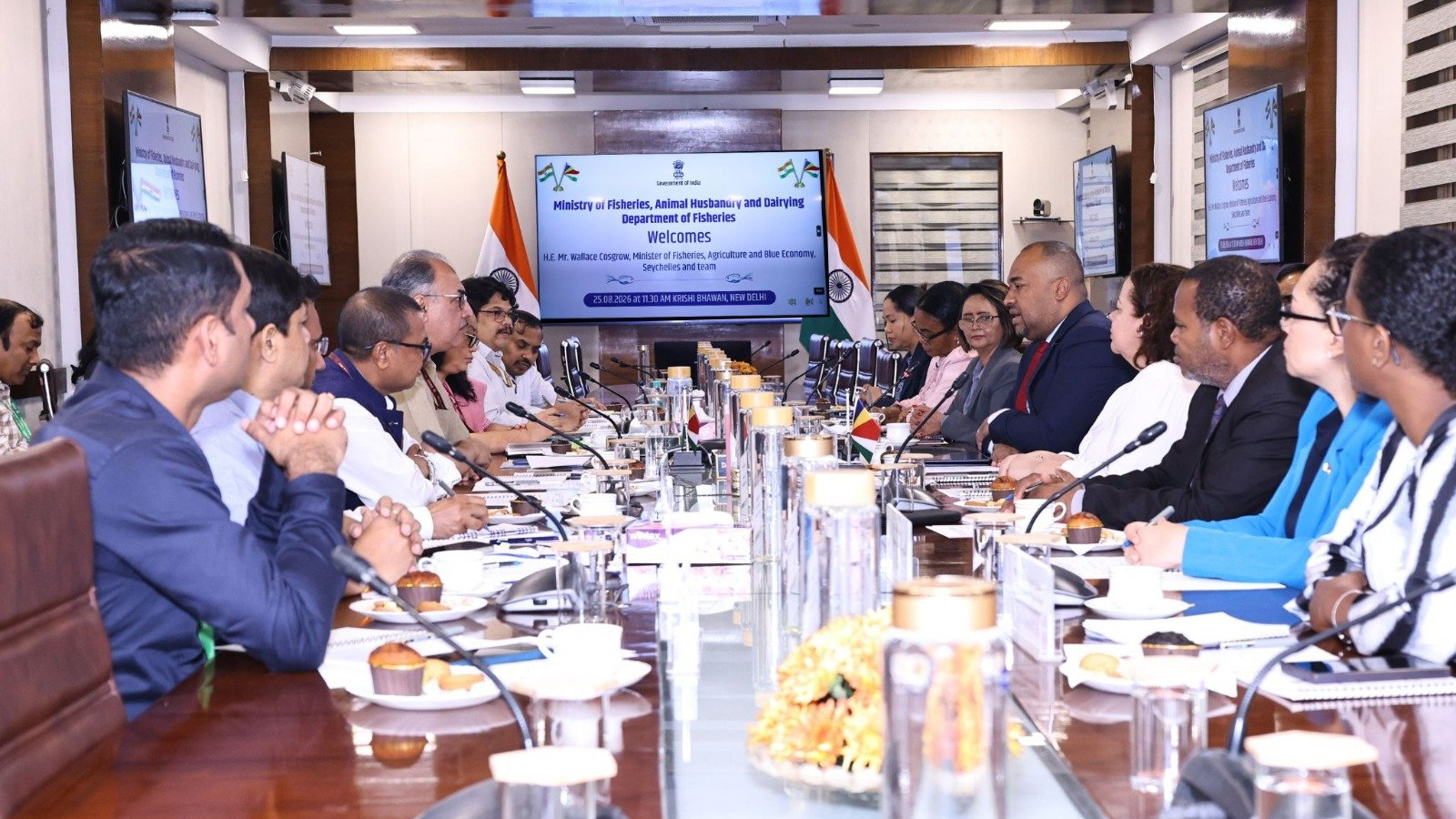
India and Seychelles have agreed to strengthen bilateral cooperation in fisheries, aquaculture and the blue economy, with a focus on sustainable marine resource management, technology, capacity building and scientific research.
The agreement was reached during a high-level bilateral meeting hosted by the Department of Fisheries under the Ministry of Fisheries, Animal Husbandry and Dairying in New Delhi on August 25.
The Seychelles delegation was led by Minister of Fisheries, Agriculture and Blue Economy Wallace Cosgrow, while the Indian delegation was headed by Secretary, Department of Fisheries, Dr Abhilaksh Likhi.
The two sides reviewed existing cooperation frameworks and discussed new areas of collaboration aimed at promoting sustainable utilisation of marine resources and strengthening the maritime partnership between the two countries.
India reiterated its commitment to expanding technical cooperation with Seychelles in fisheries, aquaculture, scientific research and capacity building. Both sides noted the importance of cooperation in these areas for promoting socio-economic stability as well as food and nutritional security in the Indian Ocean Region.
During the discussions, the delegations identified fisheries and the broader blue economy as important drivers of economic growth, employment and sustainable development.
India highlighted the growth of its fisheries sector, noting that national fish production has reached 19.7 million tonnes, while seafood exports are valued at USD 8.46 billion. The Indian side also shared its initiatives on sustainable fisheries management, responsible harvesting and technology-driven infrastructure development.
The discussions covered a wide range of areas for potential joint development, including marine aquaculture, modern hatcheries, tuna fisheries, fish stock assessment, post-harvest technology and marine conservation.
Both countries also explored opportunities for knowledge transfer through technical studies, fisheries extension services and institutional training programmes.
Digital transformation and the use of emerging technologies also featured prominently in the discussions. The two sides explored cooperation in fisheries data systems and monitoring, control and surveillance infrastructure, besides examining the potential use of artificial intelligence in harvest management.
Particular emphasis was placed on developing fisheries value chains, especially tuna processing and product diversification, as well as sustainable management of fish waste.
To ensure sustained progress, both sides stressed the need for a structured annual work plan, regulatory alignment, faster commercialisation of joint scientific research, reciprocal access to laboratories and the development of joint pilot projects.
The Seychelles delegation expressed interest in expediting the implementation of a bilateral Memorandum of Understanding focused exclusively on fisheries and aquaculture, supported by an advanced work plan.
The Seychelles side also emphasised the importance of institutionalising engagement between administrative authorities, academic institutions, researchers and technical experts from the two countries to ensure continuous cooperation.
The meeting also discussed mutual exposure visits, specialised technical exchanges and greater use of national Centres of Excellence in both countries for institutional capacity building and sharing of best practices.
The meeting concluded with both sides reaffirming their commitment to translate the existing diplomatic partnership into practical and result-oriented initiatives aimed at promoting sustainable fisheries, strengthening the blue economy and advancing long-term maritime prosperity for India and Seychelles.


