







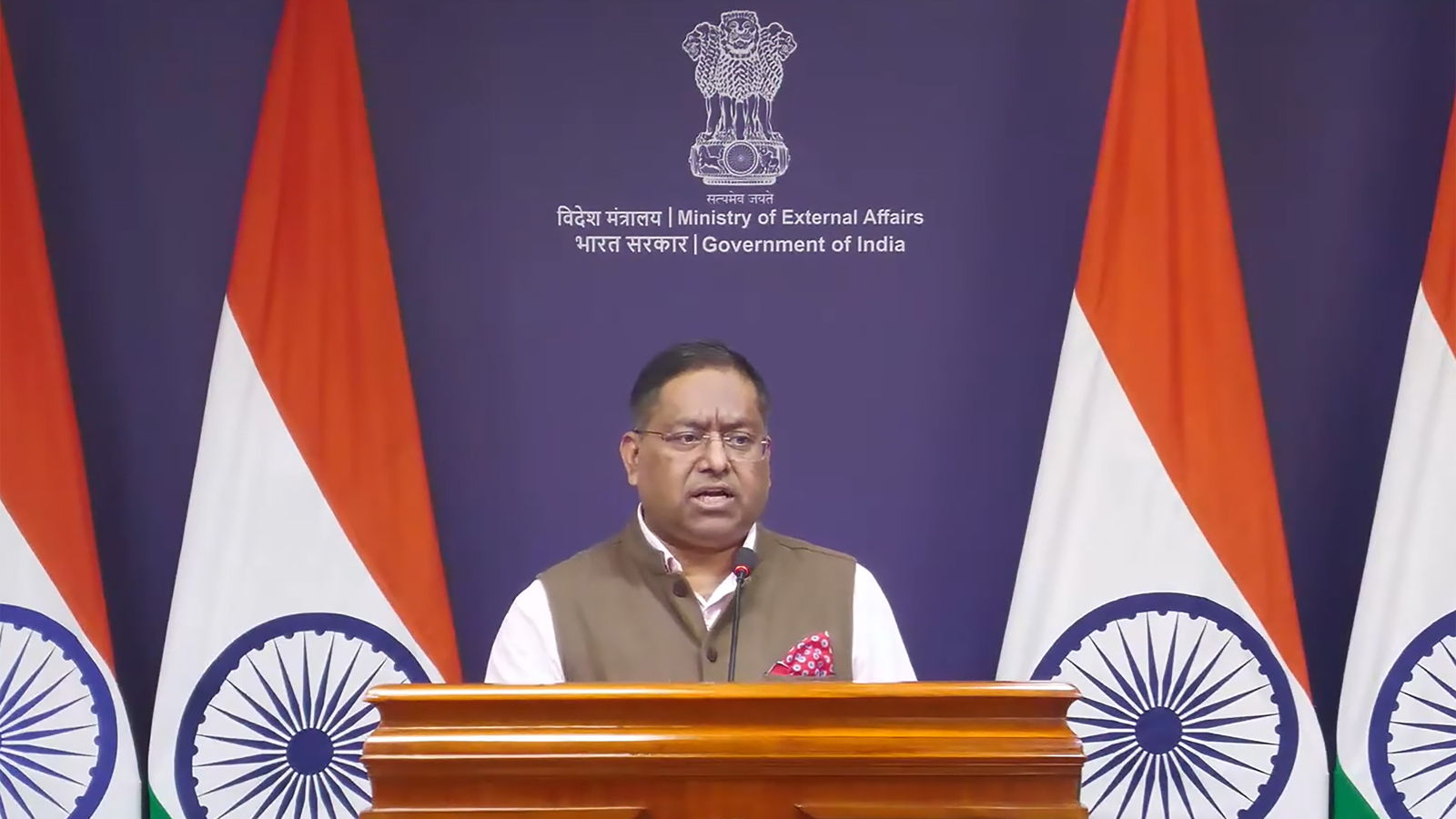
India on Tuesday called on the international community to hold Pakistan accountable for alleged human rights violations in Pakistan-occupied Jammu and Kashmir (PoJK), while reiterating that Arunachal Pradesh is an “inalienable and integral part of India”. The Ministry of External Affairs (MEA) also said it was examining the implications of the recently signed Pakistan-Saudi Arabia-Turkey defence pact and strongly condemned the defacement of the Indian Embassy in Slovenia.
Addressing a bi-weekly media briefing, MEA spokesperson Randhir Jaiswal said India had been closely following developments in Pakistan, particularly the situation in PoJK, where protests and clashes with security forces have been reported in recent months.
India seeks accountability over PoJK violence
Responding to questions about reports of appeals to the United Nations over the situation in PoJK, Jaiswal said large-scale protests during and ahead of elections had been met with repression.
“Public discontent was answered with bullets and blackouts and repression and oppression,” he said, adding that more than 90 people had reportedly been killed and many others injured during the violence in recent months.
Jaiswal said the developments highlighted Pakistan’s shortcomings in guaranteeing human rights and called for greater international attention to the situation.
“We believe that the international community should hold Pakistan accountable for the deaths of so many people in the recent violence,” he said.
The remarks came amid continuing unrest surrounding the 2026 Legislative Assembly elections in PoJK. The elections have been held in phases, with protests, clashes and allegations of excessive use of force reported in parts of the region. The final phase in several constituencies was also affected by security concerns, road closures and an internet blackout.
The Joint Awami Action Committee has been leading protests in PoJK over several issues, including opposition to the 12 refugee seats in the legislative assembly. The group has alleged interference by Pakistan’s establishment in the political process.
India said the developments warranted international scrutiny, calling on the global community to take note of what it described as “flagrant” and “gross” human rights violations.
‘Arunachal Pradesh is an integral part of India’
On China’s continued objections over Arunachal Pradesh and its attempts to assign Chinese names to locations in the state, Jaiswal reiterated New Delhi’s position that such actions cannot alter the status of the territory.
“Arunachal Pradesh is an inalienable and integral part of India,” he said, stressing that “nothing can change this indisputable reality”.
India’s remarks followed the identification of 27 locations in Arunachal Pradesh by their standard names on the official Survey of India map. New Delhi has repeatedly rejected Beijing’s attempts to rename places in the state, describing such efforts as fictitious and incapable of changing the ground reality.
The locations include places of strategic and historical significance such as Long Ju and Thag La, which were associated with military confrontations during the early stages of India-China tensions and the 1962 conflict.
China has issued several lists of names for places in Arunachal Pradesh since 2017. India has consistently rejected the practice and maintained that Arunachal Pradesh is an integral part of the country.
India examining implications of Pakistan-Saudi-Turkey defence pact
On the recently signed defence agreement between Pakistan, Saudi Arabia and Turkey, the MEA said India was examining its implications from the perspectives of national security and regional stability.
Jaiswal said India was closely monitoring developments in West Asia and would take all necessary measures to safeguard its national interests.
The agreement, signed in Mecca on August 7 by Saudi Crown Prince Mohammed bin Salman, Turkish President Recep Tayyip Erdogan and Pakistani Prime Minister Shehbaz Sharif, provides for collective deterrence and enhanced defence cooperation among the three countries.
The pact states that an armed attack against one member would be treated as an act of aggression against all three. Saudi Arabia has clarified that the agreement is not intended to constitute a military alliance or religious grouping and does not seek to promote a regional arms race.
Turkey has also said the agreement is aimed at strengthening collective deterrence, defence cooperation, joint defence production and counter-terrorism efforts.
India condemns defacement of Embassy in Slovenia
India also reiterated its strong condemnation of the defacement of the premises of its Embassy in Ljubljana, Slovenia, by what it described as anti-India elements.
Jaiswal said India had taken up the matter with Slovenian authorities in both New Delhi and Ljubljana and demanded action against those responsible.
He stressed that diplomatic premises are protected under the Vienna Convention and must be secured by the host country.
“We have strongly condemned it and have raised this issue with the government there,” Jaiswal said.
India has called for the perpetrators to be held accountable and urged law enforcement authorities to take appropriate action.
MEA monitoring case of Indian national arrested in Germany
The MEA also said it remained in contact with US authorities following the arrest of Indian national Varun Batchigari in Germany in connection with an alleged murder in Arizona.
Jaiswal said India had been formally informed about the case and that the ministry had subsequently informed relevant authorities in India. Batchigari was reportedly arrested in Berlin and is facing allegations related to the killing of his girlfriend in Tucson, Arizona.
The MEA said it was in touch with US authorities to ascertain further details about the case.
‘Neighbourhood First’ remains central to regional outreach
The MEA also linked India’s recent diplomatic engagements across South Asia to its Neighbourhood First policy, saying New Delhi intends to deepen relations with neighbouring countries across multiple areas.
Jaiswal said recent engagements with Bhutan, Sri Lanka, Bangladesh and Nepal reflected India’s efforts to strengthen bilateral ties and development partnerships.
“We have a policy of Neighbourhood First. We want to strengthen our ties with countries in our neighbourhood,” he said.
He noted that development partnership remains an important component of India’s engagement with neighbouring countries.
India’s recent diplomatic outreach has included visits by Foreign Secretary Vikram Misri to Bhutan and Sri Lanka. In Sri Lanka, India and the island nation exchanged Line of Credit agreements worth $250 million for railway projects and $100 million for livestock and priority sectors.
In Bhutan, Misri co-chaired the fifth India-Bhutan Development Cooperation Talks, focusing on the implementation of India-assisted development projects under Bhutan’s 13th Five-Year Plan.
India has also maintained high-level diplomatic engagement with Bangladesh and Nepal, with Indian envoys meeting the Prime Ministers of the two countries on August 11.
BRICS outreach
The MEA further said India had invited BRICS member and partner countries to the upcoming BRICS Summit, along with leaders of regional groupings for the outreach session.
India is scheduled to host the 18th BRICS Summit on September 12-13, 2026, during its presidency of the grouping. The summit will be held under the theme “Building for Resilience, Innovation, Cooperation and Sustainability.”
The MEA said the government would provide further details regarding the invitations as preparations for the summit progress.
(With ANI inputs)


