







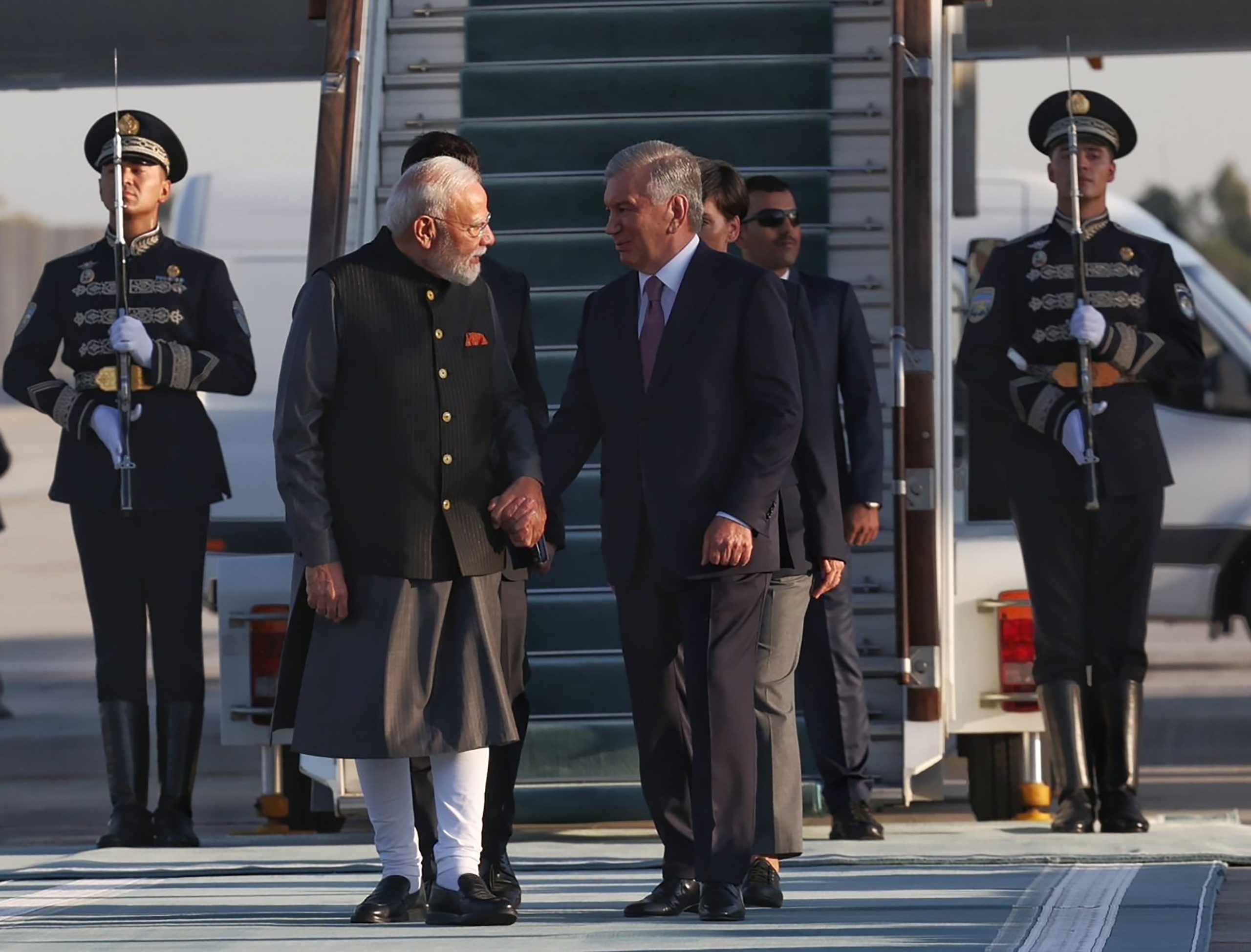
Prime Minister Narendra Modi’s recent visit to Uzbekistan has given a new direction to India’s engagement with Central Asia. The decision to elevate India-Uzbekistan relations to a Comprehensive Strategic Partnership, coming in the 15th year of their existing strategic partnership, is more than a diplomatic upgrade. It reflects the growing convergence between India’s economic, energy, technological and security interests under its Viksit Bharat 2047 vision and Uzbekistan’s ambition to build a modern, connected and economically resilient Yangi Uzbekistan or New Uzbekistan.
For India, the significance of the new partnership lies in its breadth. Uranium, critical minerals, trade, defense, digital public infrastructure, healthcare, education, connectivity and environmental cooperation are now becoming interconnected components of the relationship. The old foundations of civilizational friendship remain important, but they are increasingly being complemented by the harder foundations of strategic and economic interests.
Strategic Interdependence
The 2011 Strategic Partnership had marked an important elevation in bilateral relations. Over the subsequent 15 years, cooperation expanded steadily, but the latest decision seeks to give the relationship a stronger institutional and implementation-oriented structure. India and Uzbekistan have agreed to establish a Foreign Minister-level Coordination Council, while the existing Joint Commission will be upgraded from the Secretary level to the Ministerial level. The two sides will also organize a business summit to strengthen direct economic engagement.
For New Delhi, perhaps the most strategically significant outcome is the agreement to establish a framework for long-term uranium supplies from Uzbekistan. India’s nuclear-energy expansion is becoming an important component of its long-term energy strategy. With domestic uranium resources limited in both quantity and grade, reliable international supplies are important for sustaining and expanding nuclear power.
The uranium arrangement, hence, has significance beyond the immediate India-Uzbekistan relationship. India is seeking to expand nuclear capacity substantially by 2047, while simultaneously pursuing its broader development and climate objectives. Uzbekistan’s position as an important uranium-producing country gives it growing relevance in India’s energy-security calculations. The agreement also fits into India’s wider effort to diversify strategic supply chains and avoid excessive dependence on any single external source.
Uranium is only one part of a larger resource-security agenda. India and Uzbekistan are expanding cooperation in critical minerals, mining and geological resources. This is particularly important because India’s transformation into a manufacturing, technology and digital economy will require secure supplies of minerals essential for clean-energy technologies, advanced manufacturing, electronics and other strategic sectors. The memorandum on cooperation in geology and mineral resources provides an institutional basis for this engagement.
Test of Economic Partnership
The economic relationship, however, remains the biggest test of the new partnership. Bilateral trade has crossed the one-billion-dollar mark, and the two sides have now set an ambitious target of $5 billion by 2030. Achieving this objective will require more than political goodwill. It will depend on improving logistics, reducing non-tariff barriers, strengthening customs cooperation, facilitating payments and encouraging greater business-to-business engagement.
This is where connectivity becomes central to India’s Central Asia policy. India does not have a direct land corridor to Uzbekistan because of its geographical position and the continuing constraints on overland connectivity through Pakistan. Routes through Iran, including the Chabahar corridor, therefore, remain important for translating political ambitions into sustainable economic flows. The success of the $5-billion trade target will ultimately depend on whether India can build efficient transport, financial and commercial linkages with the region.
Digital cooperation provides another opportunity. India’s experience with digital public infrastructure, particularly UPI, has emerged as an important instrument of its development diplomacy. The latest agreements include cooperation that will enable Indian UPI applications to scan Uzbekistan’s national QR system for payments. Such initiatives can make the India-Uzbekistan relationship more visible to ordinary citizens while demonstrating how Indian technological solutions can contribute to economic integration.
The partnership is also moving beyond government-to-government relations towards paradiplomacy, where states and cities will play an important role. Gujarat-Samarkand, Ferghana-Haryana and Agra-Samarkand arrangements can provide a new layer to bilateral cooperation. Such sub-national partnerships can promote investment, urban development, tourism, education and cultural exchanges. They can also connect Uzbekistan’s development requirements with India’s experience in urbanization, digital governance and infrastructure.
The civilizational dimension remains an important asset. India and Uzbekistan share memories of the Silk Routes, centuries of cultural interaction and deep historical connections. The latest visit reinforced this dimension through agreements concerning education, Sanskrit, Hindi, tourism and the conservation of Uzbekistan’s Buddhist heritage. The proposed restoration and conservation of the Buddhist sites of Fayaz Tepa and Kara Tepa is particularly significant because it connects contemporary diplomacy with India’s historical and civilizational links with Central Asia.
The environmental dimension is equally noteworthy. India has committed $1 million under its Grant-in-Aid framework towards greening and ecological rehabilitation of the Aral Sea region, along with technical support. The initiative links Uzbekistan’s ‘Yashil Makon’ programme with India’s ‘Ek Ped Maa Ke Naam’ initiative and demonstrates that India’s Central Asian engagement is not confined to security and commerce.
Uzbek President Shavkat Mirziyoyev’s reforms have liberalized Uzbekistan’s economy, encouraged private enterprise and foreign investment, and opened new opportunities for international businesses. This creates greater scope for Indian companies in pharmaceuticals, IT, textiles, mining and manufacturing, while making Uzbekistan an increasingly attractive partner for India’s trade and investment ambitions.
Security cooperation will remain another important pillar. India and Uzbekistan share concerns over terrorism, extremism and instability in the wider Eurasian neighborhood, particularly in the context of Afghanistan. India has also expressed its intention to promote direct linkages, co-production and co-development between the defense industries of the two countries. This gives the partnership a strategic dimension while maintaining its broader economic and developmental character.
Uzbekistan and India’s Central Asia Policy
The timing of the visit is also significant for India’s wider Central Asia policy. Uzbekistan occupies a central geographical and political position in the region. A stronger relationship with Tashkent gives India an important partner for engaging not only Uzbekistan but also the wider Eurasian space. PM Modi’s visit also comes in the context of India’s participation in the Shanghai Cooperation Organization, demonstrating how New Delhi increasingly combines bilateral, regional and multilateral engagement in Central Asia.
The real test of the Comprehensive Strategic Partnership will now be implementation. India and Uzbekistan have never lacked political goodwill. What has been more difficult is translating that goodwill into sustained trade, investment and connectivity. The new institutional mechanisms, uranium arrangement, critical-mineral cooperation, digital initiatives and $5-billion trade target provide an opportunity to address this gap.
For India, therefore, the elevation of ties with Uzbekistan is not simply another milestone in bilateral diplomacy. It represents a more mature phase of India’s Central Asian strategy -one in which energy security, critical resources, technology, connectivity, defense and development are increasingly integrated. Uzbekistan is no longer merely a friendly partner in Central Asia. It is emerging as an important component of India’s strategy for building a resilient economic and strategic presence in continental Eurasia.
(Raj Kumar Sharma is an Associate Professor, International Relations, School of Social Sciences, Business and Law, SDU University, Almaty, Kazakhstan and Governing Body Member, India Central Asia Foundation, New Delhi)


