







Scientists at the Bose Institute, Kolkata, have developed a new theoretical framework that could significantly improve the efficiency of future quantum communication networks by enabling stronger long-distance connections while using fewer network resources.
The study, published in the journal Physical Review A, introduces a new protocol called General Concurrence Percolation (GCP), which provides a more efficient and sustainable approach to establishing quantum communication links than existing methods.
The research was carried out by Dr. Deep Nath and Prof. Soumen Roy of the Bose Institute, an autonomous institute under the Department of Science and Technology (DST).
Quantum networks rely on quantum entanglement—a phenomenon that enables information to be shared securely between distant locations. However, creating and maintaining strong entanglement over long distances remains a major challenge because environmental noise weakens quantum links during transmission.
Existing theoretical approaches combine quantum mechanics with percolation theory, a concept from statistical physics, to strengthen these weak connections. Most of these methods, however, achieve stronger links by systematically disconnecting intermediate stations within the network, a process that consumes valuable resources and alters the network’s underlying structure.
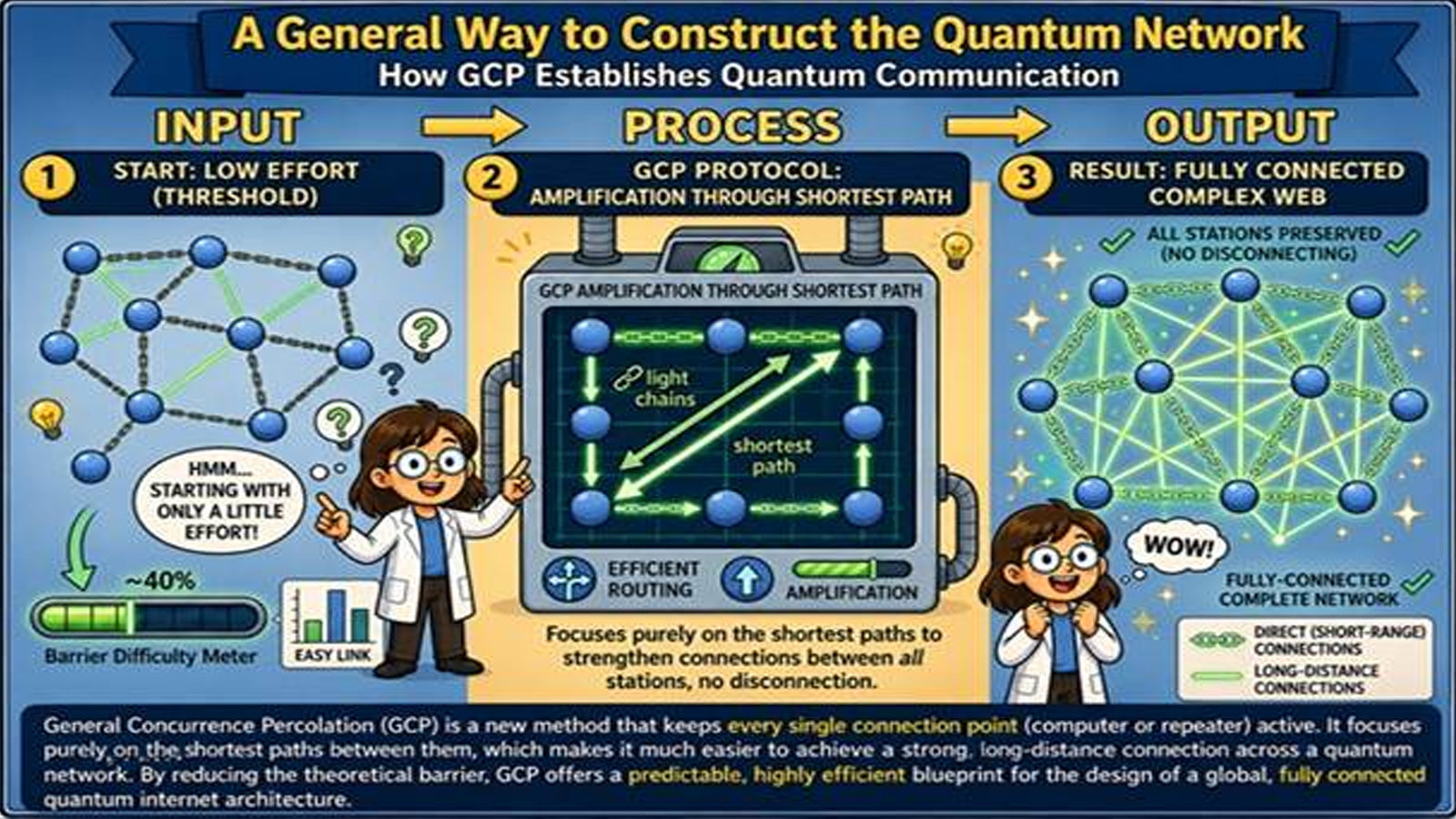
The newly proposed General Concurrence Percolation (GCP) protocol addresses this limitation by adopting a geometric routing strategy instead of removing network nodes.
Rather than disconnecting intermediate stations, the protocol strengthens quantum entanglement along the shortest available communication paths, effectively transforming a sparsely connected physical network into a much denser and more efficient communication system.
According to the researchers, the new approach enables long-distance quantum communication while requiring a lower initial level of entanglement than previously thought necessary, making quantum networks easier to establish and potentially more practical for real-world applications.
Computer simulations conducted as part of the study showed that the protocol successfully reduces the minimum entanglement threshold required to connect an entire quantum network.
The researchers also demonstrated that the new framework follows the percolation universality class, a well-established concept in statistical physics. This finding strengthens the theoretical basis of quantum entanglement percolation and provides a more predictable foundation for designing future quantum communication architectures.


