







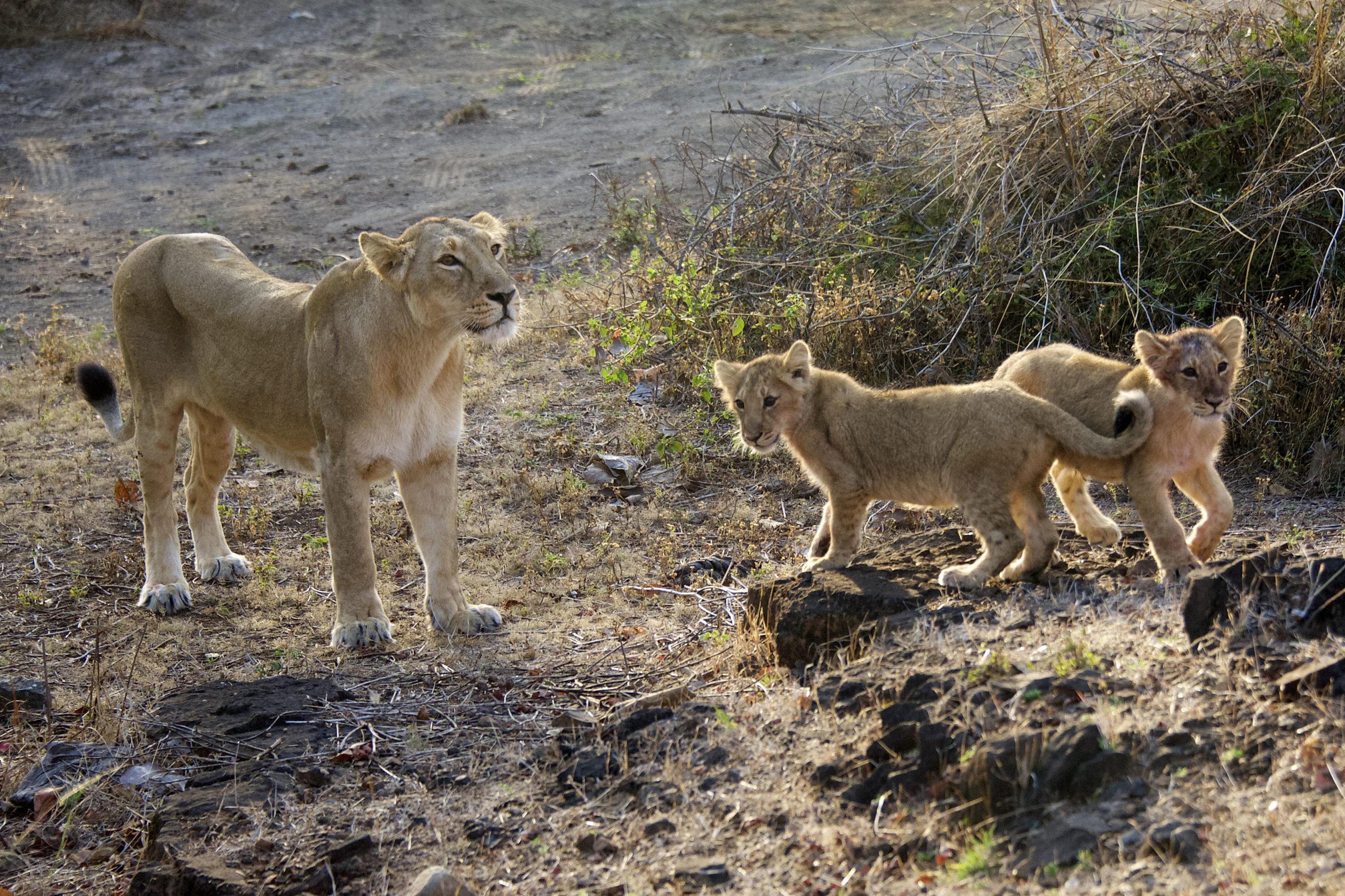
Prime Minister Narendra Modi on Monday hailed India’s conservation efforts for the Asiatic lion and underscored the role of community participation in protecting the species and expanding its habitat.
“A remarkable comeback! India’s Asiatic lion population is thriving, with its habitat and range expanding. The Government’s unwavering commitment to conservation, backed by strong community participation, is an inspiring example of protecting our wildlife and preserving the species for generations to come,” the Prime Minister’s Office (PMO) said in a post on X, sharing an article by Union Environment Minister Bhupender Yadav to mark World Lion Day.
In the article, published in The Hindustan Times, Yadav highlighted India’s success in conserving the Asiatic lion and reviving its population, particularly in the Gir and Greater Gir landscapes of Gujarat.
According to Yadav, the Asiatic lion population increased from 674 in 2020 to 891 in 2025, registering a 32 per cent rise. The species’ range has also expanded from around 30,000 sq km in 2020 to nearly 35,000 sq km, covering 11 districts.
In 1990, the lion’s range was only around 6,600 sq km, indicating an increase of more than 400 per cent over the period.
The 2025 population estimate included 196 adult males, 330 adult females and 225 cubs, reflecting a healthy breeding population and the expansion of lions into new areas, Yadav said.
Several factors have contributed to the recovery, including strict legal protection and the revival of wild prey populations, he said.
“Wild prey now constitutes about 74% of the lions’ diet, compared to only 26% in 1974,” Yadav wrote.
India has also adopted a broader landscape-level approach to lion conservation, extending protection beyond the core Gir landscape to forests, grasslands, coastal areas and other habitats across the Asiatic lion range.
Community participation has emerged as a key component of the conservation strategy.
“India’s lion conservation strategy combines prevention, rapid response and community partnership,” Yadav wrote, noting that more than 55,000 open wells have been secured to prevent lion deaths.
Other measures include the use of machans to help farmers monitor crops safely, timely compensation for losses and steps to reduce the risk of lion deaths on railway tracks. Trained locomotive pilots, trackside watchtowers, caution orders and patrolling have helped nearly eliminate lion deaths on railway tracks over the past two years, he said.
Yadav also highlighted the return of Asiatic lions to Barda Wildlife Sanctuary in Gujarat, where the species had been absent for more than a century.
A male lion naturally dispersed into Barda in January 2023 and was subsequently joined by females. By 2025, the sanctuary was home to 17 lions.
The government has been developing Barda Wildlife Sanctuary as a “second home” for the lion population, while corridor management initiatives have facilitated the safe movement of lions between different sub-populations and enabled their natural expansion into new habitats, according to a government reply in the Rajya Sabha in February.
Other conservation measures include satellite telemetry, improvement and restoration of grasslands, management of satellite populations, augmentation of water resources, eco-development activities and community participation, the Environment Ministry has said.
A key component of India’s long-term conservation strategy is Project Lion, announced by PM Modi on August 15, 2020. The project covers around 60,000 sq km of Saurashtra, encompassing the current and potential dispersal areas of the Asiatic lion.
“It adopts a landscape-level, holistic approach to biodiversity conservation, emphasising habitat enhancement, disease monitoring and veterinary support, scientific population tracking, biodiversity protection, benefit sharing, and, most importantly, community involvement,” Yadav wrote.
Earlier, speaking at a pre-summit species event under the International Big Cat Alliance (IBCA) Summit 2026 in Sasan Gir, Gujarat, Yadav had said that while lion populations globally had declined by more than 30 per cent due to habitat loss and degradation, the Asiatic lion had survived as a single wild population in India’s Gir landscape.
The Asiatic lion enjoys the highest level of legal protection under Appendix I of CITES and Schedule I of the Wildlife (Protection) Act, 1972, he had said.
In another post on X on Monday, Yadav said India’s success in conserving the Asiatic lion was a testament to its commitment to wildlife and biodiversity.
“From protecting critical habitats to strengthening conservation efforts, India has demonstrated that development and nature conservation can move forward together,” he said.
Yadav called for renewed efforts to safeguard the species and ensure that the “roar of the Asiatic Lion continues to resonate for generations to come”.
Union Minister of State for Environment, Forest and Climate Change Kirti Vardhan Singh also highlighted the government’s conservation efforts.
“On #WorldLionDay, we honour India’s extraordinary journey in conserving the majestic Asiatic Lion. By protecting critical habitats, strengthening conservation programs & fostering coexistence, India has shown the world that development and nature can thrive together,” he said in a post on X.
He called for continued efforts to maintain a balance between people and nature and preserve the Asiatic lion as a symbol of India’s commitment to wildlife conservation.


