







India’s coconut sector, deeply rooted in the country’s agricultural economy and cultural traditions, is steadily evolving from a predominantly traditional farming activity into a diversified, export-oriented industry. Supporting the livelihoods of nearly 30 million people, including around 10 million farmers, the sector is being strengthened through government interventions aimed at expanding cultivation, improving productivity, rejuvenating ageing plantations, promoting value addition and creating new opportunities for farmers and rural entrepreneurs.
Revered for centuries as the “Kalpavriksha” or Tree of Life, the coconut tree has long been associated with food, medicine, fibre, timber, fuel and a wide range of raw materials. With a cultivation history in India spanning nearly three millennia, coconut continues to occupy an important place in the country’s cultural traditions while serving as a source of income and employment, particularly for small and marginal farmers.
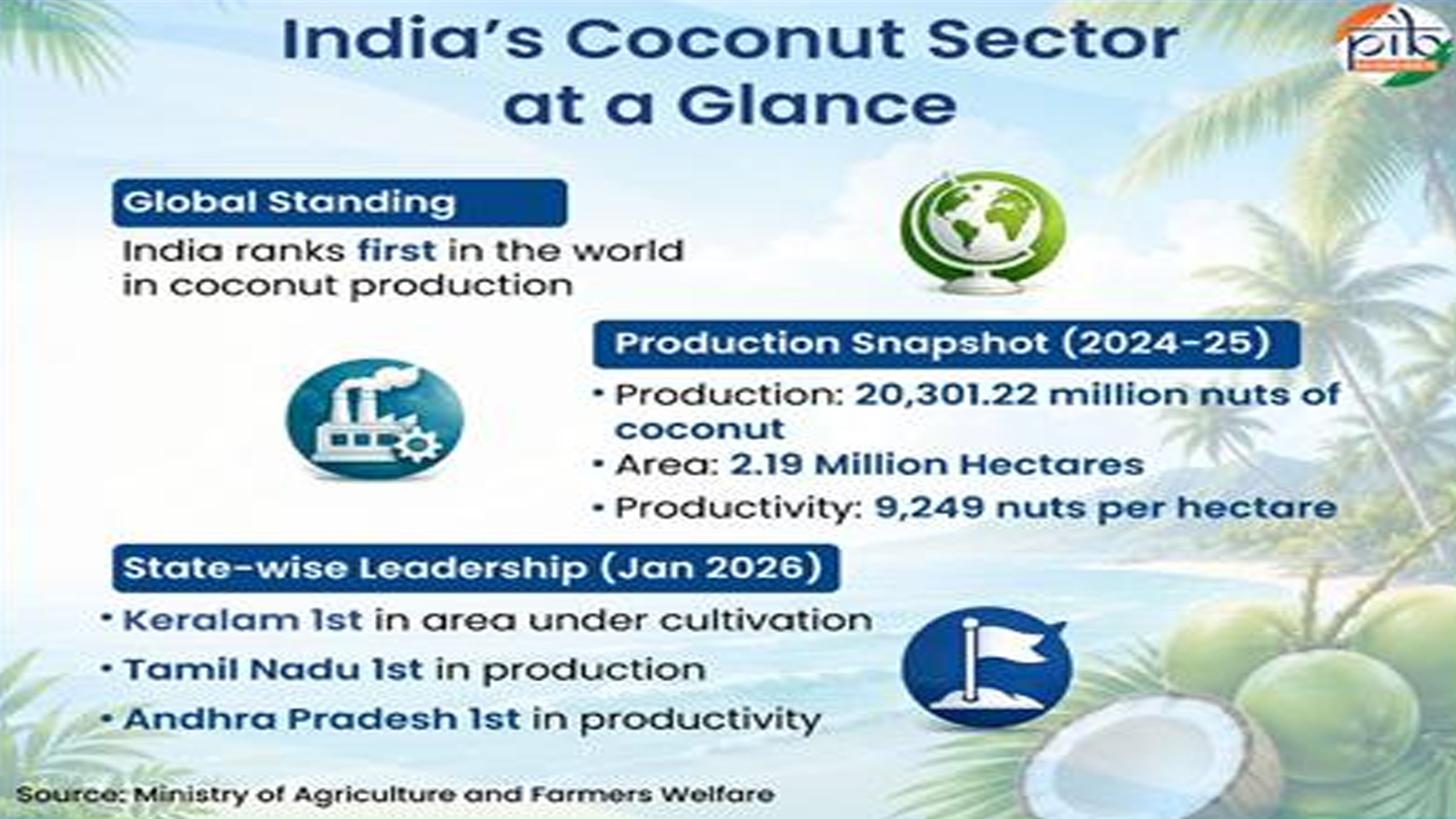
India currently ranks first globally in coconut production and third in cultivation area, accounting for 31.24 per cent of global production and 17.90 per cent of global coconut area. According to Department of Agriculture and Farmers Welfare statistics, India produced approximately 20,301.22 million nuts in 2024-25 from 2.19 million hectares, with average productivity of 9,249 nuts per hectare.
Within the country, Kerala has the largest area under coconut cultivation, covering around 7.54 lakh hectares and producing about 5,149.87 million nuts. Tamil Nadu leads in coconut production, while Andhra Pradesh records the highest productivity, followed by West Bengal and Tamil Nadu.
From traditional commodity to value-added export
The transformation of India’s coconut sector is particularly visible in its expanding export basket. Coconut product exports reached ₹7,038.35 crore, or USD 794.70 million, in 2025-26, registering a 62 per cent increase over exports worth ₹4,349.03 crore in the previous year.
The growth is substantial compared with the sector’s export performance in 2001-02, when coconut exports were valued at only ₹25.3 crore.
While India’s exports were once concentrated largely on traditional products such as coconut, coconut oil, desiccated coconut and coconut shell charcoal, the basket has progressively diversified. Indian exporters now cater to international demand for virgin coconut oil, coconut milk, coconut water, activated carbon, fresh, frozen and grated coconut, copra and other value-added products.
Activated carbon has consistently accounted for a major share of export volumes. At the same time, Indian coconut products have found markets beyond the Middle East, reaching countries across Europe, the Americas and Australia.
Over the past five years, major trading partners have included the United States, UAE, Sri Lanka, Germany, Russia, Turkey, Belgium, the United Kingdom and the Netherlands.
The expansion of exports is being supported by institutional efforts to improve product quality, market access, technology adoption and international outreach. The Coconut Development Board (CDB), which serves as the Export Promotion Council for coconut products other than those made from husk and fibre, had registered 8,299 coconut product exporters up to 2025-26, rising to 8,700 by July 31, 2026.
The export turnover from coconut-based products has increased from ₹3,236.83 crore to ₹7,038.35 crore over the five years from 2021-22 to 2025-26.
Coconut farming becomes a diversified livelihood model
The growing importance of coconut is not limited to large-scale commercial production. In several parts of the country, farmers are adopting coconut-based integrated farming systems to diversify their income.
One example comes from the Bastar Plateau of Chhattisgarh, where farmers traditionally depended on paddy, millets, maize and minor forest produce. Through the efforts of the Coconut Development Board’s Demonstration cum Seed Production Farm at Kondagaon, coconut cultivation gradually emerged as an alternative livelihood opportunity.
Farmers were trained to use vacant spaces between young coconut palms for suitable intercrops, allowing them to earn income before the coconut palms reached production.
A notable example is Eshansh Singh Rathore, a 36-year-old MBA graduate from Bakawand block. Coming from a farming family and having worked in the corporate sector, Rathore adopted coconut cultivation after receiving technical guidance from the Coconut Development Board.
He established 2,500 coconut palms, mainly dwarf varieties, of which around 500 had begun yielding. Rather than depending solely on coconut, he developed a multitier cropping system incorporating several high-value crops.
His plantation included 4,000 pineapple plants, 800 dragon fruit plants, 1,000 mango trees and 600 citrus trees, along with banana, guava, papaya, litchi, coffee, strawberry and seasonal vegetables.
The diversified system allowed him to utilise different layers of the plantation and generate income throughout the year. His farm generated approximately ₹5-6 lakh annually from coconut cultivation, while intercrops contributed another ₹10 lakh.
The model has encouraged other farmers in Bastar to consider coconut-based multitier farming as a potentially sustainable and replicable livelihood model.
Coconut Development Board at the centre of sectoral transformation
The Coconut Development Board, established on January 12, 1981, functions under the Ministry of Agriculture and Farmers Welfare. Headquartered in Kochi, the Board works towards the integrated development of coconut cultivation and the coconut industry across 22 States and Union Territories.
Its major areas of intervention include increasing the availability of quality planting material, expanding coconut cultivation, improving productivity in existing holdings, addressing pests and diseases, and promoting product diversification and utilisation of coconut by-products.
During 2025-26, ₹147.21 crore was released for implementation of activities under the Coconut Development Board.
The government’s approach combines production support with measures covering procurement, processing, exports, skill development, enterprise creation and farmer incomes.
Focus on quality planting material
Improving the quality and availability of planting material is considered fundamental to increasing coconut productivity.
The Coconut Development Board supports the establishment of seed production farms, seed gardens and nurseries, besides implementing systems for nursery accreditation and quality certification.
Under the Demonstration cum Seed Production Farm (DSPF) programme, the Board establishes farms in different states to demonstrate scientific coconut cultivation practices while producing quality planting material.
New DSPFs receive ₹30 lakh during their first two years, while existing farms can receive assistance of up to ₹1 lakh per hectare per year from the third year onwards for maintenance until yield stabilisation, which may take 15-20 years.
During 2025-26, 11 DSPFs produced 2.41 lakh quality coconut seedlings.
The Board also supports nucleus coconut seed gardens and small coconut nurseries. During 2025-26, assistance was provided for establishing 12 new small coconut nurseries, together having an annual production capacity of 1.06 lakh seedlings, while six existing nurseries also received maintenance support.
Public-sector nurseries received ₹239.35 lakh during the year, supporting the production of 11.97 lakh quality planting materials, enough for new coconut planting over an estimated 6,850-7,500 hectares.
Expansion of coconut cultivation
Government support is also aimed at bringing new areas under coconut cultivation.
Under the area expansion programme, farmers receive financial assistance of ₹56,000 per hectare for planting coconut seedlings in new areas. The assistance is provided in two equal annual instalments, with support available for a maximum of two hectares and a minimum area of 0.08 hectares, or 20 cents, per beneficiary.
During 2024-25, ₹209.24 lakh was utilised to bring 2,979 hectares under new coconut cultivation, benefiting 13,068 farmers.
The expansion continued during 2025-26, when around 2,175 hectares were brought under coconut cultivation across states including Kerala, Tamil Nadu, Karnataka, Andhra Pradesh, Odisha, West Bengal, Gujarat, Assam and Arunachal Pradesh.
Financial assistance of ₹632.77 lakh was provided for plantation establishment and maintenance.
Improving productivity in existing plantations
Alongside expanding the area under coconut, the government is focusing on increasing productivity from existing holdings.
The Comprehensive Programme for Sustainable Productivity Improvement in Existing Coconut Holdings promotes integrated farming and coconut-based cropping systems.
A major component is the Productivity Improvement through Coconut-based Cropping System (PICCS), implemented on a cluster basis through State Agriculture and Horticulture departments and directly by the Coconut Development Board.
The programme provides a subsidy of ₹42,000 per hectare, covering 100 per cent of the cost, for a maximum of two hectares per beneficiary. Assistance is released in two equal annual instalments.
During 2025-26, PICCS covered 18,800 hectares, benefiting 48,696 farmers organised into 266 clusters, with a financial outlay of ₹3,943 lakh.
Another 5,935 hectares were covered through convergence with State Governments in four States and Union Territories, with financial assistance of ₹1,246 lakh.
Kerala accounted for a substantial share, with more than 8,089 hectares covered and 33,250 farmers benefited during 2025-26.
For the current year, the scheme is being implemented over 22,430 hectares across major coconut-growing states.
The broader programme also supports water-resource creation through community tanks, farm ponds and reservoirs, promotion of organic farming, farm mechanisation, training, demonstrations and post-harvest and processing technologies.
Replanting and rejuvenating ageing coconut gardens
Ageing, unproductive and disease-affected plantations remain a major challenge for the sector. To address this, the government supports the Replanting and Rejuvenation of Coconut Gardens programme.
The scheme focuses on removing disease-affected, old and unproductive palms, replacing them with quality seedlings and rejuvenating the remaining palms through an integrated package of practices.
Financial assistance of up to ₹54,000 per hectare over two years is available under the programme.
Over the past five years, the scheme has covered 25,517 hectares at a cost of ₹130.46 crore.
During 2025-26, 1,672 hectares were covered for rejuvenation, including removal of diseased palms, replanting and rejuvenation of existing plantations.
MSP support for coconut growers
Price support is another important component of government policy for coconut farmers.
Copra, the dried kernel of coconut, is among the 22 mandated agricultural crops covered under the Minimum Support Price regime.
For the 2026 season, the Union Cabinet approved an enhanced MSP of ₹12,027 per quintal for milling copra and ₹12,500 per quintal for ball copra.
The MSP for milling copra increased by ₹445 per quintal, while the MSP for ball copra rose by ₹400 per quintal compared with the 2025 MSP.
The National Agricultural Cooperative Marketing Federation of India Ltd. (NAFED) and the National Cooperative Consumers’ Federation (NCCF) are the Central Nodal Agencies for copra procurement, with State-level agencies also engaged in procurement operations.
The higher MSP is intended to provide more remunerative returns to coconut growers and encourage production in response to rising domestic and international demand.
New Coconut Promotion Scheme seeks to tackle structural challenges
A significant new push for the sector has come through the Coconut Promotion Scheme announced in the Union Budget 2026-27.
The scheme seeks to address challenges including pest outbreaks, root wilt disease and ageing plantations. Its interventions include large-scale production of quality coconut seedlings, expansion of cultivation into potential areas, phased replanting and rejuvenation of old and unproductive gardens, holistic crop-health management and establishment of integrated coconut processing units.
The scheme forms part of a broader ₹350 crore allocation for high-value agriculture, covering coconut as well as cashew and cocoa.
The initiative aims to strengthen the sustainability and resilience of the sector and position India as a global leader in coconut and coir exports by the 2030s while improving farmer incomes.
Strengthening processing, market access and value addition
The Coconut Development Board is also working to move the sector further up the value chain.
Its Technology Demonstration and Quality Testing Lab provides technology demonstration, quality testing, training, incubation and consultancy services for coconut-based enterprises and value-added products.
The Board also undertakes market intelligence, research and export promotion activities to facilitate product development, quality improvement and access to domestic and international markets.
Over the past five years, the Board has facilitated participation of 72 entrepreneurs in 20 domestic trade fairs and 224 exporters in international trade fairs.
It has also facilitated 392 domestic Buyer-Seller Meets for 215 entrepreneurs, besides three international Buyer-Seller Meets involving six entrepreneurs.
A Virtual Trade Fair held from April 26-28, 2022 brought together 53 coconut product manufacturers and 347 buyers. Four business-to-business sessions were conducted with major players including Amazon, Flipkart, Lulu India, Lulu Dubai and Nesto Group, alongside 371 individual B2B meetings.
The Board has also organised international events to promote Indian coconut products and establish their health and commercial attributes, including the International Conference on Trade and Marketing of Coconut Products in Hyderabad in February 2023 and the International Coco Health Conference in Coimbatore in August 2025.
It also participated in the World Coconut Congress 2025 in Manila, Philippines.
Supporting quality, branding and entrepreneurship
As global demand for processed coconut products rises, quality certification and branding have become increasingly important.
The Coconut Development Board provides assistance for quality certification aimed at ensuring product quality, sustainability, worker health and welfare and environmental protection.
It also supports brand promotion to help entrepreneurs build brands around quality coconut products. Nine units have received support over the past five years.
The Board has also supported skill development for workers in coconut processing units. Between 2021-22 and 2025-26, skill training was provided to 240 participants across 24 batches.
To improve retail visibility and consumer awareness, the Board has assisted in establishing 15 coconut kiosks or retail outlets over the past five years.
It has additionally begun supporting procurement centres to help farmer collectives aggregate and market produce, improve bargaining power and reduce intermediaries. Two Farmer Producer Organisations have received assistance.
Support is also being provided for primary processing centres for milling copra, ball copra and minimally processed tender coconut, aimed at empowering farmers, entrepreneurs, FPOs and cooperatives.
Building a skilled coconut workforce
The sector’s expansion is accompanied by efforts to develop a skilled workforce.
The Coconut Development Board has been implementing the Friends of Coconut Tree (FoCT) programme for more than a decade. It trains unemployed youth in coconut palm climbing using mechanical climbing devices, along with plant protection, entrepreneurship and communication skills.
During 2024-25, 378 palm climbers were trained under programmes conducted across different states.
The Board also conducts Coconut Handicraft Training, providing unemployed youth with skills to create handicraft products from different parts of the coconut plant.
In 2025, the Board moved beyond stand-alone training programmes towards organised enterprise development through initiatives such as Cocomitra, Kera Kaushal Kendra and the Neera Tapping and Processing Technician Training Programme.
Cocomitra creates organised climbing teams
Under Cocomitra, or Coconut Climbers Task Force, trained climbers are organised into registered groups of six to 10 members. These groups receive modern climbing devices, plant protection tools and mobility support to provide timely services to coconut farmers.
Kera Kaushal Kendra promotes coconut handicrafts
The Kera Kaushal Kendra initiative seeks to establish a network of coconut handicraft centres across India, specialising in products made from coconut shell, wood and fibre.
The initiative organises artisans into 15-member handicraft production groups registered as legal entities.
From 2026-27, each approved Kera Kaushal Kendra is eligible for ₹2.67 lakh in financial assistance for common facilities, including tools and equipment, furniture, storage facilities, utilities and contingencies, as well as marketing activities.
The initiative is designed to encourage coconut-based micro-enterprises, rural entrepreneurship and sustainable livelihoods.
Training for scientific Neera tapping
The Board is also developing skills for Neera tapping and processing.
Neera is the unfermented juice tapped from coconut palm inflorescences. A seven-day field-based training programme is conducted to train technicians in safe and scientific tapping and processing through FPOs holding Neera licences.
During 2025-26, 414 awareness training programmes were conducted covering CDB schemes, scientific coconut cultivation and coconut value addition.
Beyond farming: building an integrated coconut economy
The government’s interventions extend from the planting of coconut palms to the eventual marketing of processed products. The objective is increasingly to create an integrated ecosystem in which farmers can benefit not only from raw coconut production but also from processing, value addition, exports and related services.
The Coconut Development Board’s initiatives in technology, quality testing, market intelligence, export promotion, skill development, procurement, processing and branding are intended to strengthen this value chain.
The Board is also implementing the Technology Mission on Coconut (TMOC) to support the development and adoption of technologies for pest and disease management, processing, product diversification and other technology-driven interventions.
The Kera Suraksha Insurance Scheme provides accident insurance coverage to coconut tree climbers, Neera technicians, hybridisation workers and other coconut labourers.
A sector linking farmers to global markets
The scale of India’s coconut economy illustrates how a traditional agricultural product is being integrated into modern global value chains.
From coconut oil and copra to activated carbon, virgin coconut oil, coconut milk and coconut water, the sector is increasingly moving towards value-added production. The expansion of export markets and the sharp rise in export value indicate growing international demand for Indian coconut products.
At the farm level, programmes supporting quality seedlings, new plantations, productivity improvement, rejuvenation and mechanisation seek to strengthen production. At the same time, MSP support, procurement infrastructure and farmer collectives are intended to improve returns and market access.
The emergence of diversified farming models, such as the coconut-based multitier system demonstrated by farmers in Bastar, also highlights the potential of coconut cultivation to support income diversification and rural entrepreneurship.
The road ahead
India’s coconut sector stands at an intersection of tradition and global opportunity. The coconut tree remains a cultural symbol and an important source of rural livelihoods, but the economic potential of the crop increasingly lies in its ability to support a wide range of products, enterprises and value chains.
With nearly 30 million people dependent on the sector, the expansion of cultivation, improvement of productivity and rejuvenation of old plantations have direct implications for rural incomes. At the same time, the rapid growth of exports demonstrates the potential to build stronger international markets for Indian coconut products.
The Coconut Promotion Scheme, increased MSP support, expansion of cultivation, quality planting material programmes, productivity improvement initiatives, rejuvenation measures, processing support and skill-development programmes together represent a broad policy push to make the sector more sustainable and competitive.
The government’s stated objective of strengthening coconut and coir exports by the 2030s adds an international dimension to this effort.
From the “Tree of Life” deeply embedded in India’s cultural heritage to a source of value-added products reaching markets across continents, the coconut sector is increasingly becoming an important component of India’s agricultural, rural and export economy.


