







India’s higher education sector has undergone significant expansion over the past decade, marked by a sharp increase in the number of universities and colleges, rising student enrolment, greater participation of women and students from disadvantaged social groups, and improvements in teaching and infrastructure.
Data from the All India Survey on Higher Education (AISHE), conducted annually by the Ministry of Education, shows that the country’s higher education ecosystem has grown substantially between 2014-15 and 2023-24. The survey provides an evidence base for tracking developments and reforms in higher education, including those aligned with the National Education Policy (NEP) 2020.
NEP 2020 envisions a holistic and multidisciplinary education system and seeks to strengthen India’s transition towards a knowledge-based economy. It also aligns with Sustainable Development Goal 4, which focuses on inclusive and equitable quality education and lifelong learning opportunities for all.
Expansion of higher education institutions
India’s institutional footprint in higher education has expanded considerably over the decade.
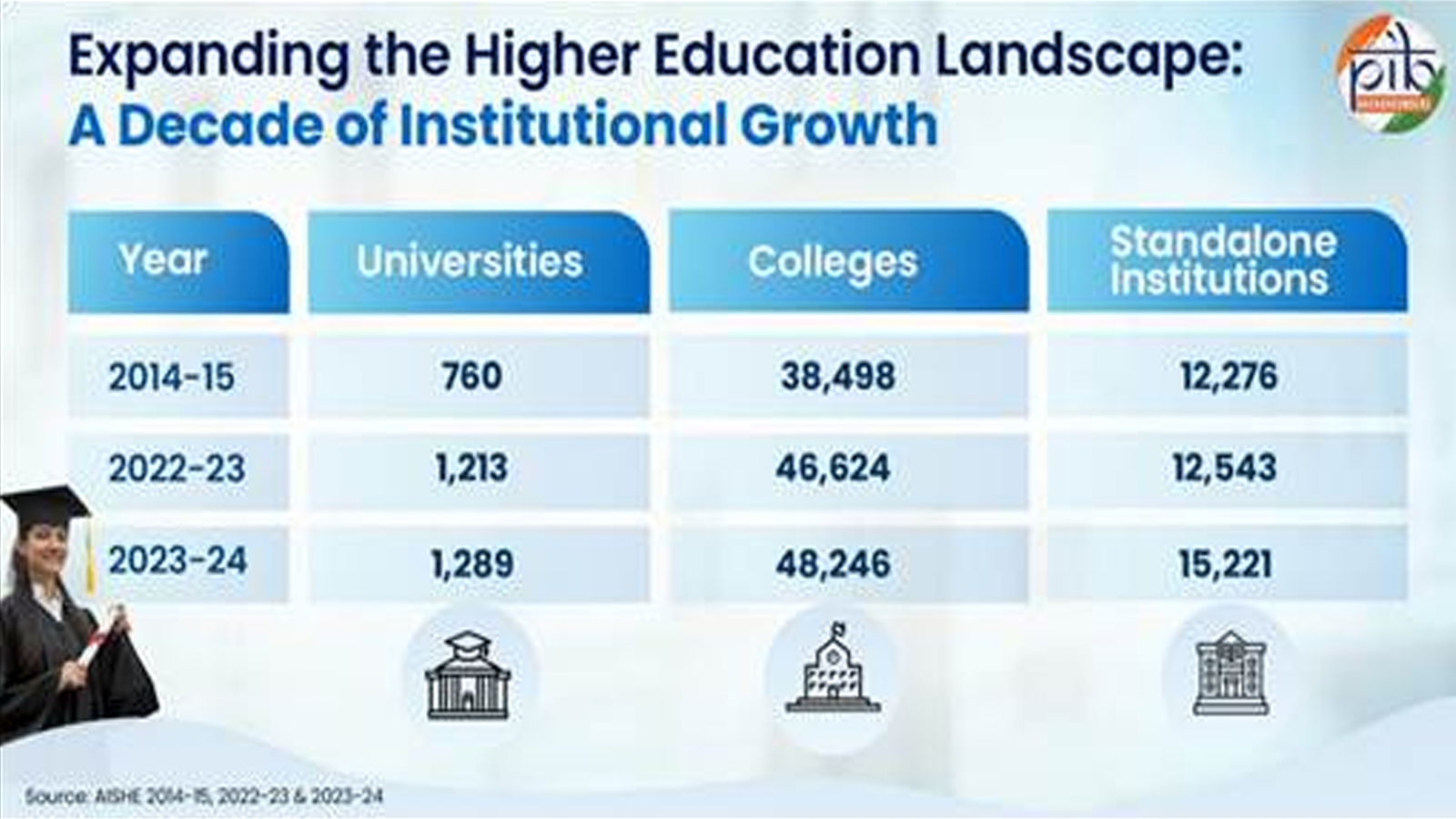
The number of universities increased from 760 in 2014-15 to 1,289 in 2023-24, registering a growth of 69.6 per cent. The number of colleges rose from 38,498 to 48,246, an increase of 25.3 per cent, while standalone institutions increased from 12,276 to 15,221, registering growth of about 24 per cent.
The expansion has increased the capacity of the higher education system to serve learners across the country and has contributed to a wider and more diverse institutional base.
Student enrolment rises 31.5 per cent
Total enrolment in higher education increased by 31.5 per cent, from 3.42 crore students in 2014-15 to 4.50 crore in 2023-24.
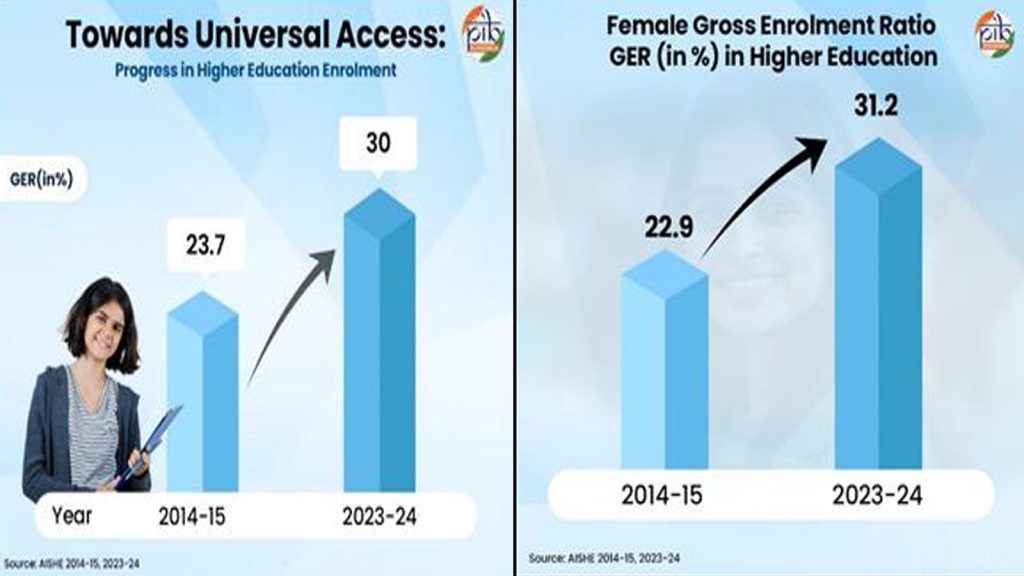
The Gross Enrolment Ratio (GER) also improved steadily, rising from 23.7 per cent in 2014-15 to 29.5 per cent in 2022-23 and 30 per cent in 2023-24. The rise represents increased participation in higher education and progress towards the NEP 2020 target of achieving a 50 per cent GER by 2035.
Enrolment growth was recorded across different levels of higher education. PhD enrolment rose sharply from 1.17 lakh to 3.43 lakh, an increase of 192.89 per cent. Postgraduate enrolment increased from 38.53 lakh to 57.85 lakh, while undergraduate enrolment rose from 2.71 crore to 3.45 crore.
Diploma enrolment increased from 25.08 lakh to 33.15 lakh, while certificate enrolment rose from 1.70 lakh to 2.08 lakh. Integrated programme enrolment recorded the highest growth, increasing from 1.41 lakh to 5.69 lakh, a rise of 301.36 per cent.
The number of students passing out of higher education institutions, or the higher education out-turn, also increased from 88.28 lakh in 2014-15 to more than 1.09 crore in 2023-24, representing growth of 24.06 per cent.
Women’s participation sees strong growth
Female participation has emerged as a major area of progress in India’s higher education system.
Female enrolment increased by 42.2 per cent, from 1.57 crore in 2014-15 to 2.24 crore in 2023-24, outpacing the growth in total enrolment.
In 2023-24, female enrolment included 1.71 lakh PhD students, 32.53 lakh postgraduate students and 1.71 crore undergraduate students. There were also 91,332 female students in PG diploma programmes, 13.27 lakh in diploma courses, 1.10 lakh in certificate programmes and 2.73 lakh in integrated programmes.
Female GER increased from 22.9 per cent in 2014-15 to 31.2 per cent in 2023-24, surpassing the male GER of 28.9 per cent for the seventh consecutive year.
The Gender Parity Index (GPI) in higher education also improved from 0.92 in 2014-15 to 1.08 in 2023-24. Among SC students, GPI increased from 0.91 to 1.11, while among ST students it rose from 0.81 to 1.08.
A GPI of one represents parity between male and female participation, while a figure above one indicates higher female participation.
Greater participation among SC, ST and OBC students
The data also points to increased participation of students from socially disadvantaged groups.
The share of SC enrolment in total higher education enrolment rose from 13.44 per cent in 2014-15 to 15.5 per cent in 2023-24. The share of ST enrolment increased from 4.8 per cent to 6.4 per cent, while OBC participation rose from 32.8 per cent to 40.1 per cent, recording the largest increase in enrolment share among the social categories mentioned.
The GER among SC students increased from 18.9 per cent to 27.8 per cent during the period, while the GER for ST students rose from 13.5 per cent to 22.8 per cent.
The trends indicate increasing participation of students from SC, ST and OBC communities in higher education.
PwBD enrolment shows mixed trends
Enrolment of Persons with Benchmark Disabilities (PwBD) increased from 64,298 in 2014-15 to 88,816 in 2022-23, registering growth of 38.1 per cent. Male PwBD enrolment increased by 54.4 per cent, while female enrolment grew by 19 per cent during the period.
However, the figures provided for 2023-24 show 54,080 PwBD students enrolled, including 34,080 males and 20,000 females. The higher number of male students indicates that a gender imbalance persists in access to higher education among PwBD students.
STEM enrolment continues to rise
Student interest in Science, Technology, Engineering and Mathematics (STEM) disciplines has also increased.
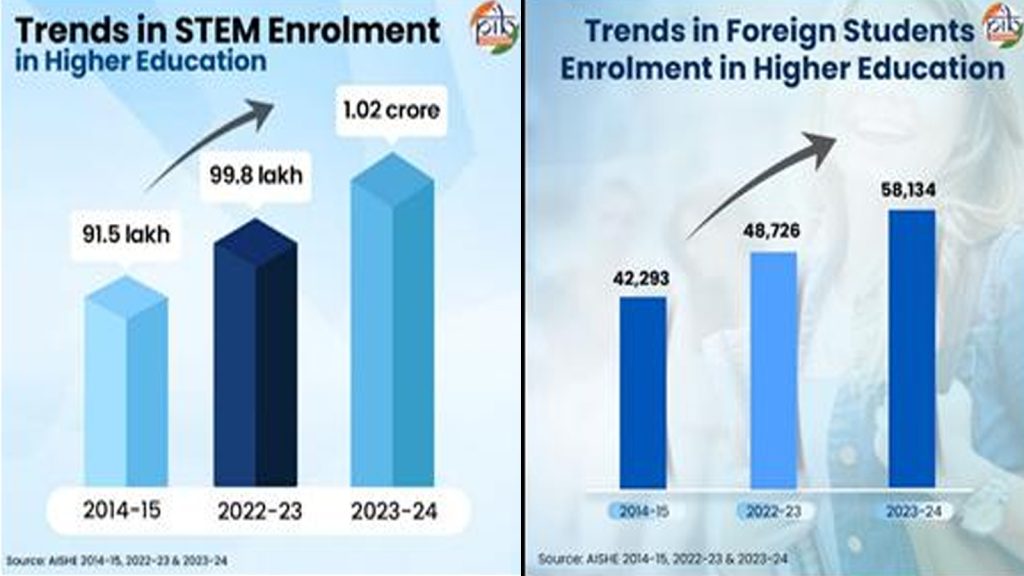
Total STEM enrolment rose from 91.5 lakh in 2014-15 to 1.02 crore in 2023-24, an overall increase of approximately 11.5 per cent.
The growth has been associated with expanding institutional capacity and continued student interest in areas linked to digital technologies, innovation, research and employment opportunities.
India attracts more foreign students
Foreign student enrolment in Indian higher education institutions increased from 42,293 in 2014-15 to 58,134 in 2023-24, representing growth of approximately 37.5 per cent.
The increase reflects the growing internationalisation of Indian higher education, academic collaboration and the appeal of Indian institutions among international students.
Teaching workforce expands
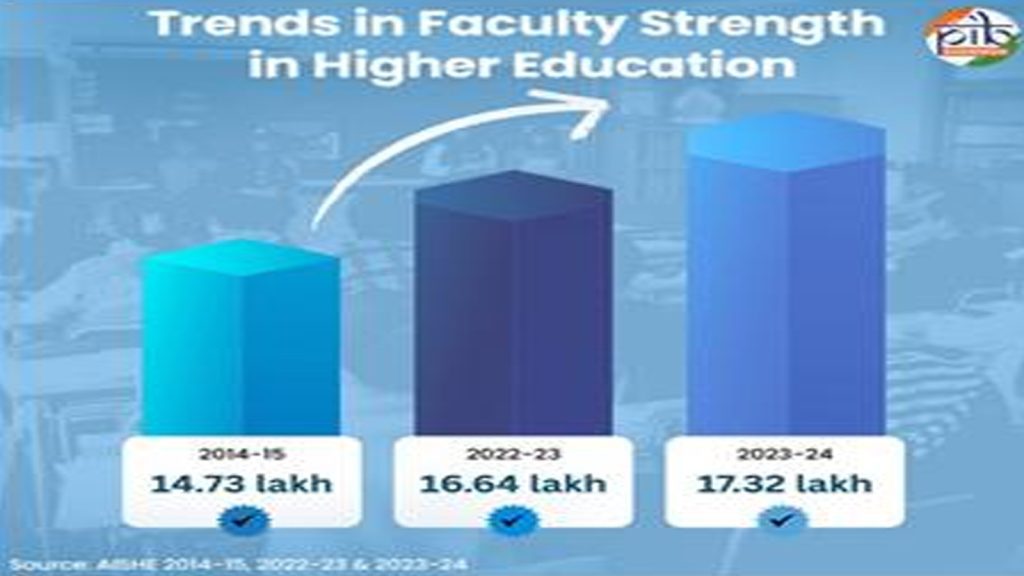
The number of teachers in higher education increased from 14.73 lakh in 2014-15 to 17.32 lakh in 2023-24, an increase of 2.59 lakh teachers, or approximately 17.6 per cent.
The number of female teachers grew by 36.7 per cent over the decade. However, male teachers continued to constitute a larger share of the teaching workforce.
The share of female teachers increased marginally from 44.3 per cent in 2022-23 to 44.9 per cent in 2023-24.
Infrastructure coverage improves
Higher education institutions have also witnessed improvements in physical, digital and other infrastructure, including facilities for women and PwBD students.
In 2023-24, 94 per cent of universities, 95 per cent of colleges and 91 per cent of standalone institutions had playgrounds.
Library facilities were available in 98 per cent of universities, colleges and standalone institutions.
Laboratories were available in 89 per cent of universities, 85 per cent of colleges and 94 per cent of standalone institutions.
Institutions also had facilities such as health centres, skill development centres, computer centres, auditoriums and conference halls.
Building a future-ready knowledge ecosystem
The decade-long trends captured by AISHE point to an expanding higher education system, with growth not only in the number of institutions but also in student participation, faculty strength, programme completion and infrastructure.
The rise in female enrolment and GER, improvement in gender parity, increased participation of SC, ST and OBC students, and growth in STEM and foreign student enrolment underline the changing profile of India’s higher education landscape.
Taken together, the data reflects progress in access, equity, inclusion, quality and institutional capacity, while supporting the broader objectives of NEP 2020 to build a more accessible, diverse and future-ready knowledge ecosystem for India.


