







India’s sugar industry is undergoing a broad-based transformation, combining a growing sugarcane production base with ethanol diversification, stronger sugar mill finances, rising exports and improved payment capacity for farmers. While sugar prices have risen in recent weeks, the government has said the increase is largely driven by short-term supply and market factors rather than an underlying shortage of sugar in the country.
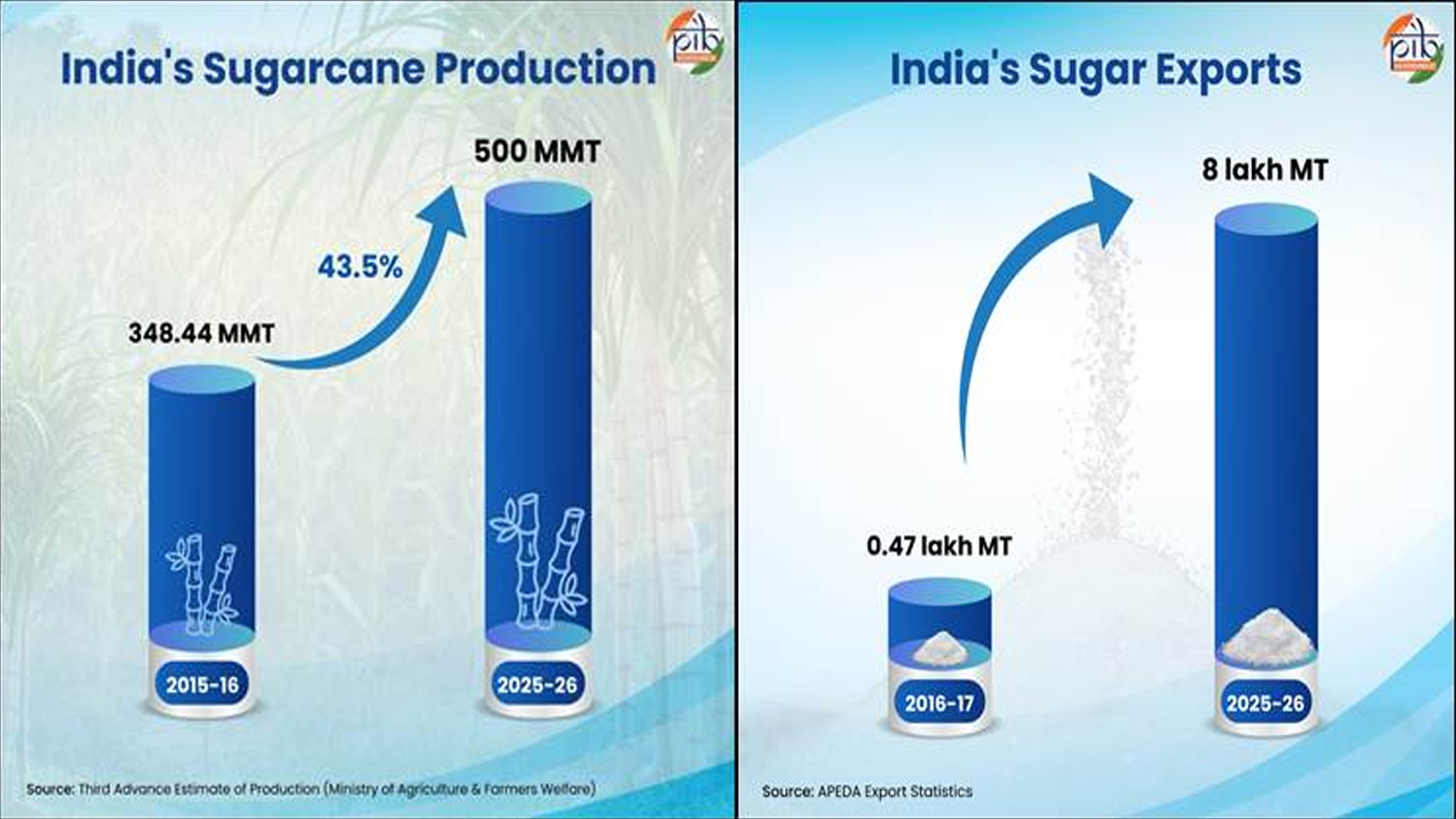
India is the world’s second-largest sugarcane producer, with the sector supporting nearly 5 crore farmers and around 5 lakh workers in sugar factories and allied industries. Sugarcane production has reached 500 million tonnes (MMT) in 2025-26, according to the Third Advance Estimate of the Ministry of Agriculture and Farmers Welfare. This represents growth of approximately 43.5 per cent over the past decade, from 348.44 MMT in 2015-16.
The expansion has also been reflected in the area under sugarcane cultivation. The cultivated area has increased from 49.27 lakh hectares in 2015-16 to 58.87 lakh hectares in 2025-26, with Uttar Pradesh and Maharashtra remaining the country’s leading sugarcane-producing states.
India’s growing production capacity has also supported its position in global sugar trade. Sugar exports increased to 8 lakh MT in 2025-26, compared with just 0.47 lakh MT in 2016-17. Major export destinations include Sri Lanka, West Asia and East Africa.
At the farmer level, the government has continued to strengthen the price support framework. The Fair and Remunerative Price (FRP) of sugarcane for the 2026-27 sugar season, covering October to September, has been fixed at ₹365 per quintal, based on a basic recovery rate of 10.25 per cent. The FRP is ₹135 higher than the ₹230 per quintal fixed for the 2016-17 sugar season, when the basic recovery rate was 9.5 per cent.
Ethanol adds a new dimension to the sugar economy
One of the most significant changes in India’s sugar sector has been the emergence of ethanol as an additional avenue for utilising sugarcane and supporting the financial sustainability of sugar mills.
The government’s ethanol-blending programme is aimed at reducing dependence on fossil fuels, strengthening energy security, promoting sustainable fuel alternatives, providing farmers with a stable income stream and reducing greenhouse gas emissions.
Importantly, the expansion of ethanol production has not translated into a reduction in sugar availability for domestic consumers. In fact, the share of sugar diverted towards ethanol production has declined from around 12 per cent in 2022-23 to around 9 per cent in 2025-26.
At the same time, the country’s ethanol mix has become increasingly diversified. Nearly three-fourths of ethanol produced in India now comes from grains, particularly maize, reducing the dependence of the ethanol programme on sugar.
The ethanol programme has also helped address a structural challenge faced by sugar mills. India typically produces around 300-340 lakh MT of sugar annually, while domestic consumption is approximately 280-290 lakh MT.
During years of surplus production, excess sugar stocks can lock up the working capital of mills and contribute to delays in payments to sugarcane farmers. Diverting part of the surplus towards ethanol has helped reduce this pressure and improve the financial health of sugar mills.
The improvement is visible in farmer payments. As of August 20, 2026, 97 per cent of sugarcane dues for the 2025-26 sugar season had already been paid to farmers.
The stronger financial position of sugar mills has also reduced their dependence on government support, while the benefits have extended to consumers. Retail sugar prices increased by only around 3 per cent annually between August 2024 and July 2026, indicating broad stability over the longer term.
Recent price rise reflects short-term pressures
The recent increase in sugar prices has nevertheless drawn attention. The retail price increased from ₹48.18 per kg on July 20, 2026, to ₹55.70 per kg on August 20, representing an increase of around 15.6 per cent in one month.
The government has, however, distinguished this recent movement from the longer-term price trend. Between August 2024 and July 2026, retail sugar prices increased by only around 3 per cent annually.
The current price increase has been attributed to several factors, including lower-than-expected domestic production, higher demand ahead of the festive season, weather-related damage to sugarcane, tightening global sugar supplies and rising international prices, as well as speculation and hoarding by some sections of the industry.
Current sugar production is estimated at around 306 lakh MT, below the initial estimate of approximately 343 lakh MT. The shortfall has been linked to Red Rot and Top Borer diseases affecting sugarcane and waterlogging caused by excess rainfall.
Despite the lower production estimate, the government has maintained that adequate sugar stocks are available to meet domestic demand until the new crushing season begins in October.
This means the present price movement needs to be viewed in the context of temporary supply-side pressures rather than a structural shortage in the domestic market.
Global sugar market also facing tighter supplies
The price pressure is not unique to India. The global sugar market is also experiencing tightening supplies.
The global sugar deficit for 2026-27 is estimated at around 33 lakh MT. Against this backdrop, international sugar prices rose from $474 per tonne on June 30, 2026, to $552 per tonne on August 20, 2026 – an increase of more than 16 per cent in less than two months.
The international price movement has therefore added another layer of pressure to domestic markets.
The government’s assessment also counters several misconceptions surrounding the recent price rise.
The increase cannot be attributed to ethanol diversion, since the share of sugar diverted for ethanol has actually fallen from around 12 per cent in 2022-23 to about 9 per cent in 2025-26. Moreover, nearly three-fourths of India’s ethanol is now produced from grains, particularly maize.
Similarly, the current situation does not indicate a sugar shortage. Adequate stocks are available to meet domestic requirements until the beginning of the next crushing season.
Nor has India’s sugar production collapsed. Although the current estimate of 306 lakh MT is below the initial projection of 343 lakh MT, the industry continues to operate on a substantial production base.
Government moves to prevent hoarding and strengthen supplies
With the government identifying speculation and hoarding as factors contributing to the recent price increase, a series of measures have been introduced to protect consumers and improve market availability.
A stock limit of 400 tonnes has been imposed on sugar dealers across the country from August 1 to November 30, 2026.
From September 1, bulk consumers will not be permitted to hold sugar stocks exceeding 15 days of their consumption.
Central and state government officials are also conducting physical verification of sugar stocks at mills to detect hoarding and attempts to create artificial scarcity.
As an additional supply-side measure, the government has decided to permit duty-free import of 10 lakh MT of raw sugar. The move is intended as a precautionary measure to augment domestic availability and provide greater stability to the market.
The government has also advised states and sugar mills to begin the next crushing season from October 15, 2026.
An earlier start to crushing is expected to significantly increase sugar availability during the festive period. October production, which normally stands at around 3-4 lakh MT, is expected to rise to more than 10 lakh MT with the early start of crushing.
A sector supporting farmers, energy security and global trade
Taken together, these developments show that India’s sugar industry is no longer limited to the conventional sugarcane-to-sugar value chain. It has increasingly become an integrated agricultural and industrial ecosystem linking farmers, sugar mills, food consumption, ethanol production, energy security and international trade.
The expansion of sugarcane production over the past decade, the rise in cultivated area and exports, and the strengthening of the ethanol ecosystem have created multiple avenues for the sector.
The ethanol programme, in particular, has provided sugar mills with an alternative use for surplus production while helping improve their financial position and payment capacity. The fact that 97 per cent of sugarcane dues for 2025-26 had been cleared by August 20 reflects the strengthening of the industry’s ability to meet its obligations to farmers.
The sector’s growing export footprint further demonstrates its increasing integration with international markets, with 8 lakh MT of sugar exported in 2025-26.
At the same time, the government has sought to balance the interests of farmers, consumers and sugar mills. Higher FRP provides a stronger price framework for sugarcane producers, while measures such as stock limits, physical verification, duty-free imports and an earlier crushing season are aimed at containing temporary price pressures for consumers.
From surplus management to energy security
The evolution of the sugar industry also illustrates how agricultural commodities can contribute to wider economic and energy objectives.
Historically, surplus sugar production could result in inventories accumulating at mills, tying up funds and affecting their ability to make timely payments to farmers. The expansion of ethanol production has created another outlet for sugarcane and surplus sugar, helping address this structural challenge.
At the same time, the declining share of sugar diverted towards ethanol and the growing contribution of grain-based ethanol demonstrate that India’s ethanol programme is becoming more diversified rather than relying exclusively on the sugar sector.
This diversification allows the sugar industry to contribute to India’s energy-security objectives without compromising the availability of sugar for domestic consumption.
Looking beyond the temporary price pressure
The present rise in sugar prices comes against the backdrop of a sector that has expanded considerably over the past decade.
Sugarcane production has grown by around 43.5 per cent since 2015-16, cultivation has expanded by nearly 10 lakh hectares, exports have increased substantially and the FRP has risen by ₹135 per quintal compared with 2016-17.
Meanwhile, the industry has gained a new revenue stream through ethanol, sugar mills have strengthened their finances and farmer payments have improved significantly.
The government has also emphasised that adequate sugar stocks are available despite the lower-than-expected current-season production and that the next crushing season will begin in October.
The immediate challenge, therefore, is to manage the temporary combination of lower production, festive demand, weather-related crop damage, global price pressures and market practices. The measures being taken are designed to increase availability, prevent artificial scarcity and stabilise prices while protecting the interests of farmers and maintaining the financial health of the industry.
India’s sugar sector today represents a wider agricultural-industrial ecosystem – one that supports millions of farmers and workers, contributes to food security, supplies an expanding ethanol economy and participates increasingly in global trade. The current price rise is a short-term challenge within this larger story of diversification, production growth and strengthening economic resilience.


