







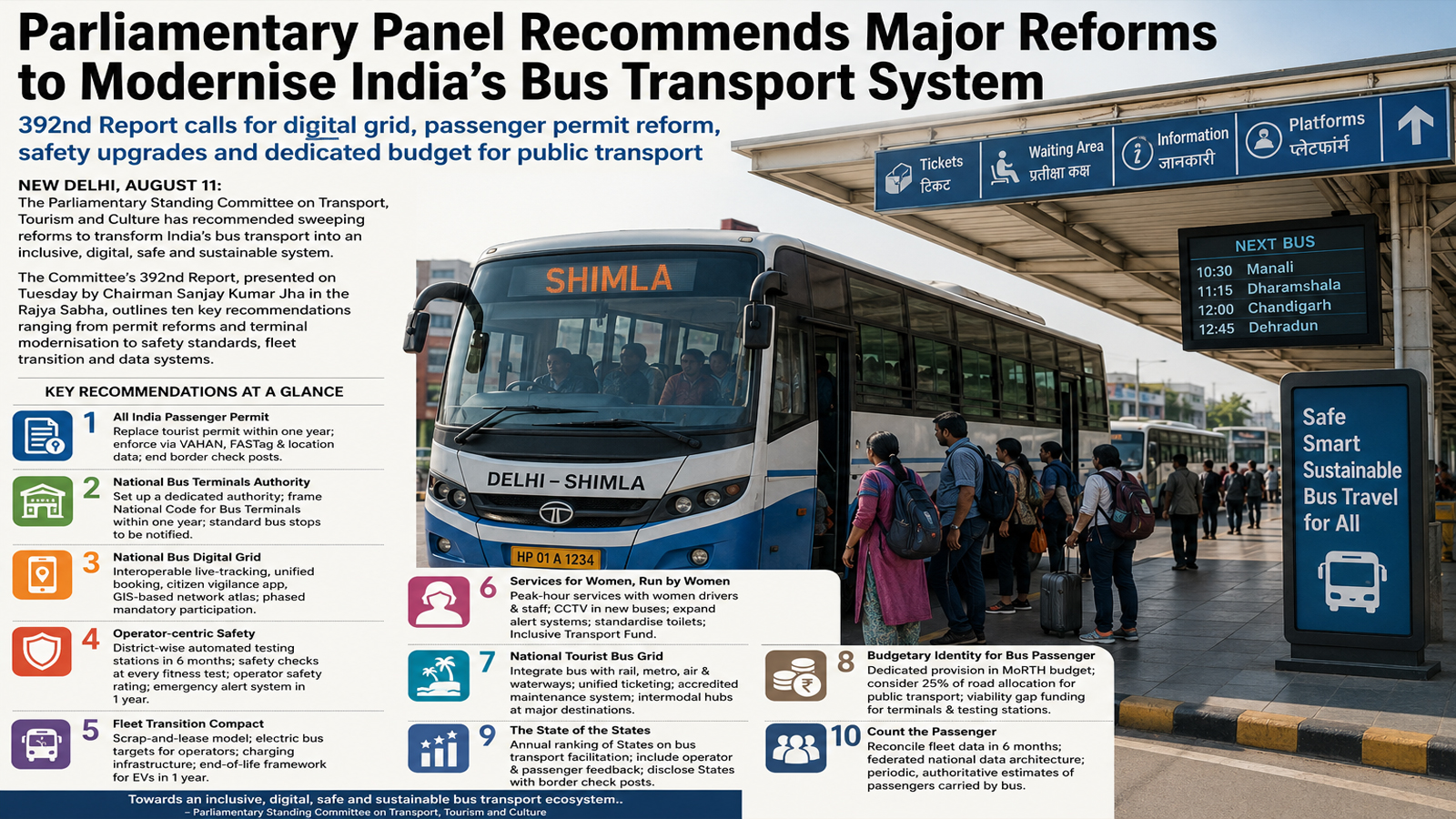
The Parliamentary Standing Committee on Transport, Tourism and Culture has recommended a comprehensive overhaul of India’s bus transport system, including replacing the existing All India Tourist Permit with an All India Passenger Permit, establishing a dedicated national authority for bus terminals and creating a nationwide digital grid for bus services.
The recommendations were contained in the Committee’s 392nd Report, titled “Enabling Inclusive, Digital and Sustainable Bus Transport: Policy, Regulation and Public-Private Partnership for Next-Gen Mobility”. The report was presented on Tuesday by Committee Chairman Sanjay Kumar Jha, Member of Parliament in the Rajya Sabha. It was adopted by the Committee on August 6, 2026.
New passenger permit system proposed
The Committee has proposed replacing the All India Tourist Permit within one year with an All India Passenger Permit issued by the state where the vehicle is first registered. The rights attached to the permit should be clearly specified, while enforcement should rely exclusively on electronic integration of VAHAN, FASTag and vehicle-location data.
The panel also recommended commissioning monitoring centres and removing remaining border check posts in the six states where they continue to operate. It further suggested working with the insurance regulator to ensure that claims of passengers injured in bus accidents are not subjected to avoidable disputes.
Dedicated authority for bus terminals
Calling for a separation of terminal ownership from bus operations as a national policy, the Committee recommended establishing a dedicated National Bus Terminals Authority on the model of the Airports Authority.
It suggested a non-discriminatory access framework for bus terminals, drawing on the Kashmere Gate model, and called for a National Code for Bus Terminals within one year. Gurugram and Katra were suggested as possible templates for developing modern terminals.
The Committee also recommended notifying a standard design for bus stops and circulating it among Members of Parliament to facilitate funding through the MPLADS scheme.
Nationwide digital bus grid
A major recommendation of the report is the creation of a National Bus Digital Grid. The Committee called for interoperability standards to be notified within one year, followed by a public live-tracking system aligned with Indian Railways specifications.
The proposed digital framework would include unified booking across public and private operators, a moderated passenger-rating system linked to permit databases and a citizen vigilance mechanism for geo-tagged, time-bound reporting of conditions at buses and terminals.
The Committee also proposed a GIS-based national bus network atlas using vehicle tracking and toll data. The system would publish information on punctuality and predictability and identify potential hazards. Participation in the digital framework would eventually become mandatory for commercial permit holders.
Stronger safety standards for operators
The panel called for district-wise plans to complete the deployment of Automated Testing Stations within six months. It recommended verification of fire safety, emergency exits and alert equipment during every fitness test to ensure that life-safety standards are maintained across the operational fleet.
The Committee also suggested examining retrofitting requirements for sleeper and school buses and introducing a publicly available operator safety rating, which could be taken into account during permit renewals.
It recommended making emergency alert systems fully functional within one year and proposed that any levy imposed on operators for such systems should cease if the system is not made operational within the stipulated period.
Push for electric and leased bus fleets
The report has proposed a Fleet Transition Compact under which operators could use buses without necessarily owning them. It recommended promoting scrap-and-lease models through registered vehicle scrapping facilities and reviewing existing incentives for private vehicle scrapping.
For the transition to electric mobility, the Committee called for a time-bound plan with specific targets for each operator and bulk procurement of buses on standardised terms. Charging infrastructure should be planned according to the routes and locations where buses operate.
It also recommended establishing an end-of-life framework for electric buses and batteries within one year, along with regional manufacturing, testing and maintenance clusters.
More services for women and tourists
The Committee recommended a dedicated programme within six months for peak-hour bus services operated by women drivers and women staff. It also called for CCTV systems in new buses, expansion of emergency alert systems to states where they are yet to be implemented and standardisation of onboard toilets under the Bus Body Code.
Sanitation at overnight bus halts should be monitored, while funding for such initiatives could be provided through a mechanism such as an Inclusive Transport Fund.
For tourism, the Committee proposed a National Tourist Bus Grid integrating bus services with railways, metros, air services and waterways through unified ticketing.
It also recommended a centralised, accredited Maintenance, Repair and Overhaul system with digital logbooks for tourist buses and the creation of intermodal transport hubs at major tourist destinations. Revenue-sharing mechanisms between public and private participants were also proposed.
Dedicated budget for bus passengers
The panel recommended giving public transport infrastructure a distinct identity in the budget of the Ministry of Road Transport and Highways. The Ministry has been asked to report within six months on the provision and present its considered position on allocating a proportion, of the order of 25 per cent of the road allocation, towards public transport infrastructure.
The Committee also proposed viability gap funding for compliant bus terminals and testing stations and called for the standard bus stop design to be circulated for MPLADS funding within three months of its notification.
Annual ranking of states proposed
The report called for an annual “State of the States” ranking to assess states on bus transport facilitation using verifiable parameters such as testing-station density, terminal access, functioning of emergency systems and network punctuality.
The ranking should also incorporate feedback from operators and passengers and track the disposal of complaints received through the proposed citizen vigilance mechanism. The first edition should identify states where border check posts are still operational, the Committee said.
National data system for bus passengers
The Committee also recommended reconciliation of national fleet figures within six months and called for the integration of Telangana into the VAHAN system, with progress to be disclosed in the interim.
It proposed a consolidated statement covering buses across all categories and a federated national data architecture under which states would retain ownership of their respective systems.
The panel further called for periodic and authoritative estimates of the number of passengers carried by buses to be published alongside statistics for other modes of transport.
The recommendations seek to create a more inclusive, digitally connected, safe and sustainable bus transport ecosystem, while strengthening coordination between the Centre, states, public transport agencies and private operators.


