







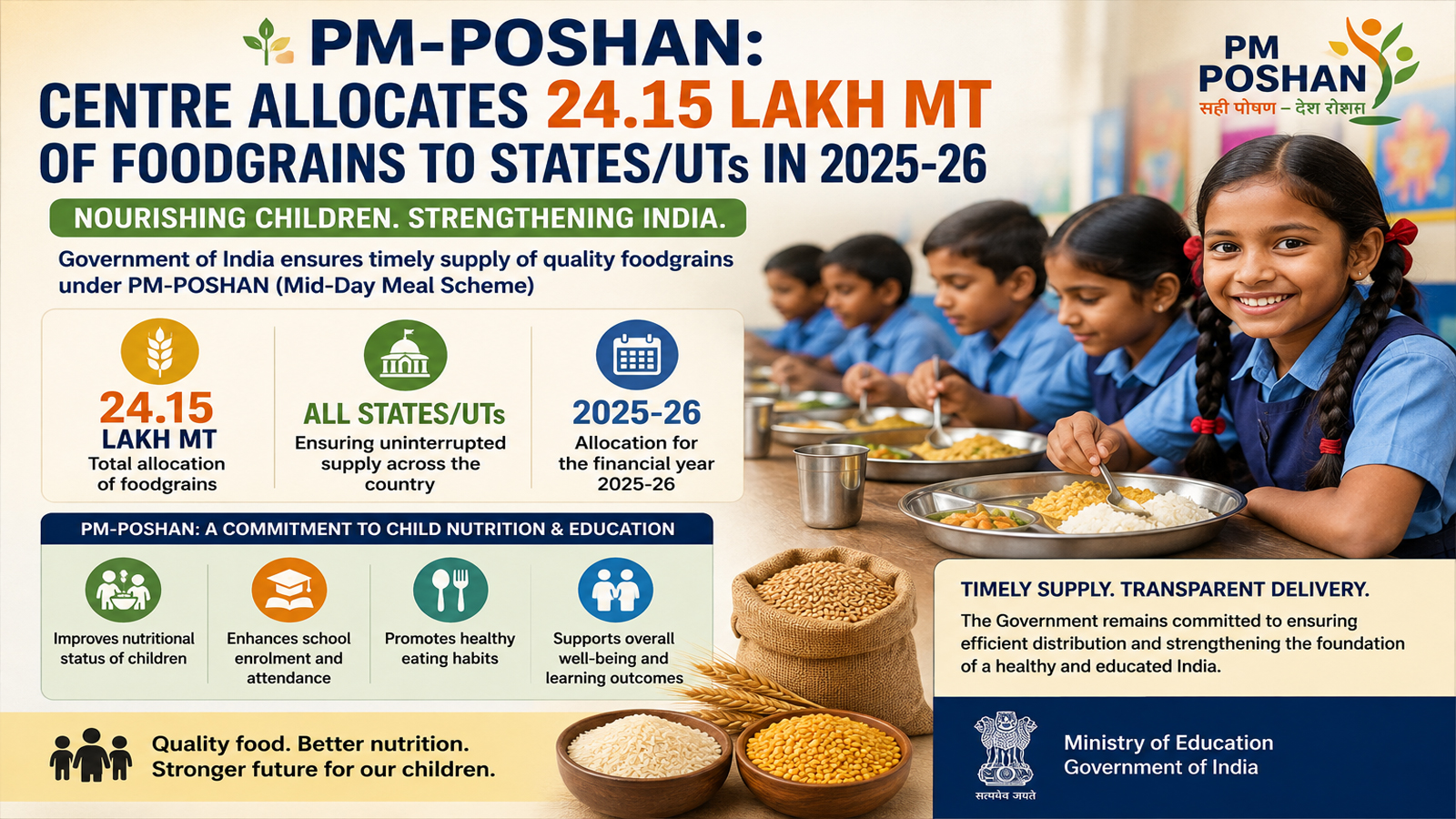
The Centre allocated around 24.15 lakh metric tonnes (MT) of foodgrains to States and Union Territories under the PM-POSHAN scheme during 2025-26, down from 25.31 lakh MT in 2024-25 and 26.82 lakh MT in 2023-24, according to data tabled in the Lok Sabha on Monday.
The figures were provided by Minister of State for Education Jayant Chaudhary in response to a question on the allocation of foodgrains under the school meal scheme.
Under PM-POSHAN, the Centre and States jointly provide hot and nutritious meals to children studying in Bal Vatika and Classes I to VIII in government and government-aided schools. The Central Government provides 100 per cent assistance towards the cost of foodgrains, transportation and Management, Monitoring and Evaluation (MME).
The foodgrains are supplied through the Food Corporation of India (FCI), with allocations made twice a year by the Department of School Education and Literacy in consultation with the Department of Food and Public Distribution.
Uttar Pradesh, Bihar among largest recipients
Among states, Bihar received the highest allocation in 2025-26 at 3,01,148.29 MT, followed by Uttar Pradesh at 2,97,399.06 MT, Maharashtra at 2,49,637.79 MT and West Bengal at 2,29,596.92 MT.
Madhya Pradesh received 1,30,864.22 MT, while Rajasthan received 1,32,888.46 MT. Karnataka was allocated 1,15,707.65 MT and Gujarat 1,17,839.94 MT.
Odisha received 1,28,285.65 MT, while Assam was allocated 89,238 MT and Jharkhand 81,904.97 MT.
The overall allocation stood at 26,81,575.28 MT in 2023-24, declined to 25,31,266.40 MT in 2024-25, and further to 24,15,007.25 MT in 2025-26.
FCI tasked with uninterrupted supply
The government said the FCI is responsible for ensuring continuous availability of adequate foodgrains at its depots and at Principal Distribution Centres in the northeastern region.
To prevent disruption in the supply chain, FCI permits states to lift foodgrains for a month or quarter up to one month in advance. The corporation is also required to supply foodgrains of at least Fair Average Quality (FAQ).
FCI has appointed a nodal officer for every state to address issues related to foodgrain supplies under PM-POSHAN. At the district level, the District Collector or Chief Executive Officer of the Zila Panchayat ensures that the grain meets the prescribed quality standards following joint inspection by FCI officials and district representatives.
Samples of the foodgrains supplied are also retained by FCI for future verification and analysis in case complaints regarding quality are received.
Multi-level monitoring mechanism
The PM-POSHAN scheme has a multi-tier monitoring structure, including an Empowered Committee headed by the Union Education Minister, the Programme Approval Board chaired by the Secretary of the Department of School Education and Literacy, and State and District Steering-cum-Monitoring Committees.
A district-level committee headed by the senior-most Member of Parliament from the district is also mandated to monitor implementation of the scheme on a quarterly basis.
States and Union Territories have also established grievance-redressal mechanisms, including toll-free facilities. Details such as the weekly menu, ingredients, quantity of foodgrains received and used, other ingredients purchased and utilised, the number of children provided meals and the roster of community members involved in the programme are required to be displayed for public information.
Uttar Pradesh data
The Ministry of Education also furnished district-wise data for Uttar Pradesh for the past three years. The figures show that 29.74 lakh children were covered in the state in 2025-26, compared with 30.91 lakh in 2024-25 and 34.64 lakh in 2023-24, based on the district-level figures provided in the reply.
In 2025-26, some of the largest foodgrain distributions in Uttar Pradesh were recorded in Lakhimpur Kheri (8,890.25 MT), Sitapur (9,861.09 MT), Bahraich (7,491.59 MT), Prayagraj (7,132.63 MT), Hardoi (7,053.73 MT), Barabanki (6,968.31 MT), Mirzapur (6,538.30 MT) and Azamgarh (6,063.14 MT).
The Ministry said the monitoring and quality-control mechanisms are intended to ensure that children covered under PM-POSHAN receive meals regularly and that the foodgrain supply chain remains uninterrupted.


