







Education is among the most powerful instruments of social transformation. It can change the trajectory of an individual, empower families and communities and provide the foundation for a more capable and equitable nation. Yet, for millions of young Indians, the journey from academic merit to higher education is often constrained not by ability, but by affordability. The Government of India’s growing emphasis on educational inclusion seeks to bridge precisely this gap by ensuring that financial circumstances do not determine how far a talented student can go.
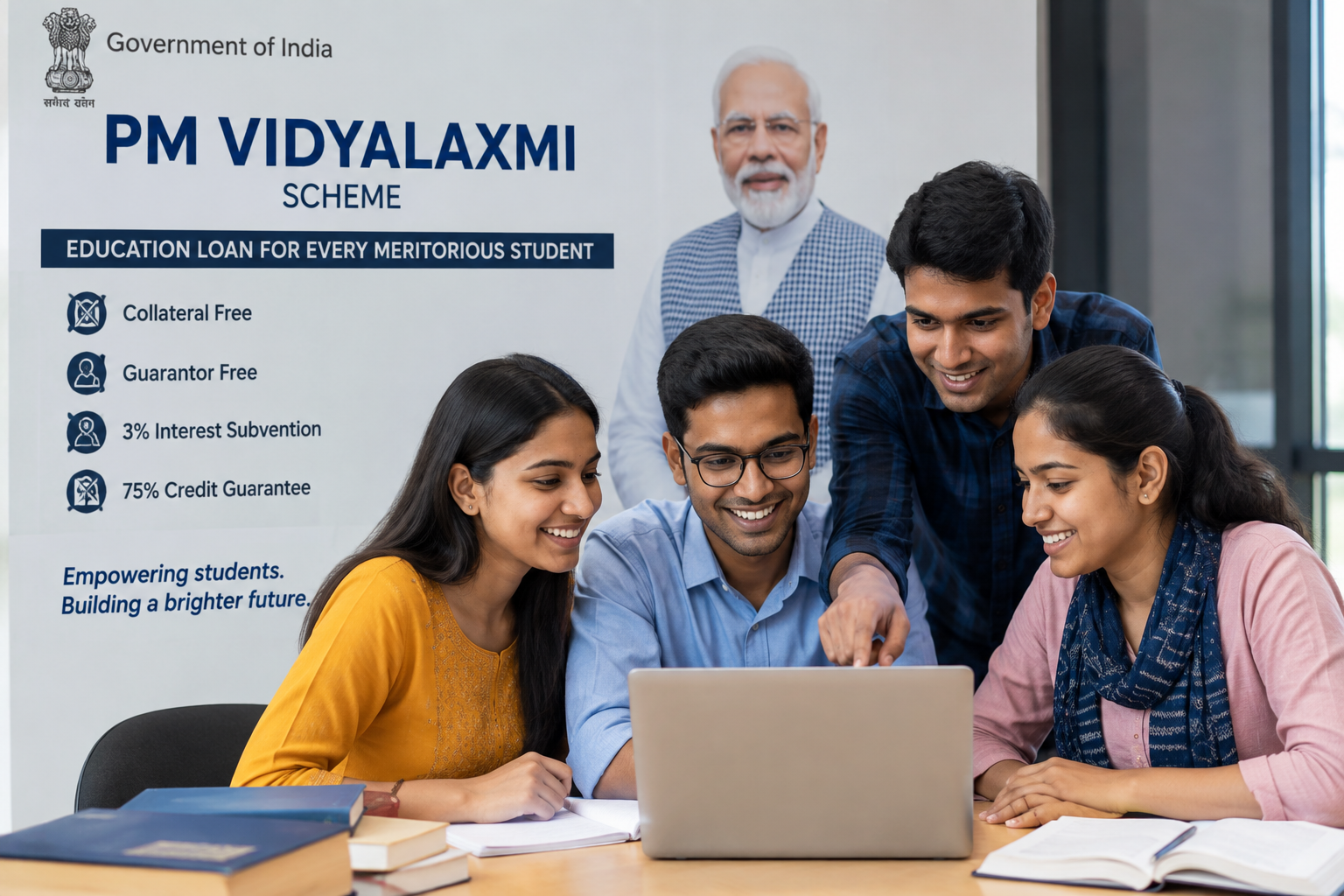
The Pradhan Mantri Vidyalaxmi Scheme represents an important step in this direction. Approved in November 2024, the scheme addresses one of the most significant barriers to higher education, which is access to affordable finance. It provides collateral free and guarantor free education loans to students, which secure admission on merit to designated Quality Higher Educational Institutions. The initiative is particularly significant because it seeks to connect merit with opportunity, irrespective of a student’s economic background.
The scale and design of the scheme underline its ambition. Currently, 1,425 Quality Higher Educational Institutions are covered under it, encompassing public as well as private institutions. Students can access education loans without providing collateral or third party guarantees, while the government provides a 75% credit guarantee on loans up to Rs. 7.5 lakh to encourage banks to expand educational lending. For students whose annual family income is up to Rs. 8 lakh, the scheme provides a 3% interest subvention on education loans up to Rs. 10 lakh, subject to the scheme’s eligibility conditions.
This is more than a financial assistance programme. It is an attempt to remove the invisible economic barriers that can prevent capable young Indians from entering India’s best educational institutions. A student who earns admission to a leading institution should not have to abandon that opportunity simply because the family cannot arrange a large sum of money or provide collateral. PM Vidyalaxmi seeks to ensure that merit remains the principal gateway to opportunity.
The importance of this intervention becomes clearer against the backdrop of India’s expanding higher education landscape. The gross enrolment ratio in higher education increased from 23.7% in 2014-15 to 30% in 2023-24. And this expanding enrolment must be accompanied by expanding access to quality institutions. The challenge is no longer merely to create more educational opportunities, but to ensure that students from different economic and social backgrounds can actually take advantage of them.
PM Vidyalaxmi is therefore an important component of the broader educational reforms inspired by the National Education Policy 2020. NEP 2020 places access, equity, quality and affordability at the heart of educational transformation. Its vision is not simply to increase the number of students entering classrooms, but to create an education system in which every capable learner has the opportunity to realise their potential.
The government’s approach to inclusion extends far beyond higher education loans. At the school level, initiatives such as PM SHRI are aimed at developing exemplary schools with modern infrastructure, quality teaching and an environment conducive to holistic learning. NIPUN Bharat focuses on foundational literacy and numeracy, recognising that meaningful educational inclusion must begin in the earliest years of a child’s learning journey.
At the higher education level, schemes such as the Central Sector Interest Subsidy Scheme complement PM Vidyalaxmi by providing full interest subvention during the moratorium period for eligible students from families with annual income up to Rs. 4.5 lakh pursuing approved technical and professional courses. PM Vidyalaxmi broadens this architecture by covering all degree and diploma programmes in designated quality higher educational institutions and extending 3% interest subvention to eligible students with annual family income up to Rs. 8 lakh.
Another important dimension is the digital delivery of the scheme. Students can apply for education loans, track applications, claim interest subvention and raise grievances through a unified digital portal. This reduces procedural complexity and makes financial assistance more transparent and student friendly. In an increasingly digital India, accessibility is not merely about providing a benefit, it is also about making the process of accessing that benefit simple, transparent and accountable.
The government has allocated Rs. 3,600 crore for PM Vidyalaxmi for the period 2024-25 to 2030-31, with an expectation that seven lakh fresh students will benefit from interest subvention during the seven year period. Such investment reflects a broader understanding that expenditure on education is not merely social spending, it is an investment in India’s human capital and consequently, in the country’s economic and technological future.
Educational inclusion also has an important gender and social dimension. When financial constraints are reduced, students who might otherwise be forced to choose less expensive educational options, or abandon higher education altogether, gain greater freedom to pursue courses and institutions according to their aptitude. This can have a multiplier effect, particularly for first generation learners and families seeking upward social mobility.
India’s aspirations for a developed economy require a large pool of educated, skilled and innovative young people. The country’s ambitions in artificial intelligence, semiconductor technology, biotechnology, space, advanced manufacturing, healthcare and other emerging sectors will depend heavily on the quality and breadth of its human capital. Ensuring that talented students can access quality institutions is therefore not only an issue of social justice, it is also an economic imperative. However, the real test of educational inclusion, however, will ultimately lie in implementation and awareness is the key in this process.
Now, India’s educational journey is moving from an emphasis on access towards a more comprehensive focus on access, equity, quality and affordability. PM Vidyalaxmi fits naturally into this larger transformation. By linking merit with financial support, it seeks to ensure that a student’s economic circumstances do not become a ceiling on their aspirations. A truly inclusive education system is one in which a talented student from a modest household can dream of studying at an IIT, IIM or any other leading institution, and have a realistic pathway to turn that dream into reality. PM Vidyalaxmi is an important step towards making that pathway wider, more accessible and more equitable.
The larger message is clear- India’s educational progress cannot be measured only by the number of institutions or students. It must also be measured by how many dreams are enabled, how many barriers are removed and how many young Indians are empowered to realise their full potential. In that sense, educational inclusion is not merely a welfare objective, it is also an essential foundation for building a confident, capable and Viksit Bharat.


