







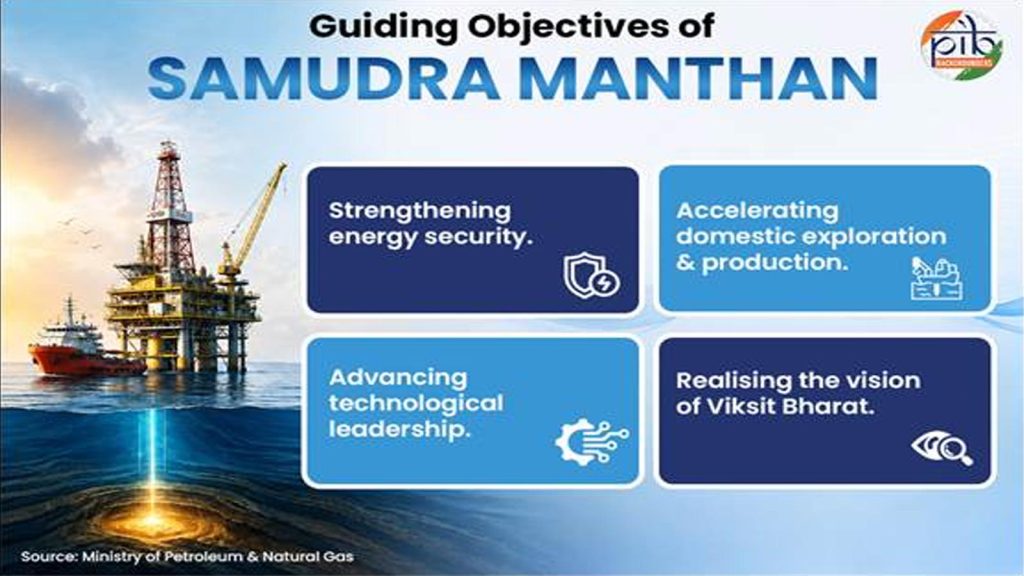
India has launched an ambitious national mission to transform its offshore hydrocarbon exploration sector with the approval of Samudra Manthan – the National Offshore Exploration Scheme, a flagship initiative aimed at enhancing domestic oil and gas production, reducing import dependence and strengthening the country’s long-term energy security.
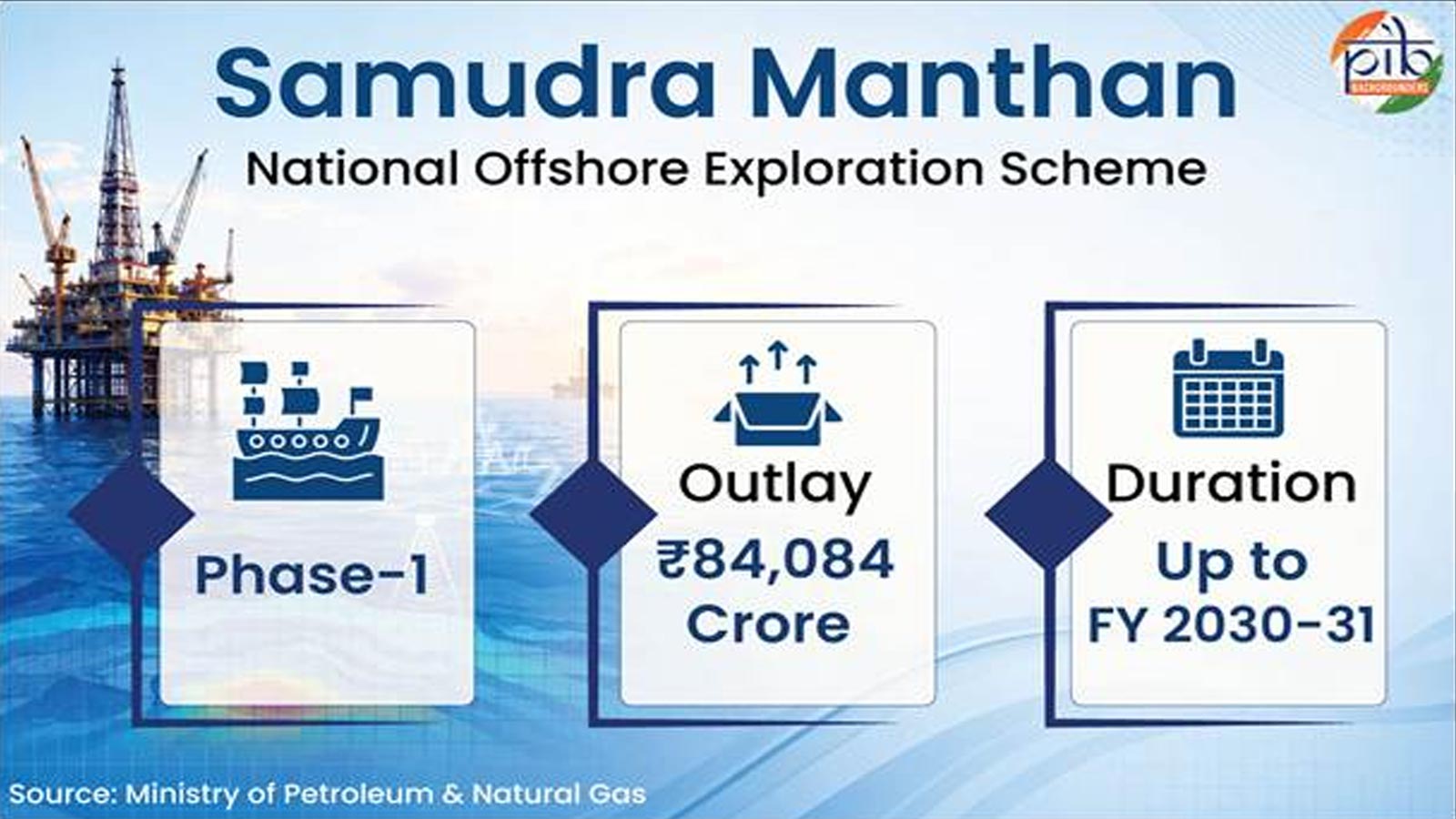
Approved on 31 July 2026, the scheme marks a major shift from policy reforms to mission-mode implementation. With a Phase-I financial outlay of ₹84,084 crore up to FY 2030-31, Samudra Manthan seeks to unlock India’s vast offshore hydrocarbon resources through advanced exploration technologies, large-scale seismic surveys, deepwater drilling, common offshore infrastructure and domestic manufacturing capabilities.
The initiative is designed to add more than 600 Million Metric Tonnes of Oil Equivalent (MMTOE) to the country’s hydrocarbon reserves while creating a globally competitive offshore energy ecosystem that supports the objectives of Atmanirbhar Bharat and Make in India.
Offshore Resources at the Centre of India’s Energy Strategy
As one of the world’s fastest-growing economies, India faces rapidly increasing energy demand across households, agriculture, transportation and industry. However, a substantial portion of the country’s crude oil and natural gas requirements continues to be met through imports, making energy security an important national priority.
According to the government, India’s annual crude oil import bill stands at nearly USD 144 billion, or around ₹13 lakh crore, highlighting the need to significantly enhance domestic production and reduce dependence on overseas supplies.
Hydrocarbons, which include crude oil and natural gas, form the backbone of India’s energy economy. These resources provide fuel for transportation, cooking gas, fertilisers, petrochemicals and numerous industrial products.
While considerable exploration has taken place onshore, much of India’s untapped hydrocarbon potential lies beneath the sea. Offshore basins along the country’s eastern and western coasts extend into water depths of nearly 3,000 metres and are estimated to contain more than 5,600 MMTOE of hydrocarbon resources. Recent discoveries in the Cauvery, Mahanadi and Andaman basins have further reinforced the potential of India’s offshore reserves.
Addressing the Challenges of Deepwater Exploration
The government noted that offshore exploration is one of the most capital-intensive and time-consuming activities in the energy sector. The journey from the award of an exploration block to commercial production typically takes between five and ten years.
Deepwater drilling involves substantial financial risks, with the cost of drilling a single exploratory well ranging between USD 125 million and USD 150 million. Such high investments often discourage companies from exploring frontier offshore regions.
Another challenge lies in maintaining existing production. Mature oil and gas fields experience a natural production decline of around 6 to 7 per cent annually, making continuous exploration essential merely to sustain present output levels.
Samudra Manthan has been designed to address these challenges by adopting a risk-sharing approach that encourages greater participation from both public and private exploration and production companies.
Four Pillars of the Samudra Manthan Mission
The scheme brings together modern technology, scientific data, infrastructure and manufacturing through four integrated components.
The first component focuses on seismic data acquisition, processing and interpretation. Limited seismic coverage has long restricted the identification of promising offshore hydrocarbon prospects. To overcome this, the government has allocated ₹28,534 crore for extensive 2D and 3D seismic surveys across offshore basins. Artificial Intelligence and advanced digital technologies will be used to accelerate data processing and interpretation, while older datasets stored in the National Data Repository will also be reprocessed using modern analytical tools.
The second component aims to accelerate offshore exploration through deepwater drilling. A total allocation of ₹43,200 crore has been made to support the drilling of 60 deepwater and ultra-deepwater exploration wells. The scheme will provide financial assistance covering up to 50 per cent of eligible drilling costs or ₹675 crore per well, whichever is lower. Both public and private exploration operators will be eligible for support, enabling faster reserve addition and increased domestic production.
The third component addresses one of the major bottlenecks in offshore production – the absence of common infrastructure. Many hydrocarbon discoveries have remained commercially unviable because companies had to individually invest in expensive production and evacuation facilities. Under Samudra Manthan, the government has earmarked ₹10,000 crore for developing shared offshore infrastructure in selected basins, particularly the Mahanadi and Kutch regions. Common facilities are expected to reduce project costs and enable stranded discoveries to enter commercial production.
The fourth component focuses on strengthening India’s domestic industrial capabilities through the establishment of an Oil and Gas Manufacturing and Services Zone with an allocation of ₹2,000 crore. The integrated hub will support manufacturing, engineering, repair, warehousing and specialised offshore services, reducing dependence on imported equipment while promoting indigenous capabilities across the exploration value chain.
An additional ₹350 crore has been allocated for programme monitoring, digital interventions, evaluation, human resource development, awareness campaigns, outreach activities and event management.
Creating an Integrated Offshore Ecosystem
Beyond financial support, the scheme seeks to establish a comprehensive enabling ecosystem for offshore exploration.
The programme includes provisions for digital programme management systems to improve transparency and implementation efficiency. It also focuses on capacity building for professionals, adoption of advanced technologies, continuous stakeholder engagement and international outreach to attract global investment and technical collaboration.
The government believes these initiatives will strengthen every stage of the offshore exploration value chain, from geological surveys to commercial production.
Expected Economic and Strategic Impact
The government expects Samudra Manthan to generate substantial long-term benefits for the country’s economy and energy sector, subject to exploration success.
The scheme aims to increase India’s hydrocarbon reserves by over 600 MMTOE, expanding the country’s total resource base from approximately 1.6 billion tonnes of oil equivalent to 2.2 billion tonnes.
Domestic hydrocarbon production is projected to increase from around 62 MMTOE annually to nearly 80 MMTOE, with incremental production estimated between 10 and 15 MMTOE, and a peak potential of 20 MMTOE.
Higher domestic production is expected to reduce crude oil imports substantially, potentially lowering the country’s import bill by nearly ₹1 lakh crore every year while generating significant foreign exchange savings.
The mission is also expected to stimulate investment throughout the offshore energy sector, contribute to GDP growth, create employment opportunities in exploration, production and associated industries, and strengthen India’s domestic manufacturing ecosystem for offshore technologies.
According to the government, these outcomes will enhance the country’s long-term energy resilience while creating new opportunities for innovation and industrial growth.
Building on a Decade of Reforms
Samudra Manthan builds upon a series of structural reforms undertaken in India’s hydrocarbon exploration and production sector over the past decade.
The government has opened more than 99 per cent of previously restricted offshore areas, making over one million square kilometres of India’s Exclusive Economic Zone available for exploration.
The introduction of the Hydrocarbon Exploration and Licensing Policy (HELP) in 2016 and the Open Acreage Licensing Programme (OALP) replaced the earlier nomination-based regime with a more transparent and investor-friendly framework featuring uniform licensing, revenue sharing and incentives for exploration.
India also shifted from Production Sharing Contracts (PSC) to Revenue Sharing Contracts (RSC), simplifying the fiscal framework and reducing administrative intervention.
Further reforms included the enactment of the Oilfields (Regulation and Development) Amendment Act, 2025, followed by the Petroleum and Natural Gas Rules, 2025, which modernised the regulatory framework, strengthened contractual stability and streamlined petroleum lease administration.
The government also standardised the functioning of the Empowered Committee of Secretaries across all contract regimes and reoriented the performance parameters of Oil and Natural Gas Corporation (ONGC) and Oil India towards exploration activities.
Parallel investments in geoscientific programmes—including Mission Anveshan, the National Seismic Programme, the Extended Continental Shelf Survey, the National Data Repository and the Hydrocarbon Resource Assessment Study—have created what the government describes as one of the world’s most comprehensive geoscientific databases.
These reforms have translated into increased investor confidence. According to the government, nearly 81 per cent of India’s active exploration acreage has been awarded since 2014. Under OALP alone, 172 exploration blocks covering nearly 3.8 lakh square kilometres have been allocated, attracting committed investments exceeding USD 4.3 billion.
During FY 2025-26, approximately 674 wells were drilled, resulting in five new hydrocarbon discoveries and the monetisation of seven discoveries.
Mahanadi Basin Marks New Beginning
The government’s offshore exploration efforts reached an important milestone on 25 July 2026 with the commencement of drilling of the first appraisal well in the Mahanadi Offshore Basin.
The MN-DWN18-1-HD appraisal well is the first of four planned deepwater wells that will evaluate one of India’s most promising offshore hydrocarbon regions. The programme will employ world-class deepwater drilling technology to assess the commercial viability of the discoveries.
According to the government, the start of drilling represents the beginning of one of India’s most challenging deepwater exploration campaigns and an important step towards expanding the country’s domestic energy resources.
Towards Energy Self-Reliance
The government has described Samudra Manthan as a comprehensive mission that integrates scientific data, technological innovation, shared infrastructure, risk-sharing mechanisms and indigenous manufacturing into a single national programme.
By combining exploration, infrastructure development and domestic industrial capacity, the scheme seeks to lay the foundation for a secure, resilient and self-reliant energy future. As offshore exploration gathers momentum, the government believes the initiative will play a pivotal role in reducing import dependence, strengthening India’s energy security and supporting sustainable economic growth in the decades ahead.


