







For the first time, Turkiye’s defence-industrial base, Pakistan’s nuclear-deterrence and Saudi Arabia’s financial muscle fuse into a single military bloc
The geopolitical shift fundamentally rewrites security-architecture from the Mediterranean to South Asia
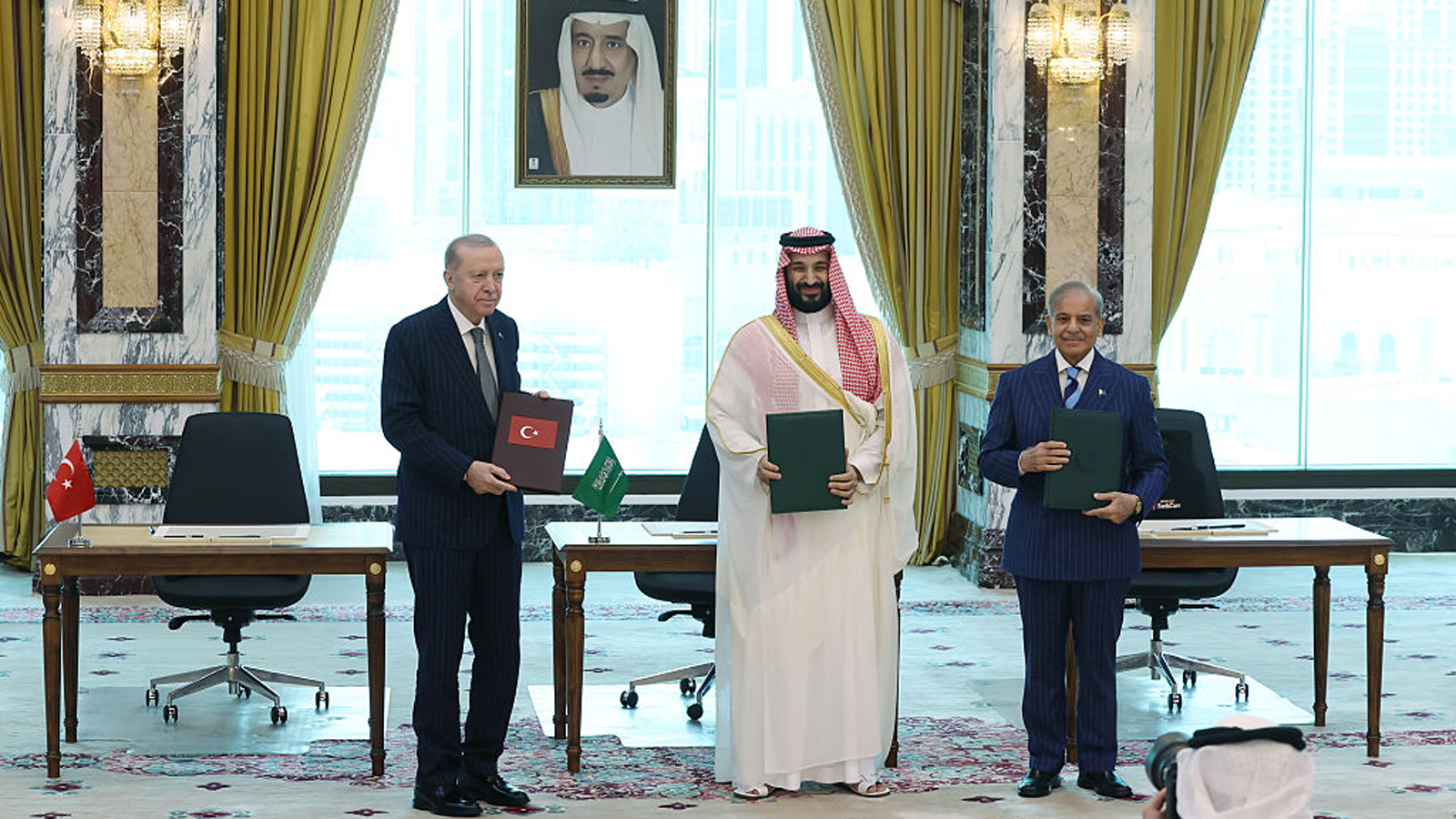
On Friday, 7th August, Saudi Arabia, Turkiye, and Pakistan, signed a trilateral, defence-pact in the holy city of Mecca. The closely-watched summit brought together Saudi Arabia’s Crown Prince Mohammed bin Salman, Turkiye’s President Recep Tayyip Erdogan and Pakistan’s Prime Minister Shehbaz Sharif.
A joint statement issued towards the end of the signing of the Makkah Joint Defence Agreement reads: “Any armed attack against any one of the three States shall be regarded as an attack against them all.” It mirrors the language of NATO’s Article 5, which says that an attack on one NATO member means that the entire alliance will fight-back together.
Each of the three countries came to the table with an acute need, and a massive asset to trade. Riyadh brought the capital; Ankara brought the industrial-defence complex; and Islamabad brought the combat experience and a nuclear umbrella to boot — although the nuclear-deterrence clause is reported to be omitted from the official text of the agreement.
If you’re wondering about the timing of this pact, three realities forced their hands. First, the U.S. security vacuum: Washington, D.C.’s pivot away from West Asia left traditional allies exposed. Riyadh realised that Washington, D.C. is no longer writing blank security-cheques. Second, the Iranian axis: Tehran’s hypersonic-missile advancements and its sweeping network of regional proxies created an existential ring of fire around the Gulf. And, third, the multi-polar chaos. With global superpowers distracted by gridlock in Europe and Asia, regional powers realised that they must police their own backyards.
So, how did Ankara, Riyadh, and Islamabad get here? The path to Mecca was forged through nearly a year of intensive but quiet negotiations, accelerated by absolute chaos in the region. Take a look at the timeline:
* 2023 to 2024: The Gaza War destabilises the region, fracturing trust in Western-led security guarantees, and triggering unprecedented cooperation between Turkiye and Arab nations
* September 2025: Sensing rising regional vulnerabilities, Saudi Arabia and Pakistan sign a bilateral Strategic Mutual Defence Agreement, introducing a mutual-protection clause
* January 2026: Turkiye’s Foreign Minister Hakan Fidan openly pushes for a broader regional security platform
* February 2026: The U.S. and Israel attack Iran, triggering a wider, ongoing war that spills directly into Gulf waters
* Mid-2026: Yemen’s Houthis declare a maritime blockade against Saudi shipping at the Bab al-Mandeb Strait. Drones and missiles strike the Kingdom’s critical infrastructure even as shipping lines through the Strait of Hormuz collapse
Faced with a direct threat to global energy-routes and their own national borders, these three powers stopped waiting for a Western shield. They built their own!
Now take a look at the complex relationship between these three nations. Turkiye is a NATO member but Pakistan and Saudi Arabia are not. Turkiye has NATO’s second-largest military. Saudi Arabia is home to Islam’s holiest sites and one of the world’s top oil exporters. And Pakistan is the only nuclear-armed Muslim country.
First, Pakistan–Saudi Arabia ties: Pakistan has given training and technical assistance to Saudi Arabia’s forces for decades. It has deployed thousands of troops to Saudi Arabia, backing them up with fighter-jets, drones, and air-defence systems. Although Pakistan signed a mutual defence pact with Saudi Arabia last year, it has not responded militarily to Iran’s attacks on the Kingdom. It has also played down suggestions that its nuclear deterrent might be extended to allies.
Next, Pakistan – Turkiye relations: Islamabad and Ankara share a deep, long-standing defence partnership, actively trading everything from Naval warships to training jets. In fact, during Operation Sindoor, Turkiye openly backed Pakistan against India, supplying the very drones and surveillance planes used in the conflict.
But it’s the relationship between Turkiye and Saudi Arabia – the third leg of this alliance – that needs some explaining. A decade ago, Saudi Arabia and Turkiye were backing opposing sides in proxy battlegrounds such as Libya. They were locked in a ‘cold war’ for ideological dominance over the Islamic world. Turkiye supported Islamist movements such as the Muslim Brotherhood, which Saudi Arabia views as an existential threat. The murder of Saudi Arabian journalist Jamal Khashoggi at the Saudi Consulate in Istanbul in 2018 had completely ruptured the ties. Turkiye aggressively used the incident to isolate Saudi Arabia globally. Saudi Arabia responded by aggressively targeting Turkiye’s economy. However, by 2022, the relationship underwent a 180-degree turn. In April 2022, Turkiye effectively buried the legal pursuit of Khashoggi’s killers. Weeks later, Erdogan visited Saudi Arabia, followed by a reciprocal visit by Crown Prince Salman to Ankara. The two signed a number of investment, trade, and defence deals, and declared a new period of cooperation. Today, their ties are driven by hard, military realism. In fact, back in 2023, Riyadh agreed to buy Turkish drones in, what Ankara called, its largest defence export contract. And that is why the most stunning visual is not the pact itself; it is Erdogan standing shoulder-to-shoulder with Crown Prince Salman.
Abdulaziz Sager, the chairperson of the Gulf Research Centre, a Saudi Arabia-based think tank, says that the political symbolism of the event is significant. “Three of the Muslim world’s most influential states are convening at a moment of heightened uncertainty, demonstrating a growing willingness among regional and middle-powers to coordinate more closely on security matters. If institutionalised and translated into concrete cooperation, the trilateral framework could strengthen the three countries’ collective diplomatic and defence weight while contributing to the emergence of a more regionally-driven security architecture,” he says.
Rayed Krimly, Saudi Arabia’s Deputy Minister for Public Diplomacy, says that the agreement does not represent an effort to establish a military axis or a sectarian bloc. Nor is it linked to any nuclear ambitions or arms-race; rather it is focussed on building sustainable capabilities.
Burcu Ozcelik, a senior research fellow at the Royal United Services Institute in London, says that the agreement is focussed on counter-balancing Iran’s hegemony in the region and building deterrence against Israel rather than moving towards a confrontation with Tehran.
The idea of such a defence pact is not new. It’s been floating around for years, especially since Saudi Arabia launched a 34-nation Islamic military alliance against terrorism back in 2015, right after the Arab Spring. It was revived in September 2025 when leaders from across the Arab- and Islamic-worlds gathered in Qatar for an emergency summit following an Israeli strike on Doha. President el-Sisi of Egypt, which has the biggest army in the Arab world, had then proposed reviving a NATO-style collective defence pact to counter the growing regional threats. He had even offered to contribute 20,000 of his troops right away, with potential involvement from other countries. However, the idea never crystallised. Until now, that is.
Interestingly, Ankara claims that the Mecca Joint Defence Agreement remains open to other regional countries. If some reports are to be believed, Kuwait and Egypt are potential candidates looking to integrate into the bloc to secure their airspace and hedge against regional instability.


