







India’s sporting landscape is undergoing one of the most significant transformations in its history, driven by sustained government investment, grassroots talent development, modern sports infrastructure and a long-term vision to establish the country among the world’s leading sporting nations. The latest milestone in this journey came with the Union Cabinet’s approval of the revamped Khelo India Scheme, which, along with enhanced Assistance to National Sports Federations (NSFs), carries a combined financial outlay of ₹36,441 crore for the period 2026-27 to 2030-31.
The expanded programme aims to build a seamless pathway for athletes – from talent identification in schools and villages to international podium finishes – through scientific coaching, better infrastructure, institutional support and wider competitive opportunities. The initiative is aligned with India’s broader sporting ambitions, including preparations for the 2030 Commonwealth Games, future Olympic and Paralympic campaigns, and the vision of Viksit Bharat@2047.
Sports as a Nation-Building Force
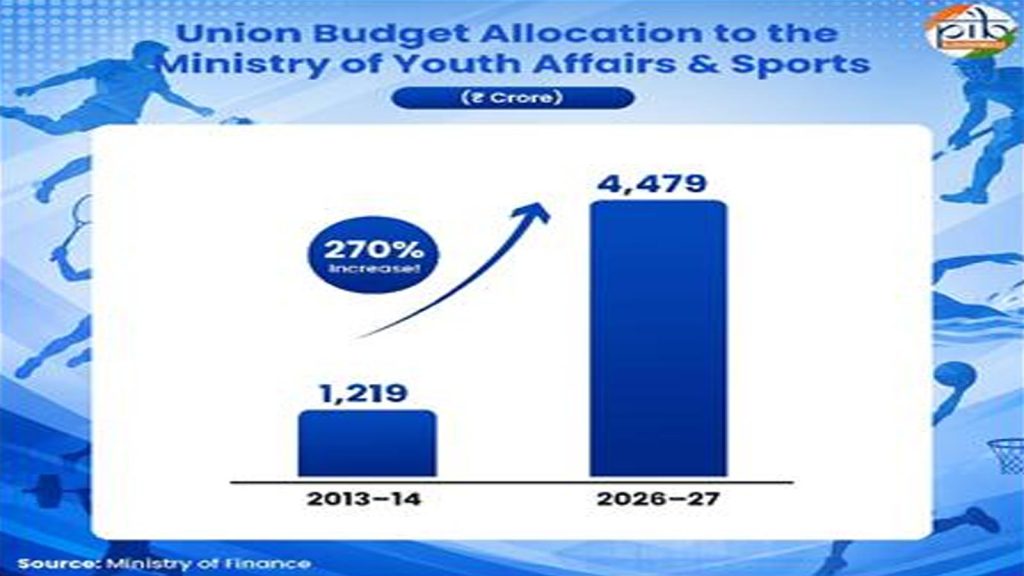
Sports have increasingly become a powerful instrument of national development, promoting discipline, confidence, unity and international recognition. Success on the global sporting stage not only brings medals but also strengthens national identity and inspires future generations. With nearly 65 per cent of India’s population below the age of 35, the country’s demographic advantage has become the foundation of its sporting strategy. Recognising this immense potential, the Ministry of Youth Affairs and Sports has steadily increased investments in sports development. The Union Budget 2026-27 allocated a record ₹4,479.88 crore to the Ministry, compared to ₹1,219 crore in 2013-14, reflecting the growing emphasis on building a comprehensive sporting ecosystem.
Khelo India: The Centrepiece of India’s Sporting Transformation
At the centre of this transformation is the Khelo India programme, which was launched in 2017 after merging the Rajiv Gandhi Khel Abhiyan, Urban Sports Infrastructure Scheme and National Sports Talent Search Scheme into a unified framework for sports development. The programme was designed to strengthen every stage of India’s sporting ecosystem by identifying promising athletes, building coaching capacity, promoting sports science, organising competitions and developing infrastructure. It also envisions establishing at least one Khelo India Training Centre in every district while integrating sports science, nutrition, psychology and technology-driven athlete monitoring to produce world-class athletes by 2036.
Growing Investments Reflect Long-Term Commitment
Government investment in Khelo India has expanded steadily over the years. The scheme initially received ₹1,756 crore during 2017-18 to 2019-20, followed by an allocation of ₹328.77 crore in 2020-21. Between 2021-22 and 2025-26, the financial outlay increased significantly to ₹3,790.50 crore, enabling the expansion of sports infrastructure, athlete support and grassroots development. For 2026-27, another ₹924.35 crore has been allocated as the programme enters a more outcome-oriented phase.
Building India’s Sporting Infrastructure
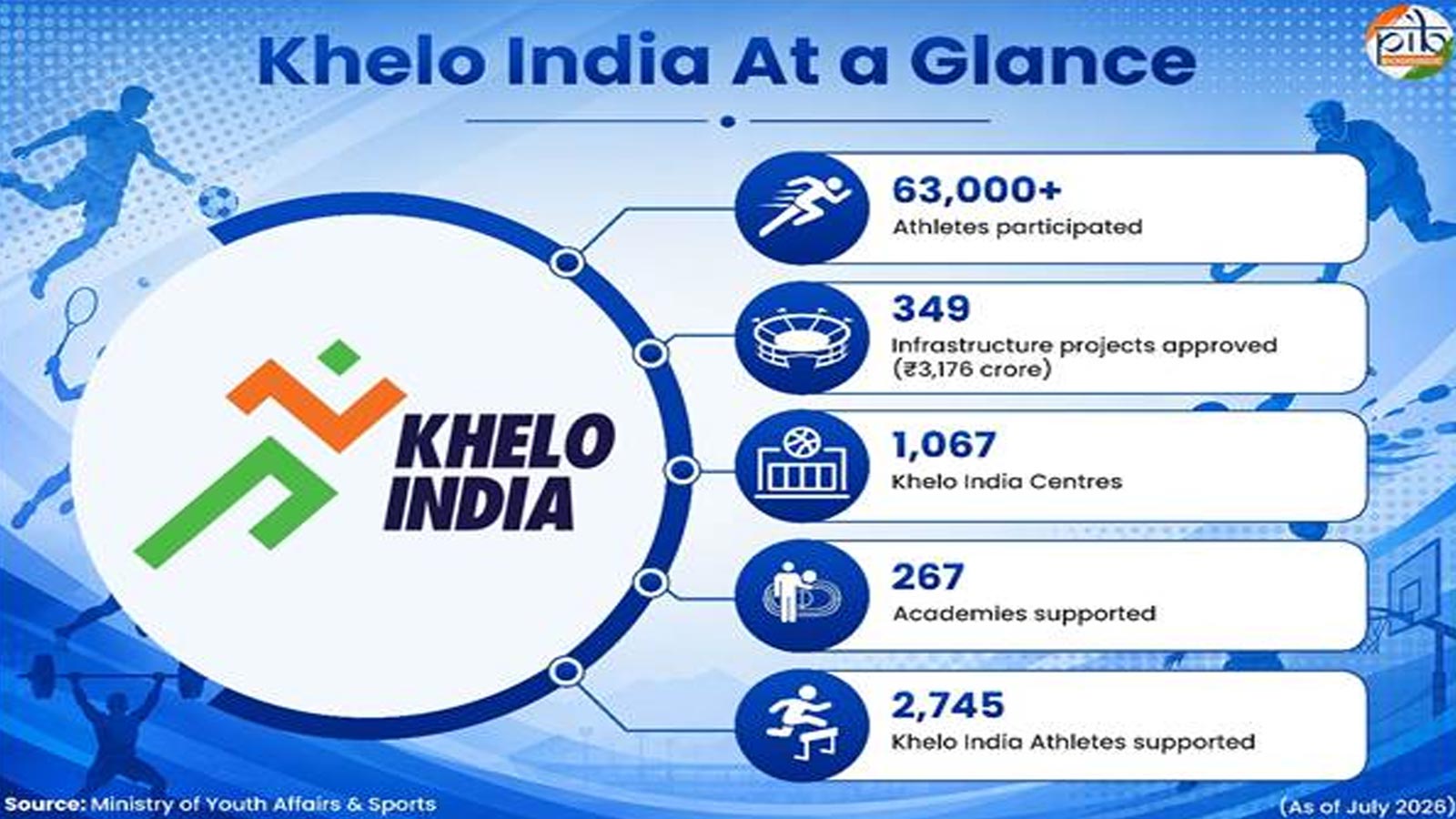
The investments have translated into a rapidly expanding sports infrastructure network. As of July 2026, 349 new sports infrastructure projects worth ₹3,176 crore have been approved across the country. The Khelo India ecosystem now includes 1,067 Khelo India Centres, 267 academies, and 2,745 Khelo India Athletes who receive coaching, equipment, medical support and monthly allowances. These facilities have strengthened grassroots training while ensuring that promising athletes receive sustained professional support closer to their homes.
Revamped Khelo India: A Complete Athlete Development Ecosystem
The newly approved Khelo India Scheme significantly broadens the athlete development ecosystem by integrating every stage of an athlete’s journey. The expanded framework brings together National Centres of Excellence, Khelo India Centres of Excellence, Sports Authority of India Training Centres, Khelo India Accredited Academies, Khelo India Centres and Youth Sports Companies of the Armed Forces into one comprehensive system. Together, these institutions will provide modern infrastructure, professional coaching, sports science support and performance monitoring.
Expanding India’s Talent Pool
The programme also introduces Khelo India Feeder Schools and Khelo India Utkrishta Vidyalayas, integrating sports with mainstream education and facilitating early talent identification. A new category of Emerging Khelo India Athletes is expected to expand the structured athlete pool nearly tenfold, creating a stronger pipeline from grassroots competitions to elite programmes such as the Target Olympic Podium Scheme (TOPS).
More Competitions, Greater Opportunities
Regular competitive exposure will form another key pillar of the revamped programme. School competitions, university events, regional leagues and sport-specific tournaments will provide athletes with greater opportunities to compete and improve. The programme also aims to expand participation among women athletes, para-athletes and indigenous sports while strengthening support for the National Games and international competitions.
Technology, Fitness and Scientific Training
Technology and scientific athlete development have also been placed at the heart of the new framework. The expanded Fit India Movement will promote healthier lifestyles across the country, while a National Coach Accreditation Board will standardise coaching quality. A unified digital platform will integrate athlete databases, infrastructure, competitions, performance assessments and funding into a single ecosystem.
Partnerships with Private Sector
The government also plans to deepen partnerships with private academies and corporate institutions to bring additional investment and expertise into sports development. Enhanced assistance to National Sports Federations will strengthen coaching, sports science, international exposure, equipment and athlete preparation.
Khelo India Games: India’s Largest Talent Identification Platform
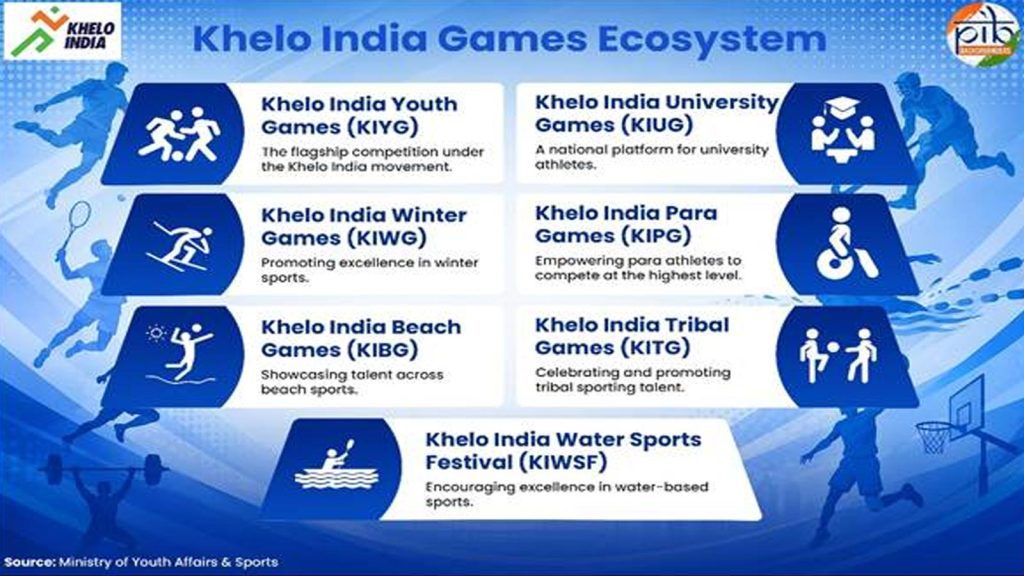
The Khelo India movement entered a new phase in 2018 with the launch of the Khelo India School Games in New Delhi. After the Indian Olympic Association became part of the initiative, the competition was renamed the Khelo India Youth Games in 2019. Since then, the programme has expanded steadily to include the Khelo India University Games, Khelo India Winter Games, Khelo India Para Games, Khelo India Beach Games, the Khelo India Water Sports Festival and the Khelo India Tribal Games. Since 2018, more than 63,000 athletes have participated in Khelo India competitions, making the Games India’s largest platform for identifying and nurturing sporting talent.
Supporting Excellence Beyond Khelo India
Target Olympic Podium Scheme (TOPS)
India’s sporting transformation has also been supported by complementary initiatives such as the Target Olympic Podium Scheme (TOPS). Launched in 2014 and revamped in 2018, TOPS provides elite athletes with foreign training, international competition exposure, coaching camps, specialised equipment and monthly financial assistance. As of April 2026, the scheme supports 51 Core Athletes, 52 Para Core Athletes and 130 Development Athletes, and played an important role in India’s medal-winning performances at the Tokyo 2020 and Paris 2024 Olympic Games.
KIRTI Initiative
The Khelo India Rising Talent Identification (KIRTI) programme has further strengthened grassroots talent identification. Designed for children between the ages of nine and eighteen, KIRTI uses scientific assessment protocols, Artificial Intelligence and data analytics to identify promising athletes. The initiative currently operates 174 Talent Assessment Centres across States and Union Territories and has completed 1,87,921 assessments, with the long-term objective of helping India become one of the world’s leading sporting nations.
Sports Goods Manufacturing
The Union Budget 2026-27 also introduced a dedicated ₹500 crore initiative for sports goods manufacturing, aimed at strengthening India’s position as a global hub for high-quality and affordable sports equipment. The initiative seeks to expand domestic manufacturing capacity, promote innovation, improve material sciences, strengthen India’s role in global supply chains and generate employment.
India’s Rising Global Sporting Performance
Olympic Games
The investments made in India’s sporting ecosystem are increasingly reflected in international performances. India progressed from winning two medals at the Rio Olympics in 2016 to seven medals at Tokyo 2020 and six medals at Paris 2024. Neeraj Chopra became India’s first Olympic athletics gold medallist, while Mirabai Chanu established herself as one of India’s most consistent Olympic performers.
Paralympic Games
India’s Paralympic performances have witnessed even more remarkable growth. The medal tally increased from four medals at Rio 2016 to nineteen at Tokyo 2020 before reaching a record twenty-nine medals at Paris 2024. Athletes such as Avani Lekhara, Sumit Antil and Pramod Bhagat have emerged as symbols of India’s growing strength in para sports.
Asian Games
The country’s performances at the Asian Games have also improved steadily, culminating in a historic tally of 107 medals at Hangzhou 2023, India’s highest-ever medal haul at the event.
Commonwealth Games
India has consistently remained among the top-performing nations at the Commonwealth Games over the past decade. The country won 64 medals at the 2014 Commonwealth Games in Glasgow, improved its tally to 66 medals at the 2018 Gold Coast Games, and secured 61 medals at the 2022 Birmingham Commonwealth Games. These consistent performances underline India’s strength across disciplines such as wrestling, weightlifting, badminton, table tennis and athletics, reflecting the country’s growing depth of sporting talent on the international stage.
Glasgow 2026: Another Milestone
The Commonwealth Games 2026 in Glasgow provided fresh evidence of India’s expanding sporting strength. India finished fourth overall with 39 medals, including 13 gold, 17 silver and nine bronze medals, won by a 124-member contingent comprising 78 male and 46 female athletes.
The Games produced several memorable moments. Mirabai Chanu became a three-time Commonwealth Games champion, while Indian boxers delivered an unprecedented performance by winning ten medals, including seven gold medals, the best performance by any country in boxing at a single Commonwealth Games. Asmita Dey became India’s first Commonwealth Games gold medallist in judo, Harsh Tokas added another judo gold, Gulveer Singh became the first Indian track and field athlete to win two individual medals at one edition, Tejaswin Shankar secured India’s first Commonwealth Games decathlon medal, and Neeraj Chopra added a silver medal in the men’s javelin throw.
Khelo India Champions Reach International Success
The Games also demonstrated the effectiveness of the Khelo India pathway in producing international champions. Boxer Arundhati Choudhary, who won three consecutive Khelo India Youth Games gold medals in Delhi, Pune and Guwahati, captured the women’s 70 kg Commonwealth Games title in Glasgow. Judoka Asmita Dey, who first gained national recognition through the Khelo India University Games, created history by becoming India’s first Commonwealth Games gold medallist in judo after defeating Canada’s Heidi Quach in the final.
A Long-Term Sporting Vision
The revamped Khelo India Scheme represents a comprehensive vision for transforming India into a global sporting powerhouse through sustained investment, scientific athlete development, modern infrastructure and strong institutional support. By integrating sports with education, technology, fitness and high-performance training, the programme seeks to ensure that sporting talent is no longer limited by geography, financial constraints or lack of opportunity.
Combined with initiatives such as TOPS, KIRTI, expanded infrastructure, enhanced support to National Sports Federations and new investments in sports goods manufacturing, Khelo India is laying the foundation for India’s future success at the Commonwealth Games, Asian Games, Olympics and Paralympics. As Indian athletes continue to achieve new milestones on the international stage, the country’s sporting ecosystem is steadily evolving into one capable of producing champions across disciplines and bringing the vision of India as a leading global sporting nation closer to reality.


