







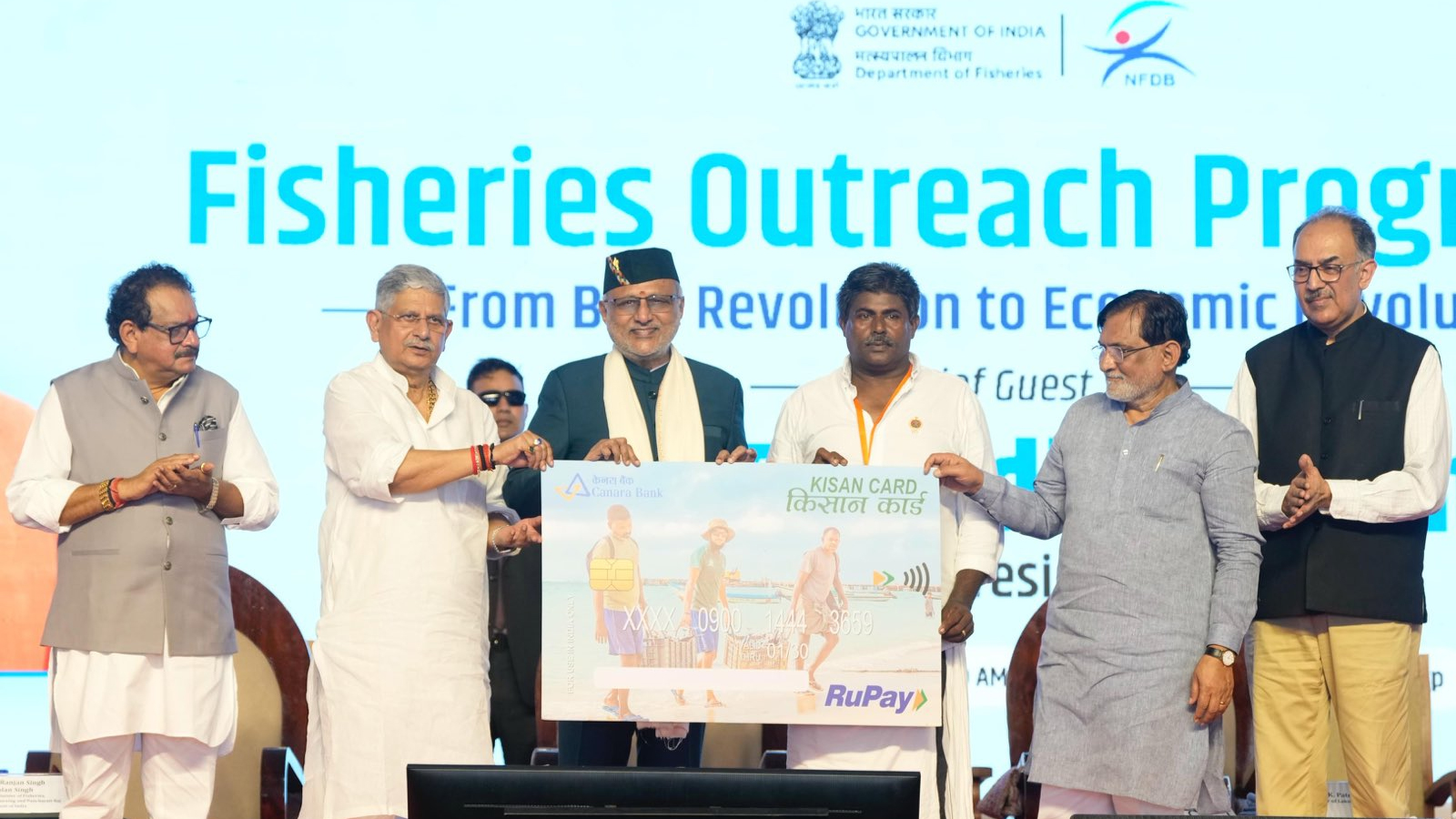
Vice President C. P. Radhakrishnan on Monday released the ‘Mission Rangeen Machhli 2031’ Strategic Action Plan for Ornamental Fisheries Development at a Fisheries Outreach Programme in Agatti, calling for sustainable use of Lakshadweep’s vast marine resources to drive a new era of fisheries-led growth and strengthen India’s Blue Economy.
Addressing fishers, fish farmers, women beneficiaries, officials and other stakeholders, V-P Radhakrishnan described Lakshadweep as a “priceless maritime asset” of the country and said the islands have immense potential to contribute to India’s Blue Revolution.
Referring to Prime Minister Narendra Modi’s vision, the Vice President said the blue chakra in the national flag represents the potential of the Blue Revolution and the ocean economy. He described fisheries and aquaculture as a sunrise sector and said the Blue Revolution could be as transformative for fishing communities as the Green and White Revolutions.
The Vice President highlighted Lakshadweep’s estimated fisheries potential of more than one lakh tonnes, including around 94,000 tonnes of tuna and tuna-like species. He stressed that this potential must be harnessed scientifically and sustainably while ensuring greater prosperity for island communities.
Lakshadweep has a 4,200 sq km lagoon area and an Exclusive Economic Zone (EEZ) of nearly 4 lakh sq km. However, against an estimated annual fisheries potential of nearly one lakh metric tonnes, the current harvest is only around 15,000 metric tonnes, according to the Lakshadweep administration.
V-P Radhakrishnan said the government was working to take schemes and development support directly to fishing communities. Fisheries development projects worth more than Rs 62 crore have been approved for Lakshadweep under the Pradhan Mantri Matsya Sampada Yojana (PMMSY).
He also highlighted the enabling framework for sustainable harvesting of fisheries resources from the EEZ and High Seas, saying it would provide fishers with opportunities to access deep-sea resources responsibly. He stressed the importance of digital authorisation systems, vessel monitoring, international certification and sustainable fishing practices to improve incomes and strengthen India’s position in global seafood markets.
India’s seafood exports reached Rs 73,890 crore in 2025-26, with shipments going to more than 120 countries. V-P Radhakrishnan said initiatives focused on the EEZ and High Seas would further strengthen India’s fisheries sector and its presence in international seafood markets.
Calling for responsible fishing and conservation of marine resources, the Vice President urged firm action against illegal, unreported and unregulated fishing. He also encouraged young people to view fisheries as a modern profession driven by science, technology, innovation and global opportunities rather than merely as an inherited occupation.
V-P Radhakrishnan said stronger cooperation among all stakeholders would be crucial to making the Blue Economy a powerful pillar of Viksit Bharat 2047, while ensuring that the conservation of marine resources remains central to long-term fisheries development.
Support for fishers and fisheries-based livelihoods
During the programme, the Vice President distributed benefits under PMMSY to beneficiaries from the fisheries sector. The assistance included support for the acquisition of Deep-Sea Fishing Vessels (DSFVs) for traditional fishers, replacement of old fishing boats and nets, safety kits for traditional and motorised fishing vessels, Kisan Credit Cards (KCCs) for fishers, and communication and tracking devices.
Support was also provided for recreational fisheries, aimed at leveraging Lakshadweep’s tourism potential and creating additional livelihood opportunities.
Union Fisheries Minister Rajiv Ranjan Singh said the outreach programme reflected the government’s commitment to understanding the needs of Lakshadweep’s fishing communities and developing a comprehensive roadmap for increasing fishers’ incomes, improving infrastructure and safety at sea, promoting value addition and expanding market access.
He said India’s fish production had increased from 95.7 lakh tonnes in 2013-14 to 197.75 lakh tonnes in 2024-25, while seafood exports reached a record Rs 73,890 crore in 2025-26 despite trade-related challenges.
Singh highlighted government initiatives including the Blue Revolution, Fisheries and Aquaculture Infrastructure Development Fund (FIDF), PMMSY and Pradhan Mantri Matsya Kisan Samridhi Sah-Yojana (PMMKSSY) as key drivers of growth in the fisheries sector.
He also stressed the need to sustainably harness Lakshadweep’s high-value tuna resources to create new opportunities for fishers, cooperatives, Fish Farmer Producer Organisations (FFPOs) and women-led enterprises.
Focus on tuna, seaweed and ornamental fisheries
Minister of State for Fisheries, Animal Husbandry and Dairying and Panchayati Raj S. P. Singh Baghel said Lakshadweep has strategic importance for India’s Blue Economy. Although the islands have a small land area, they account for nearly 17 per cent of India’s EEZ.
He said the government was working towards securing international sustainability certification and developing a global “Lakshadweep Sustainable Tuna” brand to improve export competitiveness and fishers’ incomes.
Lakshadweep has also been notified as a Seaweed Cluster, with a Seaweed Bank approved in collaboration with ICAR-CMFRI. Baghel said 575 seaweed cultivation units, involving an investment of around Rs 2 crore, are being promoted to create livelihood opportunities for women, youth and self-help groups.
The islands are home to more than 300 ornamental fish species. An ornamental fish hatchery has been established at Agatti, while three rearing units have been approved under PMMSY.
The government has also sanctioned 19 recreational fishing units under PMMSY to promote fisheries-based tourism and generate additional income for island communities.
Deep-sea fishing and infrastructure push
Lakshadweep Administrator Praful Khoda Patel said the administration was taking targeted measures to bridge the gap between the islands’ fisheries potential and actual production, with a focus on tuna fisheries, deep-sea fishing, seaweed cultivation, fish processing and value addition.
He said 16 Deep Sea Fishing Vessels, each costing around Rs 1.2 crore, had been sanctioned for fishers with full financial assistance, and their construction was already underway.
Patel said new initiatives in fisheries infrastructure, value addition and processing, along with the proposed fisheries policy of Lakshadweep, were expected to create substantial livelihood opportunities and raise the incomes of local fishers.
He expressed confidence that Lakshadweep could emerge as a model for fisheries-led Blue Economy development.
Department of Fisheries Secretary Abhilaksh Likhi said Lakshadweep and the Andaman and Nicobar Islands together account for nearly 50 per cent of India’s EEZ, offering significant opportunities in tuna fisheries, deep-sea fishing, mariculture, seaweed cultivation and ornamental fisheries.
He said the government was strengthening FFPOs and fisheries cooperatives through financial, technical and capacity-building support to enable island communities to sustainably harness high-value resources and improve aggregation, value addition, market access and incomes.
India’s wider marine fisheries potential
India has a coastline of approximately 11,099 km and an EEZ of around 24 lakh sq km. The marine fisheries potential within the country’s EEZ is estimated at 58.6 lakh MT, supporting the livelihoods of around 50 lakh fishers.
The fisheries sector contributes to food security, nutrition, employment, income generation and export earnings, with India among the leading fisheries and aquaculture producing countries globally.
The government has noted that much of India’s fishing activity is concentrated within 40-50 nautical miles of the coast, while deeper waters and areas beyond national jurisdiction offer significant opportunities for high-value species, particularly tuna and tuna-like resources.
The Sustainable Harnessing of Fisheries in the Exclusive Economic Zone Rules, 2025, and the Guidelines for Sustainable Harnessing of Fisheries in the High Seas by Indian-Flagged Fishing Vessels, 2025, provide an enabling framework for responsible offshore fisheries development.
Against this backdrop, Lakshadweep’s rich oceanic resources, particularly Yellowfin and Skipjack Tuna, offer opportunities for sustainable harvesting, processing, value addition, exports and livelihood generation.
The Fisheries Outreach Programme brought together the Centre, Lakshadweep Administration, scientific institutions, fishing communities, cooperatives and other stakeholders with a focus on ensuring that the islands’ marine wealth is developed sustainably.


