







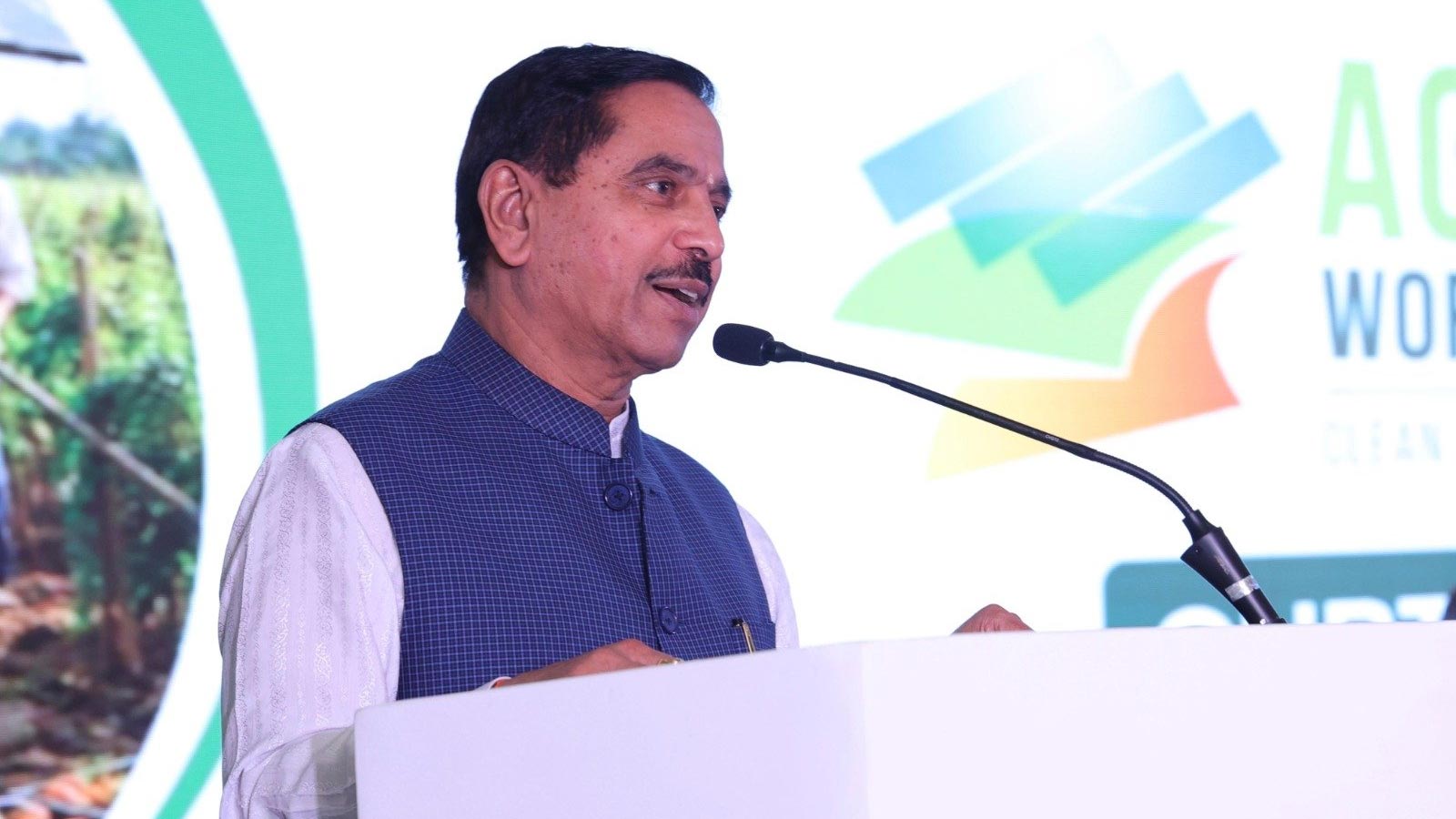
Union Minister for New and Renewable Energy Pralhad Joshi on Wednesday said India’s farmers could emerge as both “Annadatas” and “Urjadatas” by producing food and clean energy from the same piece of land through agrivoltaics.
Addressing a curtain-raiser event for the 7th Agrivoltaics World Conference 2026 in New Delhi, Joshi said the next phase of the PM-KUSUM scheme would include a dedicated component for agrivoltaics. The initiative is expected to enable farmers to continue cultivation while generating additional income by selling solar power.
The proposed focus would be on small and marginal farmers, Farmer Producer Organisations, cooperatives and panchayats, while ensuring that land ownership remains with farmers. Joshi said income from solar power could provide greater financial stability to farmers whose earnings are often affected by monsoon conditions and fluctuations in market prices.
The minister said agrivoltaics could provide farmers with three sources of economic benefit from the same acre of land – income from crops, revenue from electricity supplied to distribution companies, and savings on diesel through solar-powered agricultural operations.
“For a small farmer, solar income is not just extra income, it is security,” Joshi said, highlighting the potential of renewable energy to provide a more stable source of earnings during both favourable and difficult agricultural seasons.
Joshi pointed out that India accounts for nearly 18 per cent of the world’s population but has only about 2.4 per cent of global land resources. More than 85 per cent of the country’s farmers are small and marginal farmers cultivating less than two hectares.
He said agrivoltaics could help address the competing demands for agricultural land and renewable energy by allowing crops to be grown underneath elevated solar panels. “We do not have to choose between crop and solar plant; we can do both at the same time,” he said.
PM-KUSUM and decentralised solar gain momentum
Highlighting India’s progress in renewable energy, Joshi said the country added 55.29 GW of non-fossil fuel power capacity during the previous year, a figure he noted was higher than the entire installed power capacity of several developed countries, including Norway, Switzerland, Austria and Belgium.
He also highlighted the expansion of solarisation under PM-KUSUM, stating that around 29 lakh agricultural pumps have been solarised so far.
Decentralised solar power contributed 16.3 GW last year, comprising 7.6 GW under PM-KUSUM and 8.7 GW of rooftop solar, largely through the PM Surya Ghar Muft Bijli Yojana. The rooftop solar programme has reached around 5.6 million beneficiaries, he said.
The minister, however, stressed that agrivoltaics would require greater research to identify solutions suited to different crops, climatic conditions and geographical regions.
He cited the example of BAIF’s Rural Innovation Centre in Pune, where researchers are testing 17 different solar configurations across 30 crops. Such research, he said, would help determine the most suitable combination of panel height, spacing, tracking systems, crop selection and business models for different farming conditions.
Joshi also called for greater participation from industry and innovators in developing agrivoltaic structures that allow tractors, harvesters and other farm machinery to move freely while being capable of withstanding local weather conditions.
He emphasised the need for crop- and region-specific data from institutions such as the Indian Council of Agricultural Research, agricultural universities and Krishi Vigyan Kendras. Innovation in solar structures, materials and mounting systems would also be important to reduce the cost gap with conventional solar projects, he said.
India is also building a skilled workforce for the renewable energy sector, with nearly 70,000 Surya Mitras trained so far, Joshi said.
India’s model could benefit Global South
The minister said India’s experience with agrivoltaics could have wider relevance for countries in the Global South, particularly those characterised by small agricultural holdings, high solar potential and developing electricity grids.
With its large agricultural base and growing renewable energy sector, India has an opportunity to develop affordable and practical agrivoltaic solutions that could be replicated in other developing economies, he said.
During the curtain-raiser event, Joshi unveiled the official logo of the 7th Agrivoltaics World Conference 2026 and launched its teaser. The Agrivoltaics Pitch Hub, themed “Fueling Farm to Fork Innovations”, was also announced in partnership with the National Solar Energy Federation of India as the knowledge partner.
Built around the 3F framework of Food, Fuel and Fibre, the Pitch Hub will provide a platform for innovators to present solutions aimed at shaping the future of agrivoltaics.
The 7th Agrivoltaics World Conference 2026 will be held from October 21 to 23 at Bharat Mandapam in New Delhi. The three-day international conference is expected to bring together farmers, policymakers, researchers, industry leaders, international delegations and other stakeholders to discuss ways to scale up agrivoltaic systems.
The conference will also focus on sharing global experiences, building partnerships and developing practical, farmer-centric solutions for integrating agriculture with solar power, while strengthening India’s role in the international agrivoltaics sector.


