







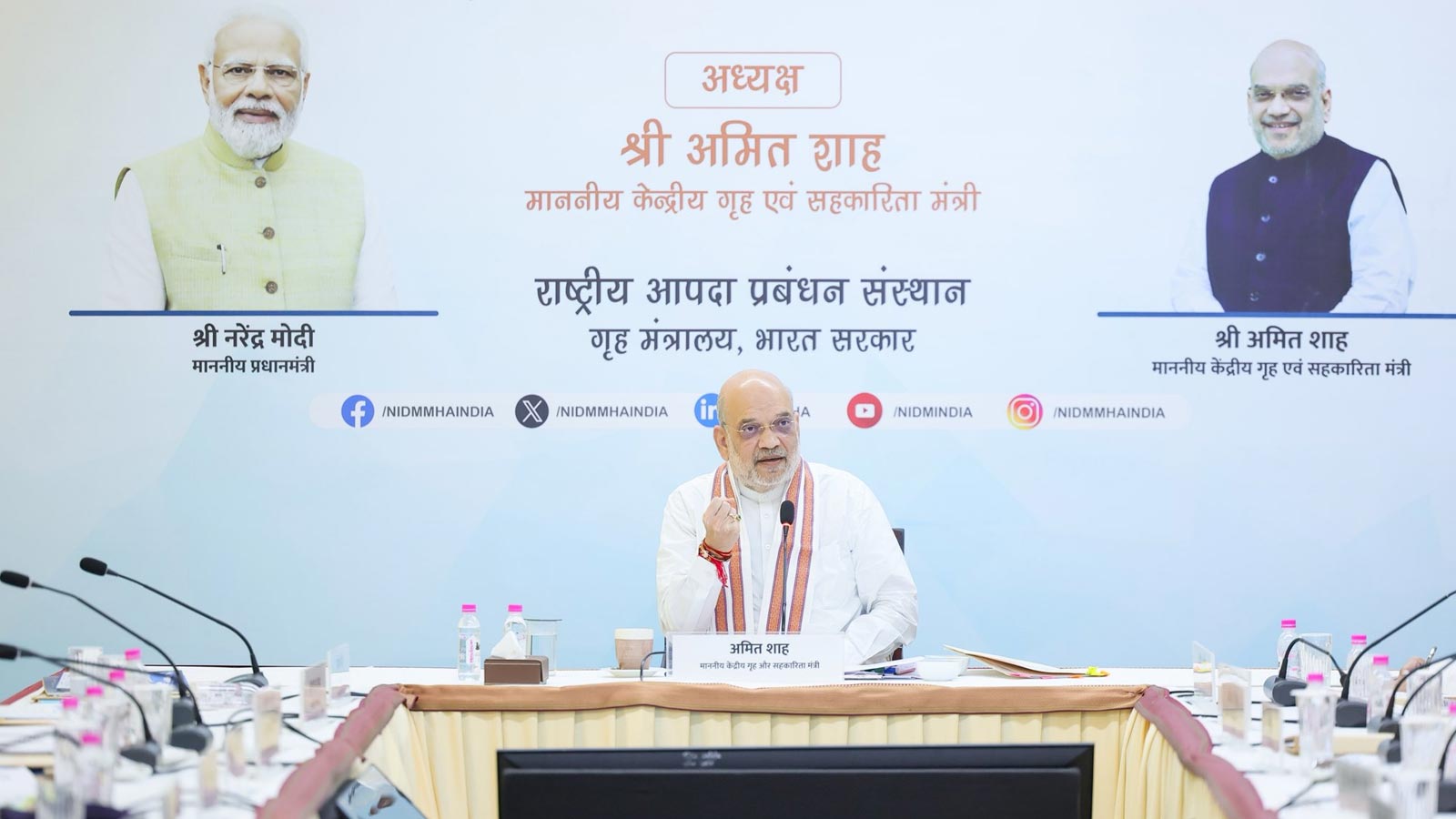
Union Home Minister Amit Shah has called for a stronger “Whole of Government” approach to disaster management, with greater emphasis on risk reduction, early warning systems and the goal of Zero Casualty.
Chairing the third meeting of the Governing Body of the National Institute of Disaster Management (NIDM) in New Delhi on Thursday, HM Shah said India’s disaster management approach had undergone a fundamental transformation over the past 12 years under the leadership of Prime Minister Narendra Modi.
He said disaster management had earlier focused largely on relief and rehabilitation, whereas India had now entered an era focused on preventing disasters, reducing risks and ensuring early warnings to minimise loss of life.
“Zero Casualty” has emerged as a central objective, HM Shah said, noting that India had successfully managed several disasters without loss of life.
Focus on Disaster-Resilient Villages and Cities
HM Shah said the government’s objective is to create disaster-resilient villages and cities, and called for this priority to guide future disaster-management efforts.
He stressed that disaster preparedness should extend beyond the immediate response to a calamity. Environmental protection, he said, is among the most effective ways of preventing disasters. Initiatives such as Mission LiFE, Pro-Planet People and the International Solar Alliance were cited as contributing to broader efforts towards environmental protection and disaster prevention.
With global warming and climate change expected to increase disaster risks, HM Shah said the relevance of institutions such as NIDM and the National Disaster Management Authority (NDMA) would grow further. New applications of science and technology could also create new categories of risks, requiring continuous research and preparedness.
NIDM to Expand Research and Capacity Building
HM Shah described NIDM as a national centre for research, innovation, policy support, training and departmental cooperation, and called for the institution to explore new areas of research and strengthen collaboration with universities.
He recalled that the institution’s predecessor, the National Centre for Disaster Management, had once been functioning from a limited space in Krishi Bhawan. In 2003, former Prime Minister Atal Bihari Vajpayee brought the institution under the Ministry of Home Affairs (MHA), giving it a new direction. HM Shah said the Narendra Modi government had further revitalised NIDM and strengthened its institutional infrastructure.
The government has also allocated four acres of land for NIDM as part of efforts to develop it into a world-class institution.
Joint Guidelines and Post-Disaster Studies
HM Shah directed NIDM and NDMA to jointly prepare nationwide guidelines clearly explaining what should and should not be done during different types of disasters and how response measures should be implemented.
NIDM should focus on training, while the National Disaster Response Force (NDRF), State Disaster Response Forces (SDRFs) and other agencies should work together to implement the guidelines on the ground.
He also called for systematic research into the causes of disasters. After every major disaster, a joint team comprising NDMA, NIDM, NDRF and SDRF should examine the causes of damage and prepare a detailed report to help improve future prevention and response mechanisms.
The Agriculture Department was specifically asked to strengthen permanent preparedness against locust swarm attacks originating from Pakistan and study international best practices for dealing with such threats.
Dedicated Cells to Monitor Implementation
The Home Minister directed all concerned departments to establish a dedicated cell for implementing decisions related to disaster management. Departmental heads should review the work of these cells at least once every three months and ensure that disaster management receives appropriate priority.
He also called for at least one top-level NIDM meeting every year, with an emphasis on meaningful outcomes and effective implementation of decisions.
Disaster Financing and Digital Preparedness
HM Shah highlighted the government’s increased financial commitment to disaster management, saying allocations under the State Disaster Response Fund (SDRF) have risen nearly fourfold, while those under the National Disaster Response Fund (NDRF) have increased nearly threefold.
Around ₹2.5 lakh crore has been spent in the sector over the last 11 years, he said. The Disaster Management Act has also been amended after two decades, while Urban Disaster Management Authorities have been introduced and digital disaster databases are being developed at the national and State levels.
The National Crisis Management Committee (NCMC) has been given statutory status, while the 16th Finance Commission has provided for ₹2 lakh crore for the current period.
HM Shah also called for wider adoption of a disaster-management mobile application across primary, secondary and higher education, saying greater awareness and preparedness among young people would strengthen the country’s disaster resilience.
He said international cooperation and learning from global best practices were important, but India’s priority must remain its five lakh villages and the creation of resilient communities across the country.
HM Shah said the ultimate objective was to transform knowledge into capacity, capacity into preparedness and preparedness into outcomes, enabling India to move closer to the goal of a disaster-resilient nation with Zero Casualty.


