







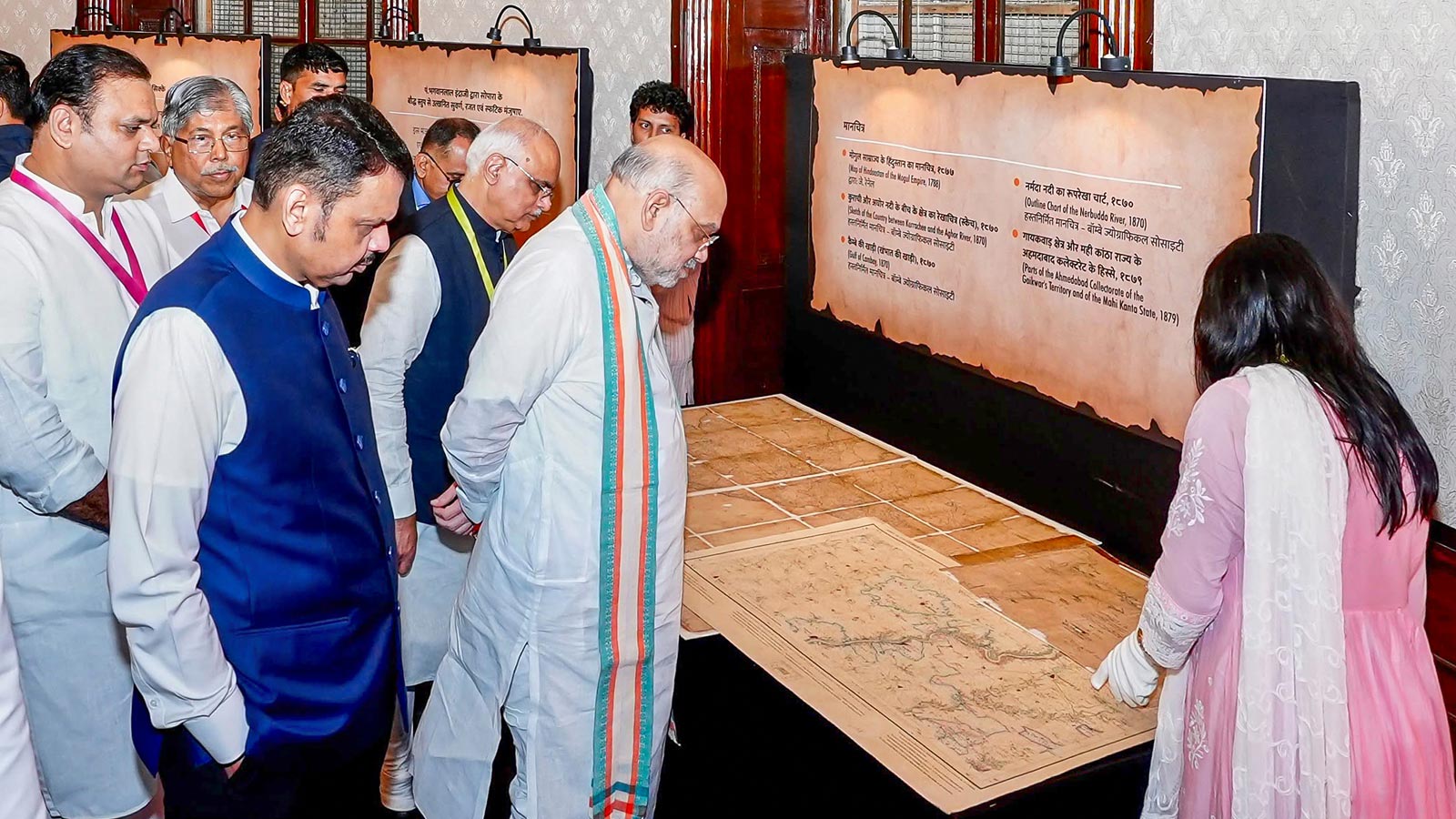
Union Home Minister Amit Shah on Sunday inaugurated the ‘Ganesh Gyanarthi Exhibition’ organised by the Asiatic Society of Mumbai, calling for the preservation, digitisation and wider dissemination of India’s rich knowledge traditions.
Maharashtra Chief Minister Devendra Fadnavis, Deputy Chief Minister Eknath Shinde and President of the Asiatic Society of Mumbai Dr. Vinay Sahasrabuddhe were among those present at the event.
Addressing the gathering, HM Shah said he had come to the Asiatic Society not merely as the Union Home Minister but as a participant in the movement to carry forward the Indian knowledge tradition that has evolved over thousands of years. He expressed confidence that the Asiatic Society of Mumbai would emerge as a bearer of the Indian knowledge tradition and help disseminate it across the country.
HM Shah emphasised that a nation that fails to protect its memory, history, values, language, records and traditions cannot sustain itself for long, while a nation that preserves these enduring pillars can withstand even prolonged periods of subjugation.
Referring to India’s ancient knowledge heritage, HM Shah said repeated attempts had been made to erase the country’s intellectual traditions but had failed. He cited the destruction of the Nalanda library as an example, stressing that while physical collections can be destroyed, knowledge preserved through traditions of Shruti and Smriti cannot be eliminated.
HM Shah said India’s tradition has been to move forward with patience after setbacks and, after victories, integrate people into its cultural tradition without destroying their memories. He also stressed that knowledge should not be held hostage by any ideology and must remain free and uninhibited.
Need to reinterpret India’s knowledge from an Indian perspective
HM Shah said understanding the Asiatic Society also requires an understanding of the concept of ‘Indology’, which encompasses areas such as numismatics, epigraphy, morphology, history, archaeology, linguistics, philosophy, literature, theology and grammar.
He said that the objectives of Indology in the colonial period differed fundamentally from those of the Indian knowledge tradition. HM Shah said while the Indian knowledge tradition has been centred on the welfare of the world and the universe, colonial approaches sought to understand Indian systems from the perspective of governing the people for an extended period.
He said India’s knowledge had often been presented through a colonial perspective that diminished the self-confidence of Indians. With the country having been independent for more than eight decades, he said, its vast knowledge repositories must now be used for the welfare of the country, the world and humanity.
HM Shah called for the compilation of ‘Kane Samagra’, based on the works of Bharat Ratna Pandit Pandurang Vaman Kane, and said the material should be made accessible to future generations.
Decolonisation means presenting history from an Indian perspective
The Home Minister said the process of decolonisation does not mean erasing history, but presenting history once again in a complete and authentic manner from an Indian perspective.
He said the Asiatic Society possesses rare and valuable collections, including illustrations of the Mahabharata, the Jain Kalpasutra and rare Buddhist texts, which should be brought to wider public attention.
HM Shah also stressed the need to separate knowledge from power, saying that knowledge should form the basis for creating power and governing the country.
Asiatic Society urged to expand manuscript preservation
Highlighting Maharashtra’s association with knowledge traditions, HM Shah said the “energy of Saraswati” was inherent in the land and called upon the new team of the Asiatic Society to expand its existing repository of knowledge.
He urged the Society to fully link its manuscript collections with the Gyan Bharatam National Manuscript Mission launched by the Government of India.
He also called for exploring a campaign to collect ancestral documents and manuscripts from villages across Maharashtra and from the homes of scholars and connect them with the Gyan Bharatam Manuscript Survey.
HM Shah emphasised the need to establish research facilities for the manuscripts held by the Society and said the knowledge contained in these manuscripts could contribute significantly to India’s future development.
Referring to discussions during an informal meeting of the Gyan Bharatam Manuscript Mission, he said the potential of India’s manuscripts to contribute to making the country a global leader in economic and defence terms should be studied through systematic research.
Call for a common national repository of knowledge
HM Shah said he had asked Maharashtra Chief Minister Devendra Fadnavis to empower the Asiatic Society of Mumbai. He added that under the leadership of Prime Minister Narendra Modi, the Union Government was providing every possible support and cooperation to the Society and would continue to do so.
He proposed linking institutions preserving India’s heritage across villages, towns and states with the Asiatic Society of Mumbai to create a shared repository of knowledge.
Such a repository, HM Shah said, would make India’s vast intellectual heritage accessible to students, researchers and scholars across the country.


