







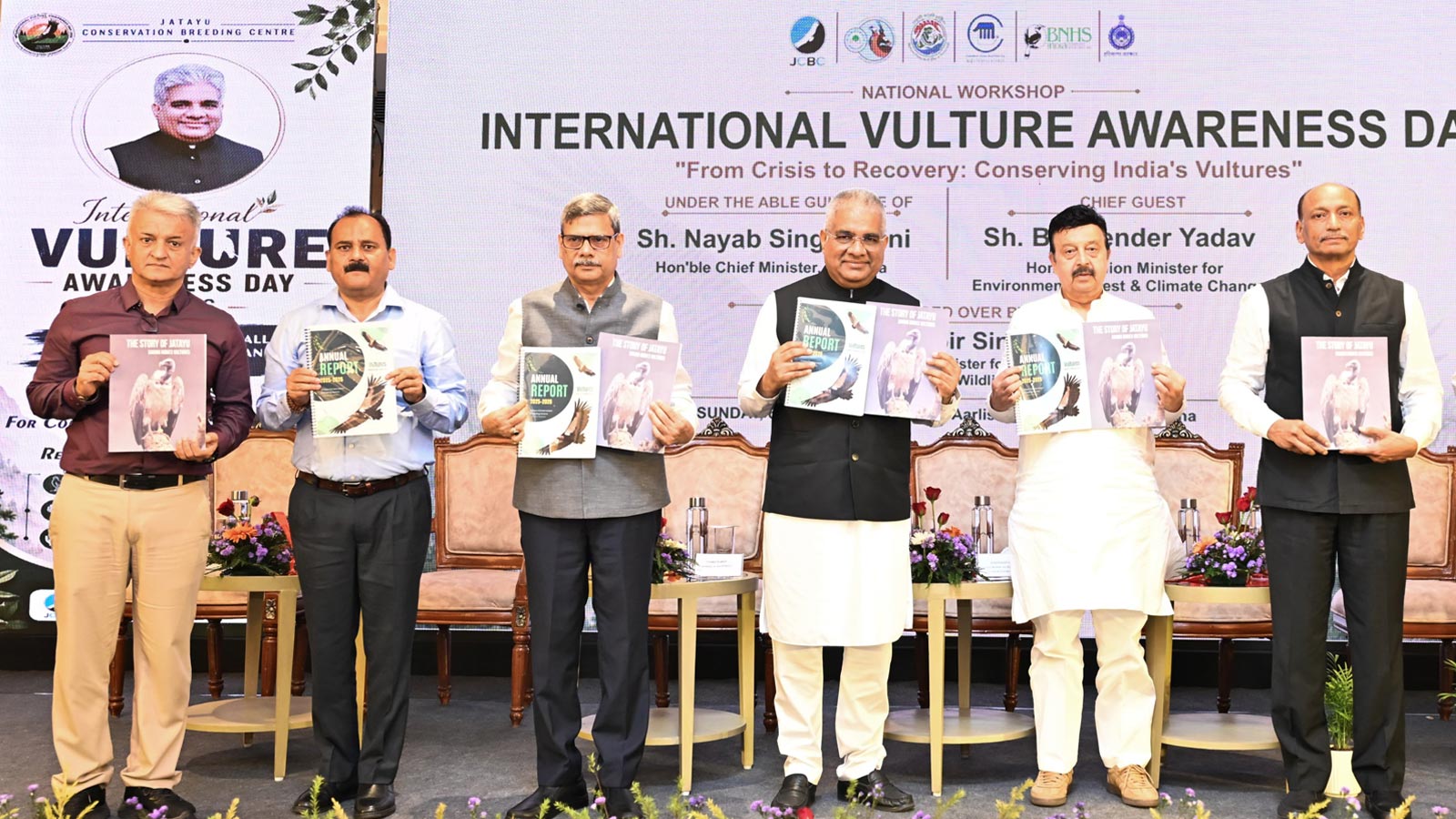
Union Environment Minister Bhupender Yadav on Sunday called for continued efforts to create Vulture Safe Zones and strengthen technical capacity to support the recovery of India’s declining vulture populations in the wild.
Yadav made the remarks while inaugurating a national workshop titled ‘From Crisis to Recovery – Conserving India’s Vultures’ in Panchkula, Haryana, as part of International Vulture Awareness Day 2026. Haryana Environment, Forest and Wildlife Minister Rao Narbir Singh and senior officials, scientists, veterinarians and conservation experts attended the event.
The workshop was organised jointly by the Ministry of Environment, Forest and Climate Change (MoEFCC), Central Zoo Authority, Haryana Forest and Wildlife Department, Bombay Natural History Society (BNHS) and Jatayu Conservation Breeding Centre (JCBC), Pinjore.
Highlighting the ecological importance of vultures, Yadav described them as nature’s highly efficient scavengers that help dispose of animal carcasses, recycle nutrients and maintain ecological balance. India is home to several resident and migratory vulture species, including the White-rumped, Long-billed, Slender-billed, Red-headed, Egyptian, Himalayan Griffon, Eurasian Griffon, Cinereous and Bearded vultures.
The minister noted that India’s vulture population witnessed a sharp decline from the 1990s, driven largely by disruption of their food chain and the use of veterinary painkillers whose residues could be fatal to vultures feeding on treated livestock carcasses.
Yadav called for a “Whole of Government” and “Whole of Society” approach to vulture conservation. He stressed the need for veterinary practices that are safe for vultures, assured availability of safe food sources, scientific capacity building and proper carcass management.
He also urged veterinary professionals, livestock owners, local administrations and communities to actively participate in conservation efforts and help create landscapes that are safe for vultures.
Earlier, Yadav visited the JCBC at Pinjore and reviewed its conservation-breeding programme. The centre, a collaboration between the Haryana Forest Department and BNHS, focuses on the conservation breeding of White-rumped, Long-billed and Slender-billed vultures.
During 2025-26, JCBC housed 356 vultures and successfully bred 35 chicks. It also released or contributed 87 vultures for reintroduction, transferred 90 birds to other conservation-breeding institutions and trained 1,222 participants from 22 institutions in vulture conservation techniques.
Singh said the success of conservation breeding should not be assessed merely by the number of birds born, but by the establishment of healthy and genetically managed populations, generation of scientific knowledge and development of technical capacity that ultimately contributes to species recovery in the wild.
A coffee table book titled ‘Story of Jatayu: Saving India’s Vulture’, documenting India’s vulture conservation journey from population decline to the development of successful conservation breeding programmes, was also released during the event.
The national workshop brought together forest officials, scientists, veterinarians, zoo professionals and conservation practitioners to strengthen coordination and advance vulture conservation through scientific research, policy support, conservation breeding, safe habitats and community participation.


