







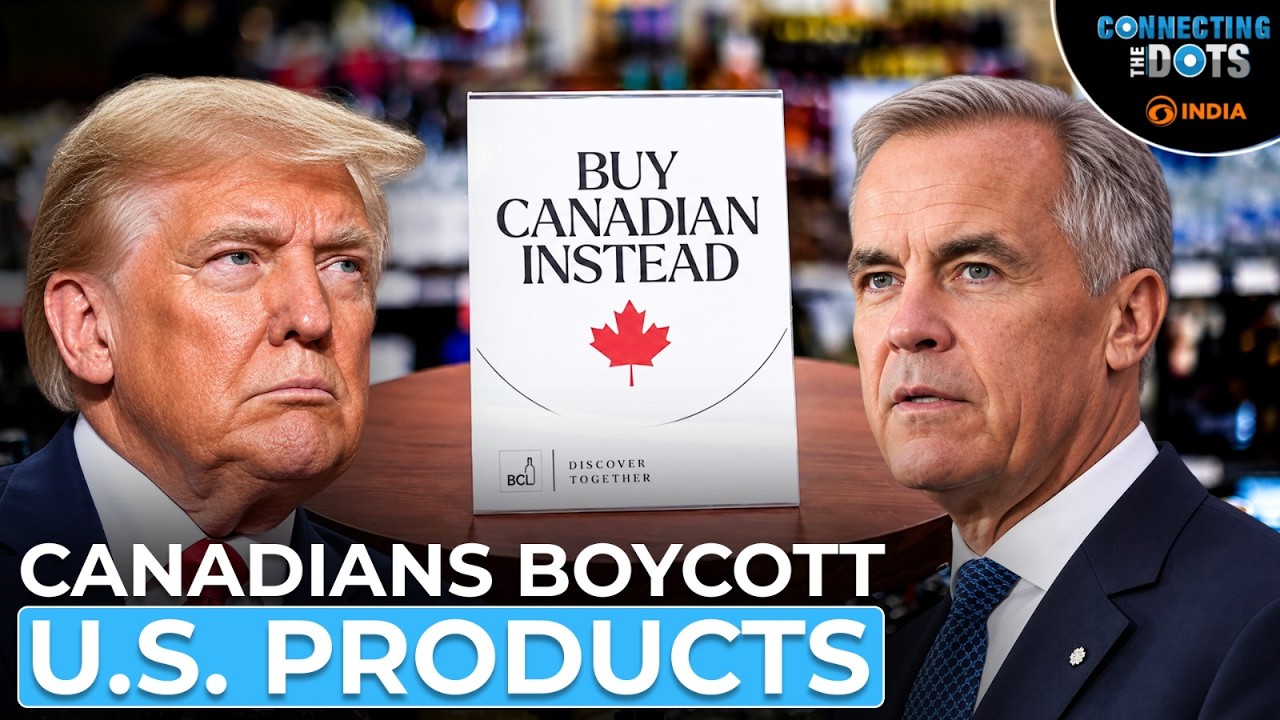
Canada is boycotting the United States, and not in a small way. Across grocery shelves, airports, living rooms and monthly subscription bills, millions of Canadians have quietly declared an economic strike against their closest neighbour.
YT Link: https://www.youtube.com/watch?v=l6xOywC2OHQ
Trade Talks Collapse, Tariffs Escalate
The move comes after months of escalating trade tensions. The United States slapped tariffs on Canadian goods. Canada hit back with tariffs of its own. Last month, trade talks between Washington and Ottawa completely collapsed.
Days later, the U.S. imposed a 50 percent tariff on nearly 20 billion dollars of Canadian goods, covering everything from furniture to wine. Canada matched it tit for tat, dollar for dollar.
The dispute goes beyond trade. Since early 2025, President Donald Trump has repeatedly suggested that Canada should become the 51st U.S. state, a comment that Canadian leaders have dismissed as ridiculous but that has deeply offended public sentiment. The anger intensified after an executive order renaming Lake Ontario to “Lake America.”
U.S. President Donald Trump has called Canada difficult to deal with on trade. “I find Canada to be the worst country to deal with. The most difficult country. With that being said, they’re dying to make a deal,” Trump said.
Canadian Prime Minister Mark Carney said Ottawa remains ready for a deal. “Canada is always ready to strike a fair deal. We believe there’s a mutually beneficial deal for Canada, the United States,” Carney said.
From Groceries To Streaming: What Canadians Are Boycotting
While the two governments talk, ordinary Canadians have already made up their minds.Cross-border travel searches have dropped by half. Streaming platforms like Netflix, Disney Plus, Amazon Prime and Apple TV are seeing cancellations. American cars like Teslas are sitting unsold on lots.
Shoppers are checking labels and skipping U.S. produce. Grocery chains have brought back maple leaf signs to flag what is actually Canadian. In liquor stores, people are replacing American brands like Jack Daniel’s and Jim Beam with local ones. Even coffee shops have joined in, renaming the Americano a “Canadiano” — same drink, different message.
Toronto resident Simon Ball said he supports the shift. “I would say buying Canadian goods is always a net positive, and relying less and less on the United States is the best possible outcome,” he said.
Toronto resident John Ambrad said the boycott is personal. “I try to avoid buying U.S. products. I’m a little bit mad with America right now. The attitude has just not been that of a friend,” he said.
Why Canada Depends Heavily On U.S. Imports
The boycott raises a bigger question: can Canada survive cutting ties with the country it depends on the most? Nearly half of everything Canada imports comes from the U.S. The reason is geography and math.
A truck can carry goods from California to Toronto in four or five days. A ship from overseas takes a month. That speed alone makes American goods cheaper. Add free trade rules like USMCA, which let most U.S. goods cross the border duty-free, and America becomes the easiest default supplier.
Economies Of Scale And Climate Barriers
Then there is economies of scale. The U.S. has more than 300 million consumers. Canada has around 40 million. A factory that produces for a larger market can spread its costs across millions of units, so each unit gets cheaper.
A Canadian factory serving a fraction of that market produces less, and pays more per unit. That is why vehicles and auto parts alone make up nearly 47 billion dollars of Canadian imports every year, alongside machinery, refined fuel and electronics.
Climate also limits domestic production. Canada’s long winters make it impossible to grow strawberries, citrus or leafy greens for months. Some goods are nearly impossible to produce at home, including bananas, coffee beans, advanced microchips and the pharmaceutical ingredients behind everyday medicines. Canada has to import them.
Beyond the U.S., Canada imports from China, Mexico, Germany and Japan to cover part of the gap, but those volumes are nowhere near what America supplies.
Uncertainty Hurts Business On Both Sides
The uncertainty is already hurting businesses. “I think the worst thing right now is the uncertainty. It’s very difficult for farmers, for business people to make investment decisions, and that increases costs in itself. And then tariffs are a tax,” said Michael Harvey, Executive Director of the Canadian Agri-Food Trade Alliance.
The relationship is not one-way. Canada’s crude oil feeds refineries in the U.S. Midwest built specifically to process it. Canadian factories build cars for American driveways. Its lumber frames American homes.
Every tariff and every boycotted product cuts both ways. The key question now is whether this boycott is a wave of national pride that fades once things de-escalate, or the start of a permanent shift in how Canada does business with its biggest neighbour.


