







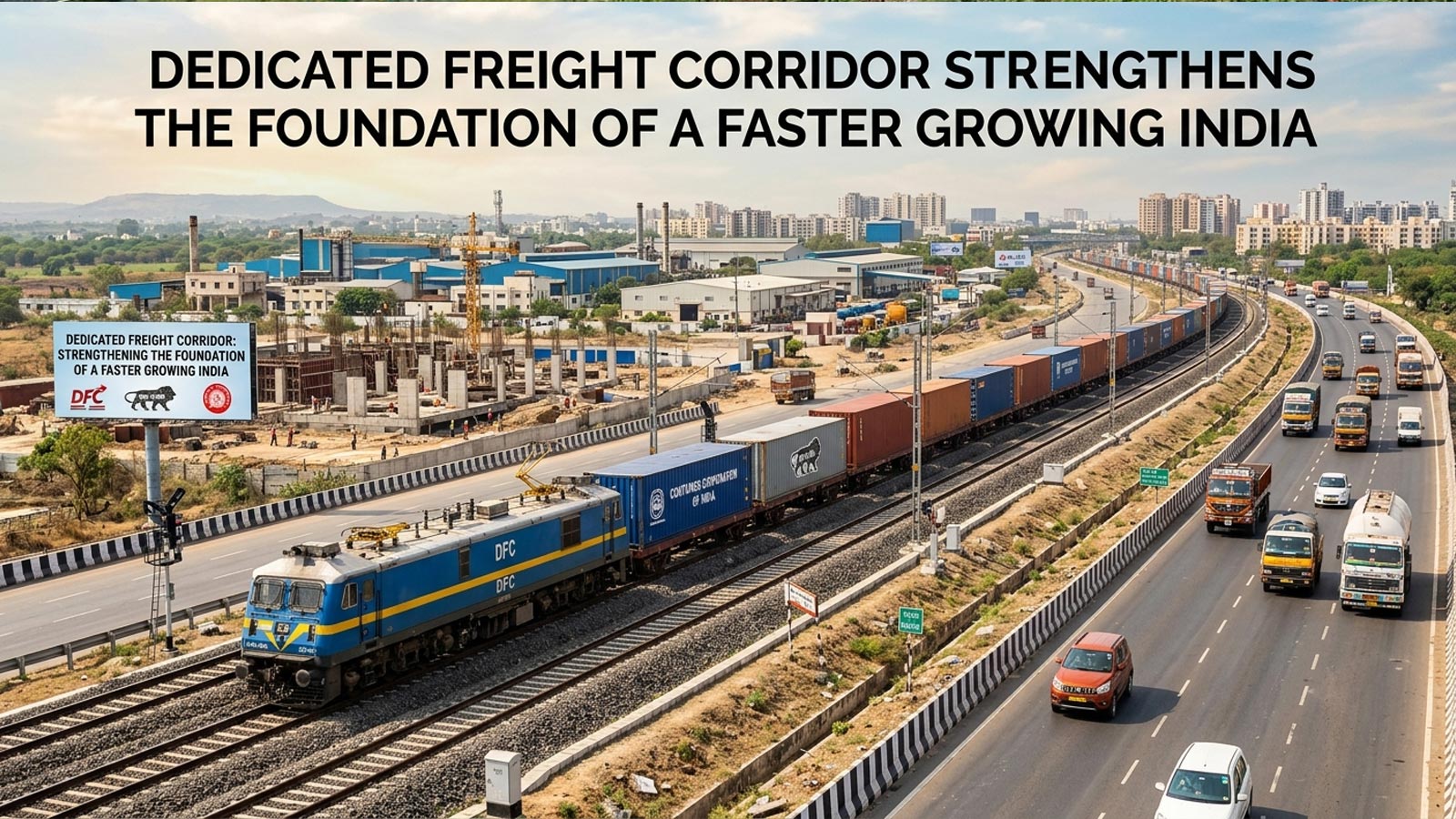
A country’s economic strength is closely linked to how efficiently it can move its goods. For a large and rapidly growing economy like India, faster, cheaper and more reliable freight transportation is not merely an infrastructure requirement, it is a foundation for economic growth. The completion of India’s Dedicated Freight Corridor (DFC) is therefore a landmark achievement that can have far-reaching benefits for farmers, industry, exporters and consumers.
Prime Minister Narendra Modi deserves appreciation for giving infrastructure development a central place in India’s growth strategy and for ensuring sustained momentum to major projects such as the Dedicated Freight Corridor. What was planned years ago as a solution to congestion on some of India’s busiest railway routes, has now become an important part of the country’s modern logistics network.
The Eastern Dedicated Freight Corridor runs from Ludhiana to Sonnagar for 1,337 km, while the Western Dedicated Freight Corridor connects Dadri with Jawaharlal Nehru Port for 1,506 km. Together, they cover 2,843 km. According to the Ministry of Railways, both corridors have now been completed and commissioned, with an average of more than 443 freight trains operating every day.
The importance of this achievement becomes clear when we understand the basic problem that the DFC seeks to address. Traditionally, freight and passenger trains have had to share railway infrastructure. Heavy freight movement on busy routes could therefore restrict capacity and affect the movement of both goods and passengers. Dedicated freight tracks create additional capacity specifically for goods trains and allow freight to move with greater speed and reliability.
The government has reported that the DFCs are already helping to reduce congestion on conventional railway routes, while enabling faster transit, higher throughput and improved reliability. By shifting freight traffic to dedicated corridors, additional paths are also being created on the conventional railway network for passenger and other services.
For Indian industry, this is a major advantage. A modern manufacturing economy depends not only on factories but also on an efficient supply chain connecting raw materials, production centres, warehouses, markets and ports. Delays in transportation increase costs and can make Indian products less competitive. Faster and more predictable freight movement can therefore strengthen the competitiveness of Indian manufacturing.
The Western Dedicated Freight Corridor has particular strategic importance because of its direct connectivity with Jawaharlal Nehru Port Authority. This connectivity will facilitate faster movement of export-import cargo, strengthen links between industrial centres and ports, reduce logistics costs and help decongest Mumbai’s railway network.
The benefits are not limited to large industries only. Farmers can also gain from better freight infrastructure. Agricultural products, particularly commodities that have to travel long distances, require reliable transportation to reach markets quickly. A more efficient rail freight system can help connect production centres with consumption centres and ports, creating greater opportunities for agricultural producers.
This is particularly important as India seeks to strengthen its position as a major manufacturing and export hub. The government’s logistics strategy aims to create a seamless multimodal transportation system in which railways, roads, ports, waterways and other modes complement one another. The PM GatiShakti National Master Plan provides an integrated framework for such development by bringing different ministries and infrastructure sectors onto a common planning platform.
The DFC also has an important environmental dimension. Rail is generally more energy-efficient than road transportation for moving large volumes of goods over long distances. The government has been working to increase the share of rail in freight transportation alongside initiatives aimed at reducing emissions and promoting greener logistics. The DFC’s electrified infrastructure and high-capacity freight operations can contribute to this broader objective.
Another important feature is the ability of the western DFC to handle double-stack container trains. This allows a large volume of cargo to be transported in a single movement and improves the efficiency of freight operations. Higher throughput means that more goods can be moved without a proportionate increase in infrastructure requirements.
The DFC also represents a significant change in the way India thinks about infrastructure. It is not an isolated railway project. It is part of a wider economic ecosystem involving industrial corridors, logistics parks, ports, warehouses and multimodal transportation. The government has emphasised that logistics infrastructure is essential for reducing costs, improving supply-chain efficiency and strengthening India’s competitiveness. The progress of the DFC is particularly noteworthy when viewed against its earlier history. The two corridors, covering 2,843 route kilometres, were originally planned to decongest the Delhi-Mumbai and Delhi-Howrah trunk routes.
This transformation reflects the importance that the Modi government has attached to completing large, long-term infrastructure projects. Such projects may take years to construct, but their economic benefits can last for decades. The DFC is an example of infrastructure being created not merely for today’s requirements but for the needs of a much larger Indian economy in the future.
Prime Minister Modi has repeatedly emphasised that infrastructure should serve as an engine of growth. The DFC reflects that philosophy in a very practical manner. Better freight movement means shorter transit times, lower logistics costs, greater reliability and improved market access. These advantages ultimately strengthen businesses and can create new employment opportunities.
The government’s larger logistics reforms reinforce this transformation. The National Logistics Policy, PM GatiShakti, the Logistics Data Bank and the Unified Logistics Interface Platform are aimed at making the movement of goods more efficient, transparent and technology-driven. Together with the DFC, they are helping build a logistics ecosystem suited to the requirements of a modern economy.
For India’s ambition of becoming a developed economy by 2047, such infrastructure will be indispensable. A larger economy will inevitably require much greater movement of raw materials, agricultural produce, manufactured goods and export-import cargo. The country therefore needs a freight network capable of handling this growth efficiently.
The Dedicated Freight Corridor provides exactly such a foundation. It can help Indian Railways carry more freight, free capacity on existing routes, improve connectivity between industrial centres and ports, reduce logistics costs and support more efficient supply chains.
The real significance of the DFC, therefore, goes far beyond its railway tracks. It represents time saved, costs reduced, markets connected and opportunities created. It strengthens the backbone of India’s manufacturing and trading economy while supporting the larger vision of a connected, competitive and self-reliant India.
Under Prime Minister Narendra Modi’s leadership, the completion of the Dedicated Freight Corridor marks an important milestone in India’s infrastructure journey. Its full potential will unfold over the coming years as industries, farmers, exporters and logistics operators increasingly use this modern freight network.
India is building infrastructure for the economy it wants to become. The Dedicated Freight Corridor is one of the clearest examples of this forward-looking approach. It is a project that can help India move not only goods faster, but also its economic ambitions faster.


