







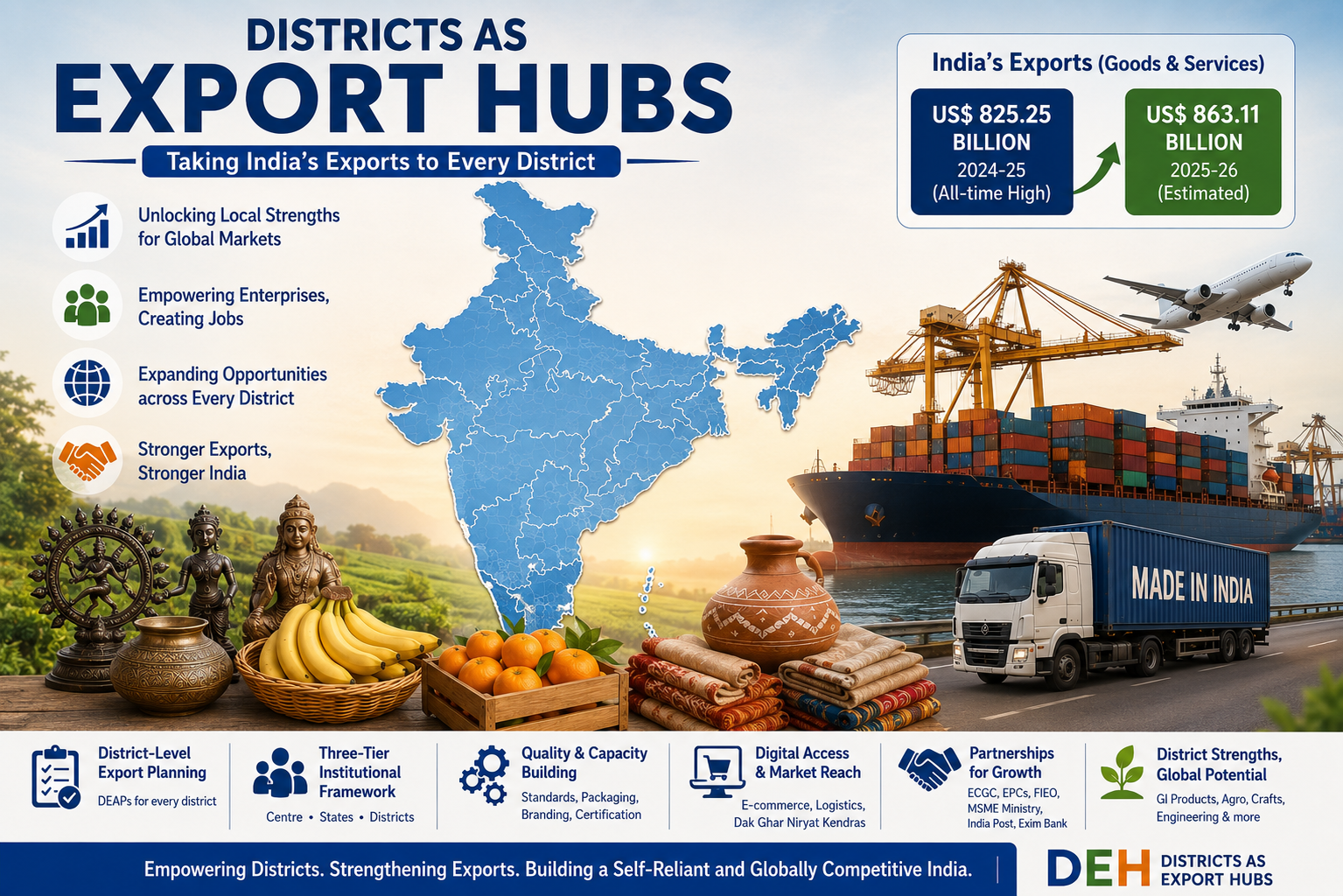
The Government is strengthening its district-led export strategy with the Districts as Export Hubs (DEH) Initiative, aimed at identifying products and services with global potential and connecting local producers with international markets.
The initiative seeks to make export growth more inclusive by leveraging the unique strengths of districts, supporting local enterprises and strengthening employment and manufacturing opportunities. It builds on the One District One Product (ODOP) approach by expanding the focus from product promotion to a broader export ecosystem.
India’s total exports of goods and services reached an all-time high of US$825.25 billion in 2024-25 and are estimated to have risen to US$863.11 billion in 2025-26, according to the PIB release.
However, export activity has traditionally remained concentrated in established industrial clusters and port cities. The DEH initiative seeks to tap the export potential of smaller towns, rural districts and remote regions by bringing their distinctive products into global markets.
Products such as Bastar’s iron craft, Jalgaon’s bananas and Meghalaya’s Mandarin oranges are among the examples cited as reflecting the untapped potential at the district level.
From ODOP to District-Level Export Planning
The DEH framework treats each district as a unit of export planning, rather than merely a unit of production.
While the ODOP initiative focused on identifying and promoting a distinctive product from each district, DEH takes a wider approach covering export promotion, market access, infrastructure, logistics and strengthening of the local export ecosystem.
As of January 2026, the initiative covered more than 770 districts across the country.
The initiative is a convergence framework rather than a separate funding scheme. It seeks to leverage existing Central and State government schemes to address district-specific export challenges and improve competitiveness.
Three-Tier Institutional Framework
The Districts as Export Hubs initiative operates through coordination between the Centre, States and districts.
The Department of Commerce provides overall policy direction, while the Directorate General of Foreign Trade (DGFT) anchors implementation, facilitates coordination and monitors progress.
At the State level, State Export Promotion Committees guide implementation and promote convergence among departments.
At the district level, District Export Promotion Committees (DEPCs) identify export opportunities, address local challenges and coordinate with exporters, industry and other stakeholders.
A key responsibility of the DEPCs is preparing District Export Action Plans (DEAPs). These plans identify products and services with export potential, assess infrastructure and logistics requirements, identify bottlenecks and recommend measures to improve competitiveness and market access.
As of March 2026, draft DEAPs had been prepared for 590 districts, of which 249 had been formally adopted by the respective DEPCs.
Focus on Quality, Digital Access and Export Readiness
The initiative also seeks to help local businesses meet international quality standards through awareness and capacity building related to testing, packaging, branding and certification.
Digital platforms are another important component of the strategy. Partnerships with e-commerce and logistics platforms are intended to provide MSMEs with more cost-effective access to international markets.
Dak Ghar Niryat Kendras are also being used to provide postal export facilities for documentation, packaging and small consignments.
DGFT Regional Authorities and district administrations are conducting capacity-building and awareness programmes covering export procedures, logistics planning, packaging norms and regulatory compliance.
Institutions including ECGC, Export Promotion Council for Handicrafts, FIEO, the Ministry of MSME, India Post and Exim Bank are supporting these efforts.
Supporting District-Specific Export Potential
The initiative covers a wide range of products and sectors, including GI-tagged products, agricultural clusters, toy clusters and engineering goods.
For example, Jalgaon has been identified for products including bananas and Bharit brinjal, while Bastar has potential in iron craft, rice, jowar and maize. Other districts have been mapped for products and sectors such as ceramics, tiles, minerals, agro-processing, glass, bamboo craft and cashew.
The Government has also partnered with Exim Bank under its Grassroots Initiatives for Development programme. Six districts — Anantapur, Raipur, Solan, Tiruppur, Kanpur and Kolhapur — have been selected for support under the programme.
Tiruppur, known as India’s knitwear capital, recorded exports of ₹46,000 crore in FY 2025-26, according to the release. The Tiruppur Exporters Association has set a target of ₹1 trillion in exports by 2030.
Focused Implementation From June 2026
To accelerate implementation, the Government adopted an outcome-oriented and phased approach under the DEH initiative from June 1, 2026.
The first phase covers districts across 27 States and Union Territories, with support from 24 DGFT Regional Authorities and 11 partner agencies.
The focus is on measurable outcomes, including new exporter registrations and increasing export values through convergence of existing Central and State schemes, as well as leveraging GI products and MSME clusters.
The Government sees the Districts as Export Hubs initiative as a shift from an export strategy centred largely on established industrial centres to one that seeks to unlock the potential of districts across the country.


