







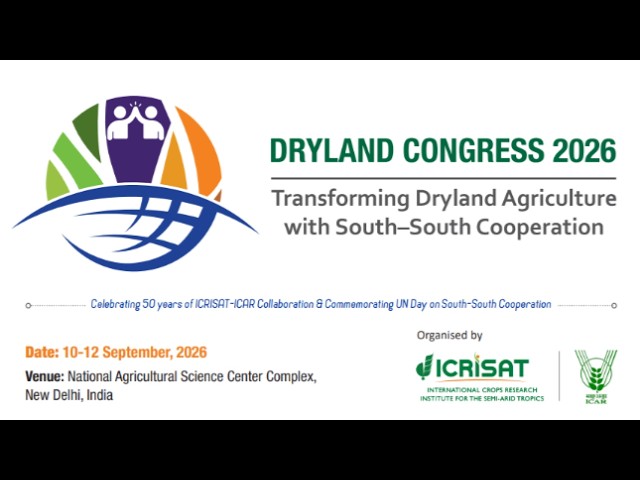
The three-day Dryland Congress 2026 concluded in New Delhi on Sunday with the adoption of the Delhi Declaration on Drylands (3D), calling for greater collaboration, knowledge exchange, innovation and collective action to transform dryland agriculture across the Global South.
The Congress, held under the theme “Transforming Dryland Agriculture with South–South Cooperation,” concluded on the United Nations Day for South-South Cooperation and brought together governments, research institutions, development partners and experts to deliberate on ways to build resilient and sustainable dryland agri-food systems.
The Delhi Declaration was endorsed at the closing plenary by participating governments, institutions, partners and delegates. It sets out a shared agenda for strengthening dryland agriculture through South-South and triangular cooperation.
Addressing the valedictory session, Dr M.L. Jat, Secretary, Department of Agricultural Research and Education (DARE) and Director General, Indian Council of Agricultural Research (ICAR), stressed the need to place foresight at the centre of efforts to address the challenges facing dryland agriculture.
He called for a strong institutional mechanism for foresight and said the ICAR-National Institute of Agricultural Economics and Policy Research (ICAR-NIAP) should be mandated to lead foresight work on dryland agriculture.
Dr Jat also underlined the importance of robust data and information systems for dryland agri-food systems and called for common innovation grounds or living laboratories that can connect research with practices and policy.
Dr Himanshu Pathak, Director General, ICRISAT, highlighted the strategic importance of drylands for global food security and called for translating the deliberations of the Congress into concrete action.
He emphasised the need to prioritise the recommendations into short- and long-term actions and move from ideas and concepts to implementation by bringing together expertise, knowledge and partnerships.
The valedictory session also saw the announcement of new partnerships and collaborations aimed at strengthening innovation and action in dryland agriculture.
New agreements and Memoranda of Understanding were announced with the Global Crop Diversity Trust. ICRISAT also exchanged MoUs with Avior Life Sciences, NIFTEM, Wipro Limited, and the Angul and Rayagada district administrations of Odisha.
The Co-Chairs of the Congress, Dr D.K. Yadava, Deputy Director General (Crop Science), ICAR, and Dr Stanford Blade, Deputy Director General (Research & Innovation), ICRISAT, presented a summary of the three-day deliberations and outlined key outcomes and recommendations.
Focus on South-South cooperation
The final day began with a Commemoration Ceremony for the UN Day for South-South Cooperation, featuring messages from UN Secretary-General António Guterres, FAO Director-General and UNOSSC Director Dima Al-Khatib.
Dr Pathak presented the vision of the International Solidarity for South-South Cooperation in Agriculture (ISSCA) and highlighted the importance of stronger partnerships across the Global South.
Representatives from ICRISAT, ICAR, CGIAR, RIS, NABARD and the CGIAR Capacity Sharing Accelerator reaffirmed their commitment to advancing South-South cooperation and creating greater impact in agriculture.
A subsequent session titled “Knowledge Without Borders: Advancing South–South and Triangular Cooperation”, convened with CGIAR, examined ways to make South-South and triangular cooperation more effective and scale up successful agricultural models.
Experts and representatives from national agricultural research systems in Ethiopia, Senegal, Brazil, China and India, along with representatives from CGIAR, FARA and APAARI, shared their experiences and perspectives.
ISSCA Global Awards recognise agricultural innovations
The Congress also featured the ISSCA Global Awards 2026, which recognise proven agricultural innovations from institutions across the Global South with potential for large-scale adoption and cross-country adaptation.
The inaugural edition received 170 nominations from 34 countries spanning Asia, Southeast Asia, Africa, the Middle East, and Latin America and the Caribbean.
The ISSCA Global Award for Transformative Excellence, or Mega Award, was presented to ICARDA, Lebanon, for heat-tolerant wheat varieties under the TAAT Wheat Compact Technologies initiative; CIMMYT, Mexico, for e-Agrology 360; and Odisha Livelihoods Mission, Government of Odisha, for Women-Led Sustainable Farming for Nutrition and Rural Resilience.
Awards were also presented across categories including crop improvement and production technologies, natural resource management and climate resilience, agribusiness and market systems, digital agriculture, and livestock improvement and production technologies.
Among the recognised initiatives were BARI Chinabadam-9 of Bangladesh Agricultural Research Institute, GPBD 4 of the University of Agricultural Sciences, Dharwad, Karnataka’s Krishi Bhagya initiative, Bihar’s Aahar-Pyne landscape rejuvenation programme, Andhra Pradesh’s APMIP Digital Ecosystem and Gujarat’s Krushi Pragati.
The livestock category recognised WorldFish’s improved carp seed system in Bangladesh and the International Livestock Research Institute’s Participatory Indigenous Chicken Breed Improvement Program in Kenya.
Sixteen Best Poster Awards were also presented to students and research scholars for promising research and emerging scientific talent in dryland agriculture.


