







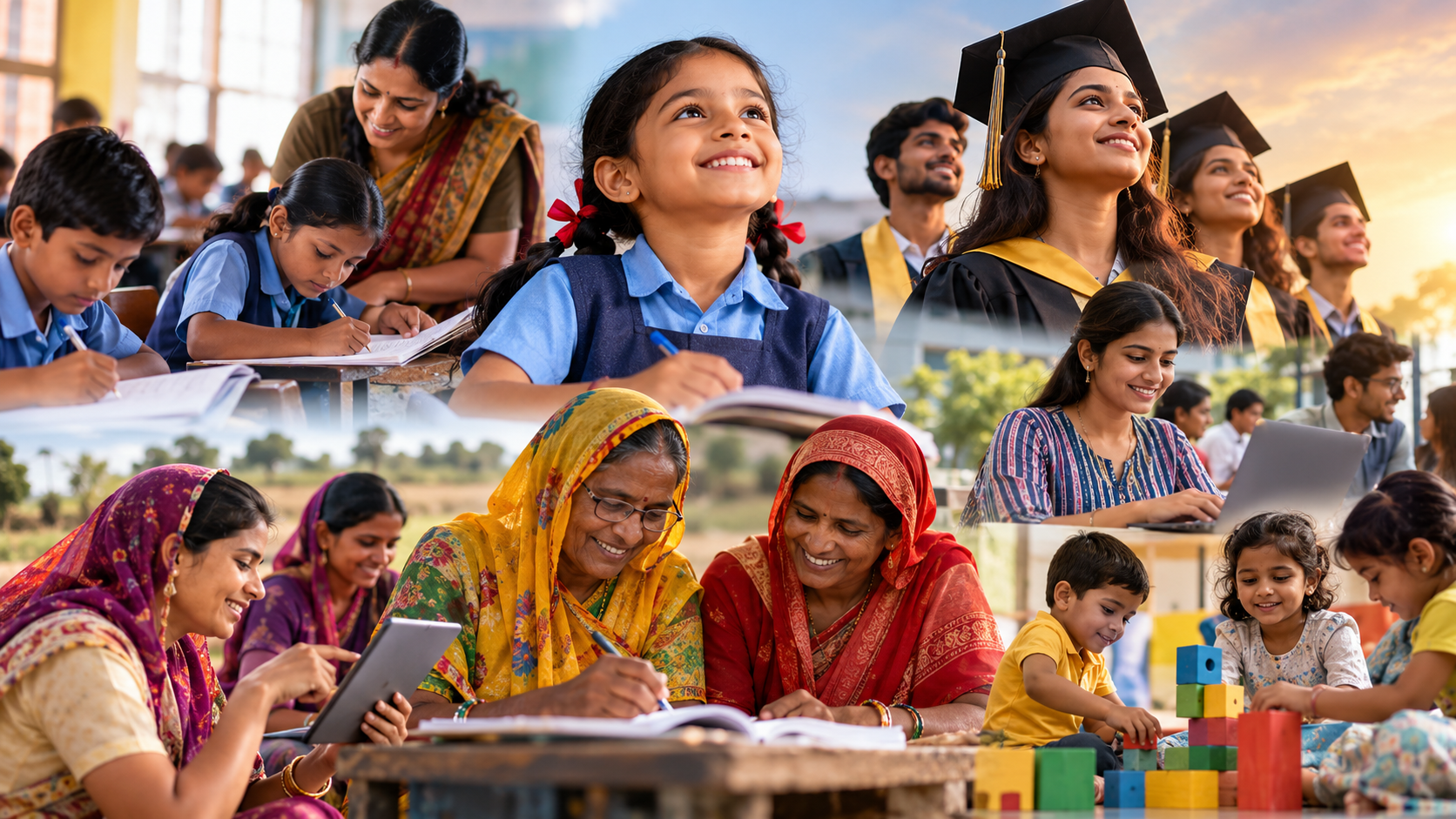
Literacy has emerged as an important pillar of India’s development journey, moving beyond the ability to read and write to include numeracy, digital skills, financial literacy and other competencies needed to participate meaningfully in society and the economy.
India’s literacy rate has increased substantially since Independence. From 18.32 per cent in 1951, the literacy rate rose to 74.04 per cent in 2011. According to the Periodic Labour Force Survey (PLFS) 2025, the overall literacy rate has reached 81.1 per cent.
What is literacy?
The Department of School Education and Literacy defines literacy as the ability to read, write and compute with comprehension, including the ability to identify, understand, interpret and create. It also includes critical life skills such as digital and financial literacy.
The department considers a literacy rate of 95 per cent in a State or Union Territory as equivalent to full literacy.
UNESCO also views literacy as a foundational skill that enables people to use reading, writing and numbers, as well as digital tools, to solve problems and participate in work, learning and everyday life.
How has India’s literacy rate improved?
India has recorded significant progress in literacy over the decades.
The overall literacy rate increased from 18.32 per cent in 1951 to 74.04 per cent in 2011. Male literacy rose from 27.15 per cent to 82.14 per cent during the same period, while female literacy increased from 8.86 per cent to 65.46 per cent.
The improvement has also been visible in rural and urban areas. Urban literacy increased from 34.59 per cent in 1951 to 84.1 per cent in 2011, while rural literacy rose from 12.10 per cent to 67.8 per cent.
Between 2001 and 2011, rural female literacy increased by 26 per cent, compared with a 10 per cent rise among rural males.
According to PLFS 2025, literacy among people aged seven years and above stood at 89 per cent in urban areas and 77.4 per cent in rural areas. Among the same age group, male literacy was 93.1 per cent in urban areas and 84.8 per cent in rural areas, while female literacy was 84.8 per cent and 70.3 per cent respectively.
What does the latest school education data show?
Improving literacy also depends on ensuring that children enter school, remain in the education system and progress through different stages.
According to the UDISE+ Report 2025-26, more than 24.72 crore students were enrolled in schools.
The Gross Enrolment Ratio stood at 42.8 per cent at the Foundational stage, 91.7 per cent at the Preparatory stage, 89.6 per cent at the Middle stage and 71.7 per cent at the Secondary stage.
Dropout rates were recorded at 1.8 per cent at the Preparatory stage, 3.6 per cent at the Middle stage and 7 per cent at the Secondary stage.
Transition rates also indicate the movement of students between stages of education. The transition rate from the Foundational to the Preparatory stage stood at 99.2 per cent, while it was 93.8 per cent from Preparatory to Middle and 88.3 per cent from Middle to Secondary.
What about higher education?
Participation in higher education has also expanded over the past decade.
Student enrolment increased from 3.42 crore in 2014-15 to 4.50 crore in 2023-24. During the same period, the Gross Enrolment Ratio in higher education increased from 23.7 per cent to 30 per cent.
The number of students completing higher education also rose from 88.28 lakh in 2014-15 to more than 1.09 crore in 2023-24.
The government has linked these efforts with the National Education Policy 2020 target of achieving a 50 per cent higher education Gross Enrolment Ratio by 2035.
ULLAS: Expanding literacy among adults
One of the key initiatives for adult literacy is ULLAS — Understanding of Lifelong Learning for All in Society, also known as the New India Literacy Programme.
The centrally sponsored scheme focuses on people aged 15 years and above who missed formal schooling. It provides functional literacy, numeracy, critical life skills and opportunities for lifelong learning.
The programme follows the vision of ‘Jan Jan Saakshar’ and encourages volunteerism and community participation under the principle of Janbhagidari.
ULLAS uses a hybrid learning model. Its mobile application is available on iOS and Android and provides learning material in 27 languages.
Learners are identified through surveys at the district and block levels. Volunteers, including teachers, civil society workers, ASHA workers and Anganwadi workers, can support learners through the programme.
After completing the learning process, participants appear for the Foundational Literacy and Numeracy Assessment Test, or FLNAT, followed by evaluation and certification.
The programme aims to cover five crore learners between 2022 and 2027, with a financial outlay of ₹1,037.90 crore.
So far, around 4.03 crore learners have registered under ULLAS, along with more than 52.20 lakh volunteers. More than 3.3 crore learners have participated in the FLNAT.
Ten States and Union Territories — Ladakh, Mizoram, Goa, Tripura, Himachal Pradesh, Chandigarh, Andaman and Nicobar Islands, Sikkim, Uttarakhand and Jammu and Kashmir — have declared themselves fully literate between 2024 and 2026.
NIPUN Bharat: Focus on foundational learning
While ULLAS focuses on adult literacy, NIPUN Bharat addresses foundational learning among children.
Launched in July 2021 under Samagra Shiksha, the National Initiative for Proficiency in Reading with Understanding and Numeracy aims to achieve universal foundational literacy and numeracy by 2026-27.
The mission focuses on children in the Foundational Stage, covering the age group of three to eight years, with the objective of ensuring that children acquire foundational skills by Grade 2.
Other initiatives supporting education
Several other government programmes complement literacy and foundational learning efforts.
Samagra Shiksha focuses on school effectiveness, equal opportunities and improved learning outcomes. It also supports foundational learning, teacher development and vocational integration.
PM SHRI, or Pradhan Mantri Schools for Rising India, seeks to strengthen more than 14,500 exemplar schools and promote a holistic, inclusive and equitable learning environment.
PM e-VIDYA brings together digital, online and on-air education initiatives to provide multiple modes of learning and is expected to benefit nearly 25 crore school-going children.
PM POSHAN provides one hot cooked meal to 11.20 crore students in Bal Vatika and Classes I to VIII across 10.36 lakh government and government-aided schools on all school days. The scheme aims to provide nutritional support while encouraging school participation.
Literacy matter for Viksit Bharat
Literacy has implications beyond the education sector. It can support employment, productivity, economic participation, women’s empowerment and social inclusion.
The backgrounder links literacy and education with Sustainable Development Goal 4, which focuses on inclusive and equitable quality education and lifelong learning opportunities for all.
For India’s development vision, literacy is increasingly being viewed as part of a broader skill set that includes digital capabilities, financial understanding, foundational learning and lifelong education.
The road ahead
India’s literacy journey has moved from a focus primarily on basic reading and writing towards a broader understanding of learning and participation.
NEP 2020, ULLAS and NIPUN Bharat represent different components of this approach — from foundational learning among children to adult education and lifelong learning.
The government backgrounder notes that continued implementation, along with greater attention to regional and gender disparities, will be important to ensure that the benefits of literacy reach all sections of society.
As India works towards the vision of Viksit Bharat, literacy and education remain central to building a skilled, informed and empowered population.


