







India’s fisheries sector is emerging as a significant driver of livelihoods, food security, exports and the country’s wider Blue Economy, with the government’s Pradhan Mantri Matsya Sampada Yojana (PMMSY) providing a major push towards modern infrastructure, technology and sustainable growth.
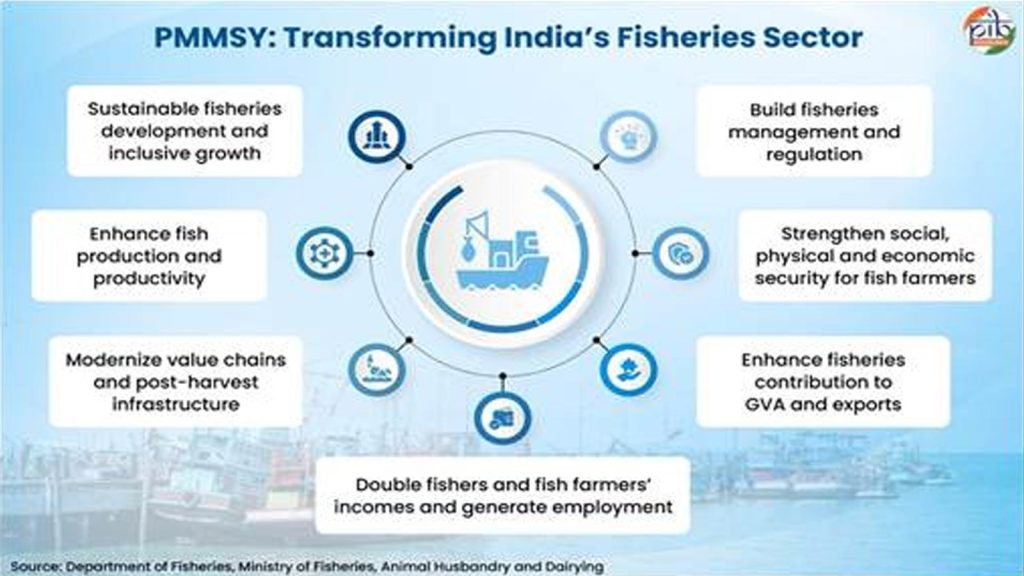
Launched in 2020, PMMSY completes six years on September 10, 2026. With a total outlay of ₹20,750 crore, the scheme has sought to address critical gaps across the fisheries value chain, from production and aquaculture to post-harvest management, marketing and fisher welfare.
The government has further reinforced its commitment by allocating a record ₹2,500 crore under PMMSY in Budget Estimates 2026–27. As of August 11, 2026, the Department of Fisheries had approved fisheries and aquaculture projects worth ₹21,394.88 crore, including a Central share of ₹9,510.89 crore, based on proposals from States, Union Territories and implementing agencies.
Production and Exports on the Rise
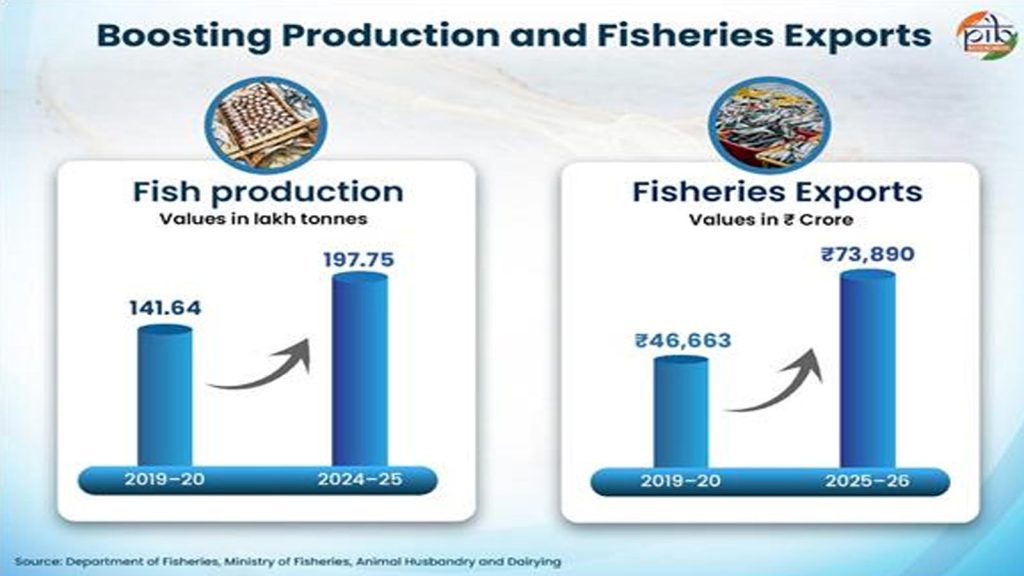
The impact of the sectoral push is reflected in India’s fish production. It rose from 141.64 lakh tonnes in 2019–20 to a record 197.75 lakh tonnes in 2024–25.
Fisheries exports have also expanded substantially, increasing from ₹46,663 crore in 2019–20 to ₹73,890 crore in 2025–26. At the same time, PMMSY has created direct and indirect employment opportunities for 58 lakh people in fisheries and aquaculture-related activities.
The sector itself sustains nearly three crore livelihoods, particularly among marginalised and coastal communities, making its development important not only for economic growth but also for rural and coastal livelihoods.
Building a Modern Fisheries Value Chain
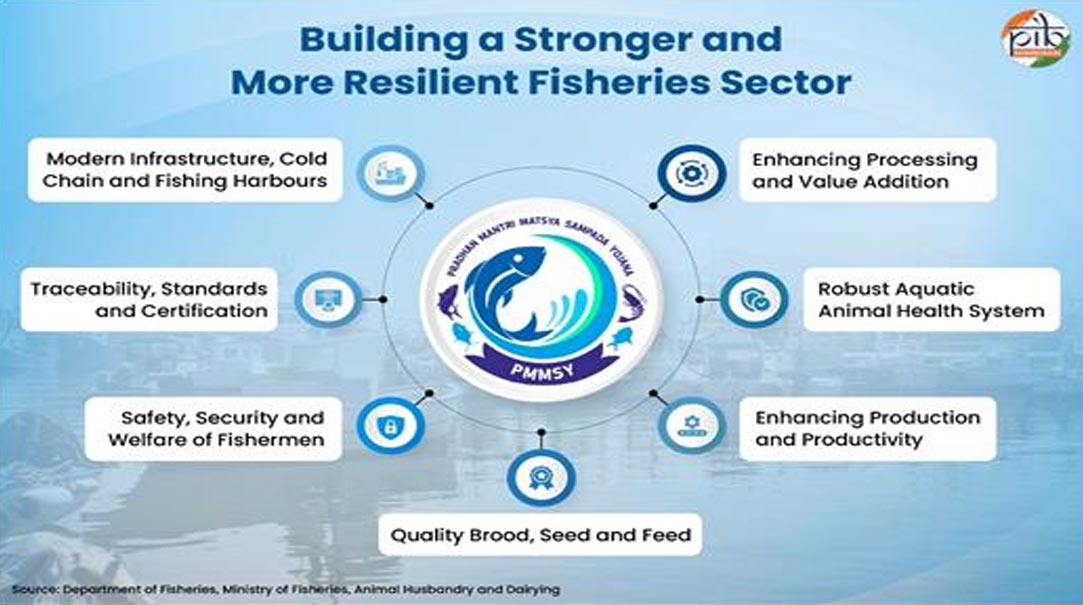
PMMSY has focused on strengthening the entire fisheries ecosystem rather than production alone. Investments have targeted fishing harbours, landing centres, cold chains, transportation, markets and post-harvest infrastructure.
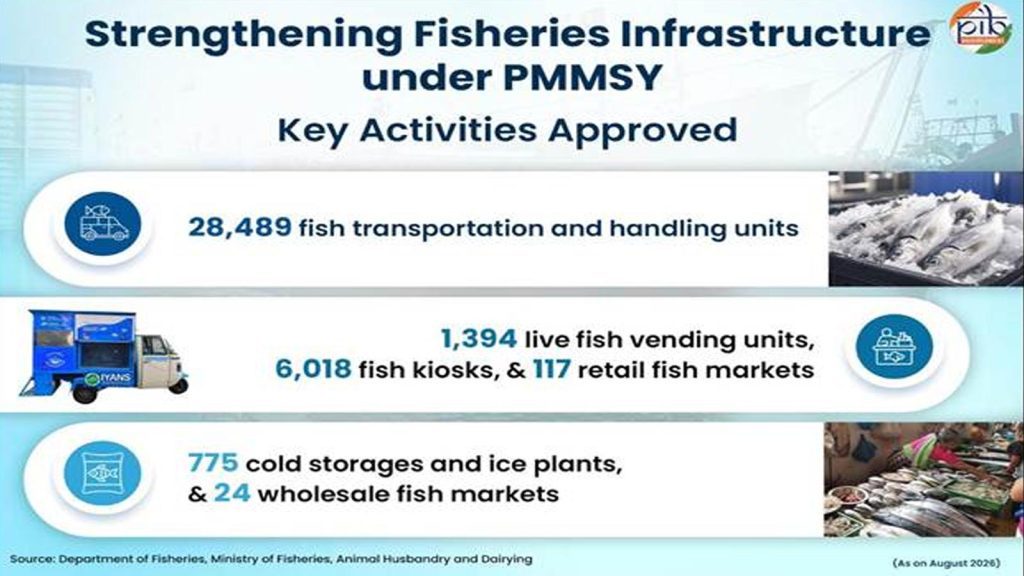
The government has approved ₹2,797 crore for cold-chain and marketing infrastructure. This includes support for 28,489 fish transportation units, 775 cold storage and ice plants, 1,394 live fish vending units, 6,018 fish kiosks, 117 retail fish markets and 24 wholesale fish markets.
Over the last five years, ₹3,741.89 crore has also been approved for 28 fishing harbour development or modernisation projects, 25 fish landing centres and 23 dredging projects.
The expansion of infrastructure is aimed at reducing post-harvest losses, improving fish quality and connecting producers more efficiently with markets.
Technology Reshaping Aquaculture
PMMSY is also promoting technology-driven aquaculture to increase productivity while making more efficient use of land and water.
The scheme has supported 12,081 Recirculatory Aquaculture Systems (RAS) and 4,205 Biofloc units, alongside 52,058 reservoir cages and 23,285.06 hectares of pond area for inland aquaculture.
Twelve Integrated Aquaparks have been approved at a cost of ₹713.80 crore, while projects worth ₹198.17 crore have been approved for seaweed cultivation and allied activities during 2020–25. The scheme has additionally supported 2,672 ornamental fish rearing and integrated ornamental fish units.
These interventions are intended to improve productivity, resource efficiency and sustainability while opening new opportunities for aquaculture entrepreneurs.
Empowering Fishers Through Collective Action
An important dimension of PMMSY is the effort to strengthen the economic position of small fishers and fish farmers through collective organisations.
Between FY 2021–22 and FY 2025–26, projects worth ₹544.86 crore were approved to establish 2,195 Fish Farmers Producer Organisations (FFPOs). The support covers incubation, management costs and equity grants, helping producers improve bargaining power and market access.
The scheme has also identified 100 Climate Resilient Coastal Fishermen Villages. Each village is eligible for support of ₹200 lakh, fully funded by the government, for resilient infrastructure, livelihood opportunities and post-harvest facilities.
From Ice Plant to Greater Prosperity
The impact of targeted support can be seen in individual enterprises as well. In Porbandar, Gujarat, fishing entrepreneur Pravinbhai Babulal Masani used a ₹48 lakh PMMSY subsidy received in 2021–22 to establish a 30 MT-per-day ice plant.
The facility enables fishing boats to carry adequate ice to preserve their catch during fishing operations, reducing spoilage and improving the efficiency of the fishing business. The investment has strengthened his enterprise and improved his family’s livelihood.
Digital Fisheries Ecosystem
The transformation is increasingly moving into the digital domain. The National Fisheries Digital Platform (NFDP) was launched under the Pradhan Mantri Matsya Kisan Samridhi Sah-Yojana (PM-MKSSY) in September 2024.
The platform is designed to formalise the fisheries sector by creating digital identities and a comprehensive stakeholder database. It provides a single-window system through which beneficiaries can access institutional credit, aquaculture insurance, traceability mechanisms and performance-linked incentives.
As of September 8, 2026, NFDP had recorded more than 37.01 lakh individual registrations, with total registrations crossing 37.23 lakh.
PM-MKSSY itself operates as a Central Sector sub-scheme under PMMSY from 2023–24 to 2026–27, with an estimated financial outlay of ₹6,000 crore. Its focus includes formalisation, insurance, institutional finance, quality assurance and traceability across the fisheries value chain.
Towards a Sustainable Blue Economy
PMMSY’s broader significance lies in its attempt to combine economic growth with sustainability. Modern aquaculture systems such as RAS, Biofloc, cage culture and mariculture are being promoted alongside measures aimed at responsible fisheries management and aquatic resource conservation.
The approach also contributes to Sustainable Development Goal 14—Life Below Water, which focuses on the sustainable use and conservation of oceans and aquatic resources.
Six years after its launch, PMMSY has evolved into a broad-based effort to modernise India’s fisheries sector—from boats, harbours and cold chains to aquaculture technology, producer organisations and digital platforms.
With fish production and exports reaching new highs, the government’s continuing investment is aimed at creating a more productive, resilient and competitive fisheries economy. As India expands its Blue Economy, the sector is increasingly positioned not merely as a traditional livelihood activity, but as an important engine of employment, food security, exports and sustainable economic growth.


