







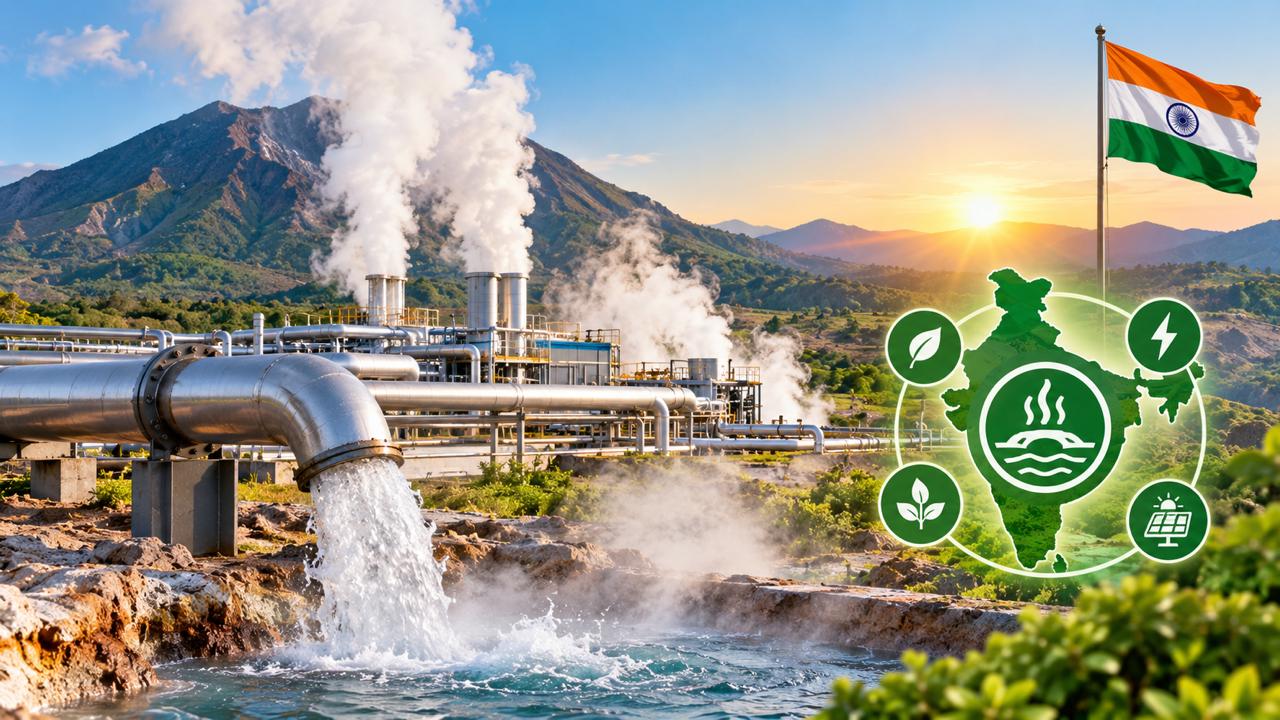
India is looking to tap its vast geothermal energy potential as part of its transition towards a cleaner and more diversified energy mix, with the government aiming to develop the resource as a reliable, low-carbon source of power and heat.
Geothermal energy harnesses heat from deep within the Earth to generate electricity or provide direct heating and cooling. Unlike solar and wind power, it can provide energy round the clock and is largely independent of weather conditions.
The government notified the National Policy on Geothermal Energy in September 2025, laying down a framework for systematic exploration, development and utilisation of the country’s geothermal resources. The Ministry of New and Renewable Energy (MNRE) is the nodal ministry for implementing the policy.
India reached a significant milestone in July 2026 when the ONGC Energy Centre commissioned the country’s first two geothermal wells in Puga Valley, Ladakh. Located at an altitude of more than 14,000 feet, Puga is considered one of India’s most promising geothermal sites because of its hot springs and underground heat resources.
The two wells, each about 1,000 metres deep, will facilitate reservoir evaluation and support the development of India’s first 1-MW demonstration geothermal power project.
India’s geothermal potential
The Geological Survey of India (GSI) has mapped 381 hot springs and identified 10 geothermal provinces across the country. India’s theoretical geothermal potential is estimated at nearly 10.6 GW, with 42 sites identified as promising for power generation and direct heat applications.
The identified provinces include the Himalayan Geothermal Province, Naga-Lusai, Andaman and Nicobar Islands, Son-Narmada-Tapi (SONATA), West Coast, Cambay Graben, Aravalli, Mahanadi, Godavari and South Indian Cratonic regions.
India’s geothermal rift basins offer significant potential because of their favourable geological and tectonic conditions. However, suitable projects could be developed wherever viable geothermal resources are available. Emerging technologies such as Enhanced Geothermal Systems (EGS) and Advanced Geothermal Systems (AGS) could further expand the areas suitable for geothermal development.
How geothermal energy works
The Earth’s interior comprises four principal layers — the crust, mantle, outer core and inner core. Temperatures increase with depth, with the mantle reaching about 3,700 degrees Celsius near its boundary with the core, while temperatures in the core can range between 5,000 and 6,000 degrees Celsius.
Much of the Earth’s internal heat comes from radioactive decay of elements such as uranium, thorium and potassium, along with residual heat from the planet’s formation.
In geologically active regions, faults and fractures allow heat to move closer to the surface, creating reservoirs of hot water and steam within permeable rocks. These resources can be accessed through deep wells.
For electricity generation, hot water and steam brought to the surface can drive turbines connected to generators. The process is similar to conventional thermal power generation, except that geothermal systems use naturally occurring underground heat instead of burning fuel.
After power generation, the water can be condensed and reinjected into the reservoir, helping sustain the resource and support continued production.
Geothermal heat can also be used directly for applications such as district heating, agriculture, aquaculture, and space heating and cooling.
Repurposing oil and gas wells
The government is also exploring the potential to repurpose abandoned or unproductive oil and gas wells for geothermal applications, subject to technical and operational feasibility.
Such projects could benefit from existing drilling expertise, geological data and infrastructure developed by the oil and gas industry, potentially reducing some of the costs and challenges associated with new geothermal exploration.
India expands geothermal research
India is moving from resource assessment towards field demonstrations. Between July and August 2025, MNRE sanctioned five research and development projects covering resource assessment, indigenous technology development and field demonstrations for electricity generation as well as heating and cooling applications.
Government-supported projects include a pilot initiative at Ankleshwar, Gujarat, to assess electricity generation by retrofitting unproductive oil and gas wells. Field investigations and baseline geological and production data have been completed.
At Gandhinagar, Gujarat, a demonstration project combining solar and geothermal energy has drilled three geothermal wells producing geothermal fluid at temperatures of 70-80 degrees Celsius. The project has demonstrated electricity generation of 50-90 kilowatts.
In Tawang, Arunachal Pradesh, studies are being conducted at five geothermal sites through field investigations and geochemical analysis to assess the region’s resources.
A research project in Hyderabad is developing a geothermal cooling system for air-conditioning applications through modelling and performance analysis. Another pilot project is developing analytical models for shallow geothermal systems using borehole heat exchangers for heating and cooling.
These initiatives are generating technical data and field experience needed to assess the feasibility of larger-scale commercial deployment.
Policy and international cooperation
The National Policy on Geothermal Energy seeks to establish geothermal power as an important component of India’s renewable energy portfolio. It prioritises exploration, drilling, reservoir management, research and development, and direct-use applications.
The policy also promotes Ground Source Heat Pumps for heating and cooling, encourages public and private sector participation, and provides for a national geothermal data repository, pilot projects and Centres of Excellence.
MNRE’s Renewable Energy Research and Technology Development (RE-RTD) programme is supporting the development of indigenous and cost-effective renewable energy technologies, including geothermal applications, through research institutions and industry partners.
India has also identified geothermal energy as an area of cooperation with Australia and Iceland. An MoU with Saudi Arabia has similarly identified geothermal energy as a focus area for bilateral engagement, creating opportunities for technology development, knowledge exchange and international collaboration.
A new dimension to India’s renewable energy mix
Globally, geothermal power capacity reached 15.67 GW by the end of 2025, with Indonesia, the US, the Philippines, Türkiye and New Zealand accounting for around 67 per cent of the installed capacity.
For India, geothermal energy remains at an early stage of development, with commercial-scale power generation yet to be established. However, resource mapping, pilot projects, research initiatives and international partnerships are gradually building the foundation for a wider geothermal ecosystem.
With a theoretical potential of nearly 10,600 MW, geothermal energy could add a dependable, indigenous source to India’s renewable energy portfolio while supporting applications beyond electricity, including heating, cooling, agriculture and tourism.
As India works towards its Net Zero target for 2070, geothermal energy is emerging as another potential pillar of the country’s long-term clean energy transition.


