







India’s rapidly expanding aquaculture sector is increasingly confronting a challenge that can undermine years of investment in a single crop cycle – the financial impact of disease, floods, cyclones and other natural and non-preventable risks.
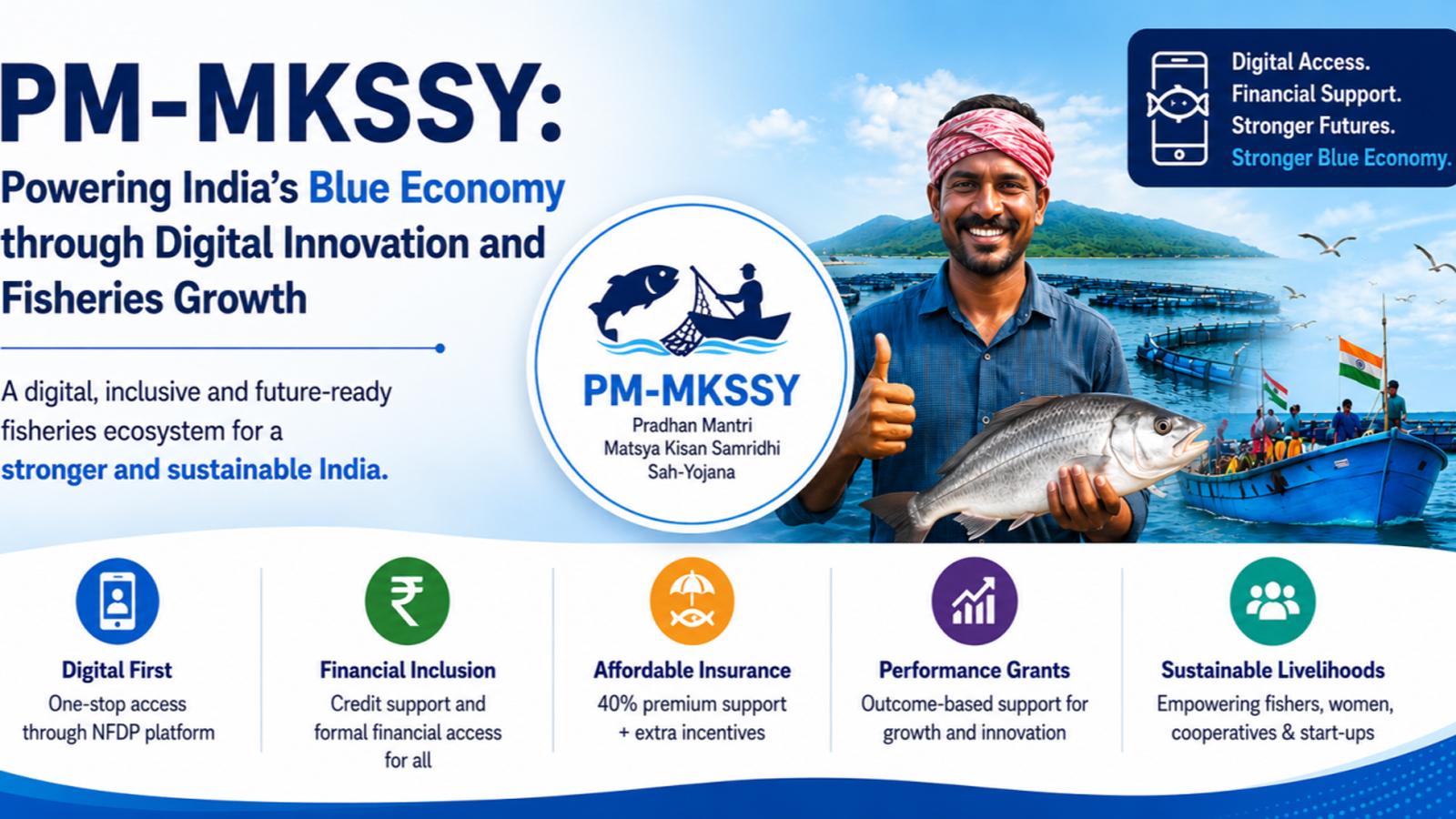
With fish production more than doubling over the past decade and aquaculture now accounting for around 74 per cent of the country’s total fish production, the government is seeking to make insurance an integral part of aquaculture risk management through the Pradhan Mantri Matsya Kisan Samridhi Sah-Yojana (PM-MKSSY).
The aquaculture insurance initiative under PM-MKSSY is designed to make insurance more affordable for farmers by providing a one-time incentive towards the premium for one crop cycle. The initiative is being implemented through the National Fisheries Digital Platform (NFDP), with the benefit transferred directly to eligible farmers through Direct Benefit Transfer.
Aquaculture growth brings new risks
India recorded its highest-ever fish production of 19.8 million tonnes in 2024-25, making it the world’s second-largest fish-producing country with an estimated 8 per cent share of global production.
The country’s total fish production has increased from 9.6 million tonnes in 2013-14 to 19.8 million tonnes in 2024-25. Inland fish production has also risen sharply, reaching 14.74 million tonnes in 2024-25 from 6.1 million tonnes in 2013-14.
Aquaculture, which includes freshwater carp farming, brackish-water shrimp and prawn farming, cage culture and the production of cold-water and marine species, now contributes more than 74 per cent of India’s total fish output.
The sector still has considerable room for expansion. India has around 1.95 lakh km of rivers and canals, 31.5 lakh hectares of reservoirs, 22.1 lakh hectares of ponds and tanks and 14.1 lakh hectares of brackish-water area. However, only around 17 per cent of the available brackish-water area has been developed for aquaculture.
Average aquaculture productivity has risen to 4.77 tonnes per hectare, close to the government’s target of 5 tonnes per hectare under the Pradhan Mantri Matsya Sampada Yojana (PMMSY).
The growth, however, is accompanied by exposure to a range of risks. Disease outbreaks, summer kill, pollution, earthquakes, cyclones, floods and other natural calamities can destroy an entire crop cycle, leaving farmers with significant losses after months of investment.
For small and marginal aquaculture farmers operating on limited margins, a crop failure can also create difficulties in servicing loans and financing the next production cycle. The government therefore sees insurance not only as a mechanism for compensating losses, but also as an instrument to strengthen the sector’s resilience and encourage continued investment.
How the aquaculture insurance incentive works
The Union Government approved PM-MKSSY on February 8, 2024, with incentivisation of aquaculture insurance included under Component 1-B of the scheme.
Eligible aquaculture farmers can receive an incentive of up to 40 per cent of the insurance premium for one crop cycle.
For pond-based aquaculture, the incentive is capped at ₹25,000 per hectare of water-spread area, subject to a maximum of ₹1 lakh for up to four hectares. Farms measuring less than one hectare are eligible for the incentive on a pro-rata basis.
For advanced aquaculture systems such as cage culture, Recirculatory Aquaculture Systems (RAS), biofloc and raceways, the incentive is 40 per cent of the insurance premium, subject to a maximum of ₹1 lakh and an eligible unit size of up to 1,800 cubic metres.
The scheme also provides an additional incentive for certain beneficiaries. Scheduled Caste, Scheduled Tribe and women beneficiaries are eligible for an additional incentive of 10 per cent of the incentive payable to beneficiaries in the general category.
Focus on timely claim settlement
The effectiveness of insurance ultimately depends on how quickly and transparently claims are settled after a loss.
Under the scheme, farmers are required to immediately inform the insurance company when an insured peril occurs and submit documentary evidence in accordance with the terms of the policy. The insurer then appoints a loss assessor to evaluate the damage.
Following assessment, the claim is processed and payment is made to the insured, with status updates provided through the insurer’s portal.
The stipulated settlement period is 30 days for shrimp culture and 45 days for other aquaculture activities.
Four insurers are currently operational under the initiative – Oriental Insurance Company Limited (OICL), Agriculture Insurance Company of India Limited (AICL), National Insurance Company Limited (NICL) and United India Insurance Company Limited (UIIC). They provide coverage for shrimp and prawn farming, freshwater fish and cold-water species. The onboarding of private insurers is also underway to expand the insurance ecosystem.
Early implementation shows progress
The One-Time Incentive (OTI) component has so far received 316 applications covering 730.61 hectares.
Of these, 127 applications have been approved and the incentive has been disbursed to farmers covering 321.74 hectares. The total amount disbursed stands at ₹40.03 lakh.
The government views these initial numbers as an indication of growing adoption, while recognising that wider participation will be necessary for aquaculture insurance to become a mainstream risk-management tool.
Building confidence in insurance
For aquaculture farmers, the effectiveness of the scheme will ultimately depend on whether insurance delivers timely and fair protection when losses occur. Greater transparency in assessment, faster verification of damage and predictable claim settlement will therefore be critical to building confidence among farmers.
The government’s approach under PM-MKSSY extends beyond subsidising insurance premiums. It seeks to develop a sustainable aquaculture insurance market in which risk protection becomes part of routine farm management.
This will require coordination among multiple stakeholders. The Centre is responsible for policy direction and digital infrastructure, while States are expected to support outreach and implementation at the field level. Insurers need to develop and service credible insurance products, while farmers need to adopt risk protection as part of their production planning. Technical institutions also have a role in strengthening risk assessment, disease surveillance and loss verification.
As India’s aquaculture industry expands and becomes increasingly important to rural livelihoods, food security and seafood exports, the government is positioning insurance as a tool to help farmers withstand production shocks and sustain their participation in the sector.
The longer-term objective is for aquaculture insurance to evolve from a government-supported intervention into a durable component of a resilient and financially sustainable aquaculture economy.


