







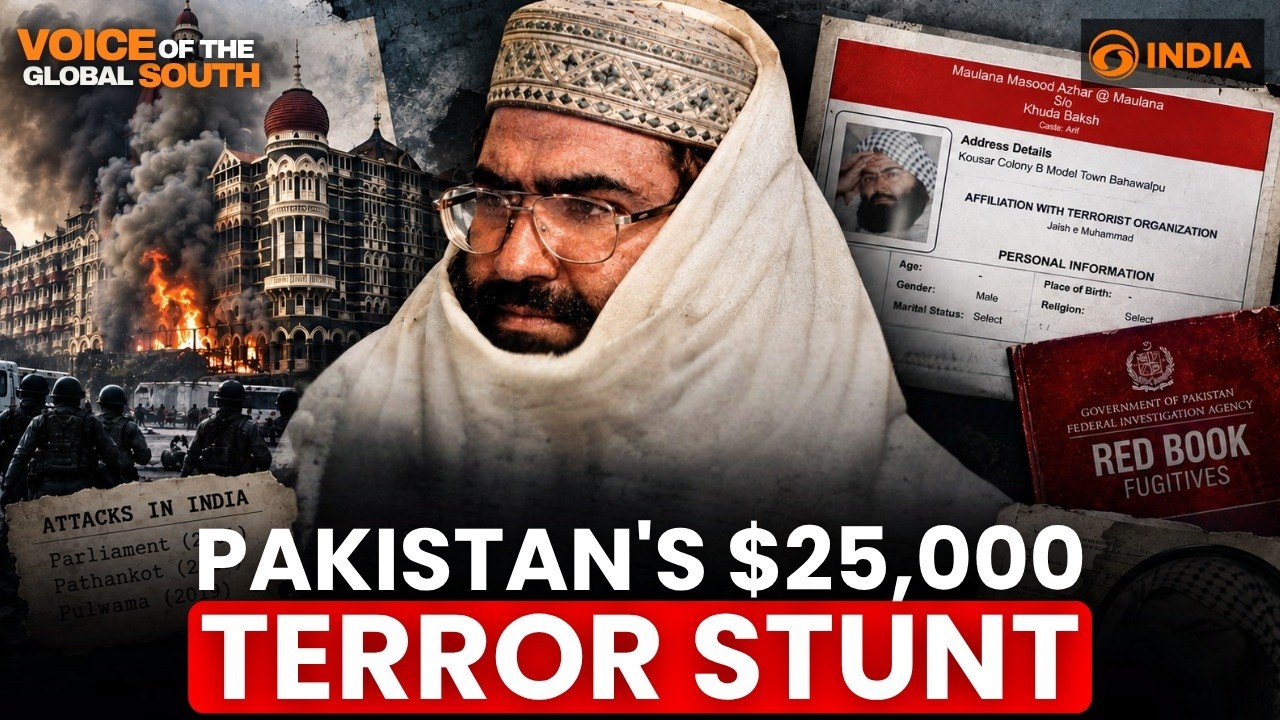
Pakistan’s Federal Investigation Agency has rolled out its latest “Red Book,” a public directory showcasing the State’s most-wanted fugitives. Standing out prominently on this updated roster is Maulana Masood Azhar, the notorious mastermind and commander of the terrorist outfit Jaish-e-Mohammed.
WATCH YOUTUBE VIDEO:  youtu.be/pIKIIMvrO4o
Compiled by the F.I.A.’s Counter-Terrorism Wing — a specialised unit set up in 2003 to handle high-profile cross-border crimes such as espionage and terror financing — the document paints a curious picture. Within the 2026 registry, Azhar is catalogued at the 1,480th spot out of 1,804 active targets.
To project a sudden wave of anti-terror compliance, Islamabad has hiked the bounty on Azhar by two million Pakistani Rupees. The total reward for information leading to his capture now stands at seven million Pakistani Rupees — about 25,000 U.S. dollars. The registry notes that Azhar faces three active criminal warrants spread across Lahore, Multan, and Gujranwala.
Yet, the timing of this public display is far from accidental. The move appears strategically engineered just ahead of the Financial Action Task Force’s crucial plenary review this October. Having previously taken severe economic hits from global financial watchdogs, Islamabad is desperately eager to showcase compliance with international counter-terrorist financing rules. The stunt serves as a defensive shield to prevent Pakistan from sliding back onto the crippling F.A.T.F. “Grey List,” an outcome that would lock it out of vital international capital markets and institutional financing.
New Delhi has dismissed the announcement entirely, labelling it an empty tactical stunt. ‘All that I would say is that such gimmicks and hoodwinking by Pakistan is not new. We have seen such gimmicks in the past as well. For a State sponsor of terror to make phony announcements … we all know how hollow it is. They must take action and not make phoney announcements which are of no consequence,’ said the spokesperson of the Ministry of External Affairs.
Echoing the Indian Government’s stance, Lt. Gen. D.P. Pandey (Retd.) characterised the announcement as pure political theatre staged solely to dodge F.A.T.F. scrutiny. He said: “Whenever Pakistan faces pressure from the F.A.T.F., it stages certain theatrics or takes actions intended to demonstrate to the world that it does not harbour terrorism. It tries to project the image that there is no terrorist infrastructure on its soil. However, the world is well aware of the reality. That is precisely why the F.A.T.F. has consistently kept Pakistan on the ‘Grey List’.”
Masood Azhar was formally declared a global terrorist by the United Nations Security Council in May 2019, following years of diplomatic stalling by China. The U.S. has also maintained a massive 10-million-dollar bounty on his head.
However, India’s grievances with the Jaish commander stretch back over two decades. Once held securely in an Indian prison, Masood Azhar was freed in December 1999 as part of a high-stakes hostage exchange during the hijacking of Indian Airlines flight I.C.-814. Five armed terrorists seized the New Delhi-bound flight shortly after take-off from Kathmandu in Nepal. To secure the safety of the civilian passengers marooned in Taliban-controlled Kandahar, India reluctantly swapped Azhar and two other jailed operatives.
After his release, Masood Azhar founded the Jaish-e-Mohammed. Since then, Jaish-e-Mohammed has been involved in six major terrorist attacks in India.
— In April 2000, a local Jaish recruit drove an explosives-rigged vehicle into the main gates of the Indian Army’s 15 Corps Headquarters in Jammu and Kashmir, killing four soldiers
— 2001 J&K Assembly Assault: An October suicide bombing targeted the legislative assembly building in Srinagar, taking over 30 lives
— 2001 Breach at Parliament: On 13th December 2001, a joint squad of Jaish-e-Mohammed and Lashkar-e-Taiba terrorists stormed the Indian Parliament complex in New Delhi, resulting in 14 fatalities, including eight security officers
— 2016 Pathankot Airbase Raid: A heavily armed team infiltrated the Indian Air Force base in Punjab, triggering a multi-day counter-offensive that cost the lives of several security personnel
— 2016 Uri Base Ambush: On 18th September 2016, a pre-dawn strike on a military brigade station in Uri left 19 Indian soldiers dead
— 2019 Pulwama Convoy Bombing: On 14th February 2019, a vehicle-borne improvised explosive device rammed a Central Reserve Police Force convoy, killing 40 personnel
Jaish-e-Mohammed operates openly out of its expansive headquarters, Markaz Subhan Allah, in Bahawalpur. This very stronghold was hit by Indian retaliatory strikes during Operation Sindoor in May 2025, launched in the wake of the Pahalgam terror attack. While Azhar managed to escape the blast, the strike eliminated 10 of his relatives and four inner-circle aides.
To deflect mounting international heat, Islamabad began floating claims in 2021 that Azhar was no longer inside Pakistan, asserting he had fled across the western border into Afghanistan. That narrative was promptly shot down. The Afghan Taliban leadership issued a blunt public rejection, denying that the Jaish chief was taking refuge anywhere on their soil.
Masood Azhar is hardly the only protected asset featured in the latest Red Book. The list includes 19 operatives linked to the 26th November 2008 Mumbai terror attacks — individuals who coordinated sea transport, ran safehouses or handled the financial backing for the carnage. Despite being officially branded as “absconders” for 18 years, Indian intelligence asserts that 17 of these central planners continue to live under state protection inside Pakistan.
This policy of absolute denial follows a classic historical template. Throughout his tenure, President Pervez Musharraf routinely swore that his military had no clue where Osama bin Laden was, falsely suggesting the Al-Qaeda chief was deep within Afghan territory. In 2009, Prime Minister Yousuf Raza Gilani rejected direct American intelligence warnings, stating boldly that there was zero proof bin Laden was on Pakistani soil. Islamabad sustained that deception for an entire decade — right up until U.S. Special Forces tracked down and killed the Al-Qaeda leader in the military garrison town of Abbottabad in 2011.
Today, the same playbook is being used to claim Masood Azhar has vanished abroad. History suggests that he is likely hiding out in plain sight with absolute State complicity. On 16th September, India’s Permanent Representative to the United Nations, P. Harish, delivered a scathing indictment of Pakistan’s long-running game of double-dealing. Speaking at a U.N. Security Council meeting on Afghanistan, the Indian diplomat invoked Osama bin Laden, Khalid Sheikh Mohammed and other Al-Qaeda operatives as he called for action against environments that allow terrorist networks to survive. He also named Lashkar-e-Taiba and Jaish-e-Mohammed while warning about continuing support and impunity for Al-Qaeda affiliates.
Ramesh Ramachandran is a senior consulting editor with D.D. India


