







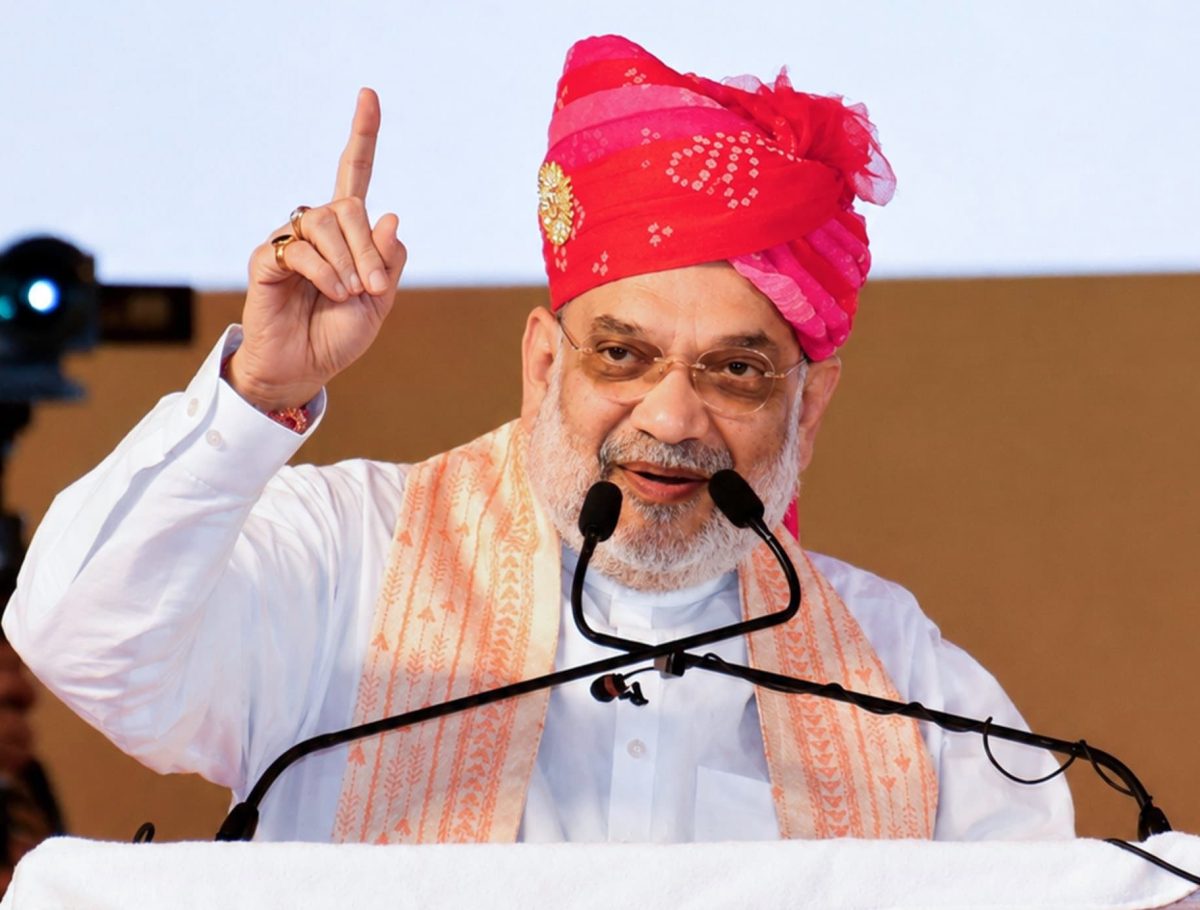
Union Home Minister and Minister of Cooperation Amit Shah on Monday said India’s linguistic diversity is a strength and stressed the need to promote Indian languages while ensuring that the country’s cultural and national identity remains united.
Addressing the Hindi Diwas 2026 celebrations and the 6th All India Official Language Conference in Mumbai, Shah said the Modi government has undertaken several initiatives to strengthen Hindi and other Indian languages, with a focus on making them languages of governance, science and literature.
Shah said the government’s efforts are aimed at creating greater interconnectivity among Indian languages and enriching each language through the exchange of words, knowledge and literature.
He said the Hindi Shabd-Sindhu dictionary, which began with around 51,000 words, has now expanded to 8 lakh words, with more than 50,000 words from local Indian languages incorporated into it.
Shah expressed confidence that Hindi Shabd-Sindhu would become the world’s largest dictionary by 2029.
He said the incorporation of words from languages including Tamil, Telugu, Marathi, Gujarati, Bengali and Odia has made Hindi more flexible and adaptable.
“The government wants to enrich every language of India,” Shah said, adding that Indian languages should be connected with one another to create a vast collective linguistic resource.
Mother tongue central to understanding India
The Home Minister said children can truly understand India only through their mother tongue, asserting that learning one’s mother tongue is essential for developing a strong connection with the country’s land, culture, traditions and values.
He said the process of thinking begins in one’s mother tongue and that people are able to think, analyse and make decisions better when they do so in their own language.
Shah also highlighted the government’s emphasis on learning another Indian language alongside one’s mother tongue, saying this would strengthen the spirit of ‘Ek Bharat, Shreshtha Bharat’.
He urged people to rise above political differences and work towards promoting Indian languages.
“Those who try to create disputes between languages should understand that a child can truly understand India only through his or her mother tongue,” he said.
Hindi as a bridge across linguistic diversity
Shah said Hindi has developed a connection with languages spoken across the country because Indian languages have interacted with one another for centuries.
Quoting Acharya Vinoba Bhave, he said Hindi had helped him communicate the message of Bhoodan and Gramdan across villages in different parts of the country.
Shah said that although Gujarati is his mother tongue, he never faced difficulty working at the national level because he could communicate in Hindi.
He said the Official Language had given him the opportunity to work across the country.
AI and technology initiatives
The Home Minister also highlighted the government’s efforts to use technology to promote Indian languages.
He said the AI-based Kanthasth 2.0 platform, which has a database of more than five crore sentences, has been opened to foreign users as well.
He also highlighted the LILA Rajbhasha and LILA Pravah initiatives, based on artificial intelligence, and the development of ‘Bharti – Bahubhashi Anuvad Sarathi’ and the Indian Languages Section.
Shah said more than 5 lakh Government of India employees have been trained in the Official Language.
He also noted that examinations such as JEE and NEET are now conducted in 13 languages, describing this as part of the government’s efforts to expand the use of Indian languages in education.
Savarkar’s contribution to Hindi
Shah said the Department of Official Language has also undertaken the task of incorporating words coined or revised by Veer Savarkar into the Hindi Shabd-Sindhu dictionary.
He described Savarkar as one of the most learned linguists of his time and said many words coined by him were accepted in Marathi, Hindi and other Indian languages.
‘Many languages, one voice of India’
Shah invoked Rabindranath Tagore’s vision of Indian languages as different petals of a single lotus, saying India’s linguistic diversity should be celebrated without compromising national unity.
“India’s languages may certainly be different notes, but the song is one,” he said.
“There is no objection to having many languages. The sentiment must remain Indian. There may be many dialects, but India’s voice must remain one.”
Vande Mataram and awards
The Home Minister also spoke about the historical significance of Vande Mataram, describing it as an important force in awakening India’s consciousness during the freedom struggle.
He said the government has sought to restore the song to its full glory and highlighted its significance during the 150th year of Vande Mataram.
On the occasion, Shah conferred the Rajbhasha Kirti Awards and Rajbhasha Gaurav Awards on the recipients.
He also released special commemorative editions of Rajbhasha Bharati centred on ‘Shiv Anadi Hain, Anant Hain’, ‘Bharatiya Gyan Tantra: Srot Aur Swaroop’, ‘Andheron Se Ujalon Tak’ and ‘Vande Mataram’, along with the publication ‘150 Chapters of Vande Mataram’.
Shah also recalled the contribution of Chhatrapati Shivaji Maharaj and Lokmanya Bal Gangadhar Tilak to Maharashtra’s cultural and linguistic traditions, saying the state represented India’s tradition of multilingualism and expansive thinking.


