







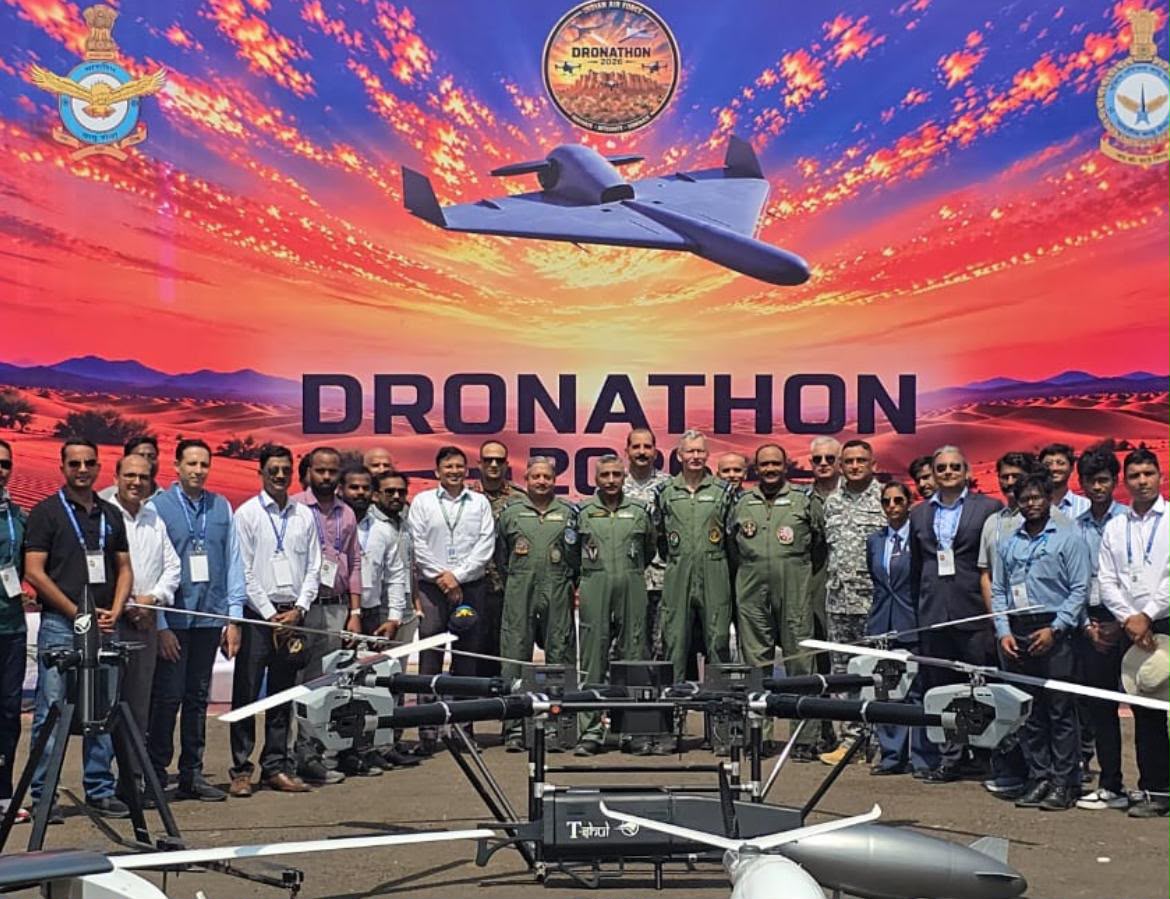
The Indian Air Force on Monday launched its first Dronathon-2026 at the Pokhran Field Firing Range in Jaisalmer, bringing together more than 20 defence companies, start-ups, MSMEs, DPSUs and innovators to demonstrate advanced unmanned systems under realistic operational conditions.
Air Marshal Ashutosh Dixit, Vice Chief of the Air Staff, inaugurated the three-day event, which will continue from September 14 to 16. Senior officials from the Ministry of Defence, Headquarters Integrated Defence Staff, Indian Army and Border Security Force attended the inaugural ceremony.
The Dronathon is an IAF initiative aimed at directly engaging with India’s rapidly evolving unmanned systems industry and evaluating emerging technologies in demanding operational environments.
The demonstrations cover a wide range of capabilities, including surveillance and reconnaissance, autonomous operations, swarm technologies, electronic warfare and Counter-Unmanned Aircraft Systems (CUAS).
The IAF said unmanned systems can complement manned aviation by providing commanders with additional options to enhance the reach, persistence, responsiveness and flexibility of air operations.
A key focus of Dronathon-2026 is to move beyond technology demonstrations towards assessing their operational effectiveness. Participating systems are being evaluated for reliability, effectiveness in contested environments, adaptability to changing operational requirements and their ability to counter emerging threats.
During the event, the Vice Chief of the Air Staff also released the ‘IAF UAS Roadmap’, aimed at providing greater clarity to Indian industry on the IAF’s future capability priorities.
The roadmap is expected to help industry, academia and research organisations align their innovation and development efforts with the future requirements of the Air Force.
On the opening day, the IAF also demonstrated ‘Vayu UTtaM’, its indigenously developed multi-mode Unmanned Traffic Management system.
During a real-time demonstration at Pokhran, Vayu UTtaM detected and tracked both military and civil unmanned aircraft systems. The system is designed to support coordinated management of increasingly congested airspace while enabling the identification and timely mitigation of unauthorised or rogue drones.
The technology could also find applications beyond military operations, including airspace safety, critical infrastructure protection, civil aviation and public safety.
Dronathon-2026 also underlines the IAF’s focus on Atmanirbharta in unmanned systems. The initiative covers not only drone airframes but the wider ecosystem, including propulsion systems, sensors and payloads, communications, autonomy, electronic warfare, countermeasures and airspace management.
The three-day exercise is expected to provide the IAF and the Indian unmanned systems industry with an opportunity to assess emerging technologies, identify operationally relevant capabilities and accelerate the development of indigenous solutions for future air operations.


