







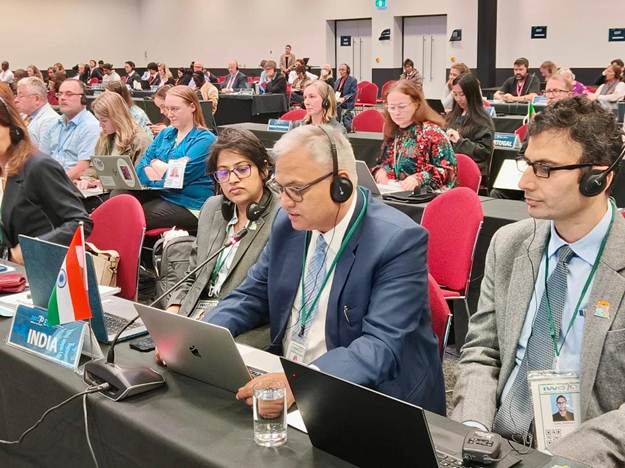
India has reaffirmed its commitment to the conservation of whales and other cetaceans, stressing the importance of science-based approaches, international cooperation and practical measures to address threats to marine species.
India made the remarks at the 70th meeting of the International Whaling Commission (IWC-70), being held in Hobart, Australia, from September 28 to October 2.
In its opening statement, India emphasised the need for continued collaboration among range countries, scientific institutions and international organisations for effective cetacean conservation.
India highlighted the importance of strengthening scientific knowledge on the population status, distribution, movement patterns, breeding ecology and threats faced by cetaceans. It said improved scientific information is essential for strengthening conservation measures and supporting informed decision-making.
India also reiterated its support for scientific studies and evidence-based approaches to ensure that conservation and management measures for cetaceans are based on sound scientific understanding.
The country stressed the importance of greater cooperation among governments, researchers and local communities to develop practical and locally appropriate approaches for addressing threats to whales, dolphins and other cetaceans.
The IWC-70 meeting holds particular significance as it coincides with the 80th anniversary of the signing of the International Convention for the Regulation of Whaling.
The International Whaling Commission was established under the Convention, signed in Washington, DC, on December 2, 1946. The commission serves as the global body responsible for the management of whaling and conservation of whales and currently has 89 member governments.
India has been a member of the IWC since 1981 and has played an active role in whale conservation efforts.
In India, cetacean species found in national waters receive the highest level of legal protection under the Wild Life (Protection) Act, 1972.
The country has also notified several Marine Protected Areas to safeguard marine biodiversity, including whales, dolphins, dugongs, sharks, rays, turtles and corals.
The Government of India has also launched Project Dolphin, which adopts a holistic approach to the conservation of dolphins, whales, porpoises and their associated aquatic ecosystems.
India has also accorded particular importance to the conservation of the Arabian Sea humpback whale, which has been identified among 25 species for focused conservation efforts.
At IWC-70, India reiterated that the future work of the International Whaling Commission should continue to be guided by science-based conservation priorities, international cooperation and practical measures to address the diverse threats faced by whales and other cetaceans.


