







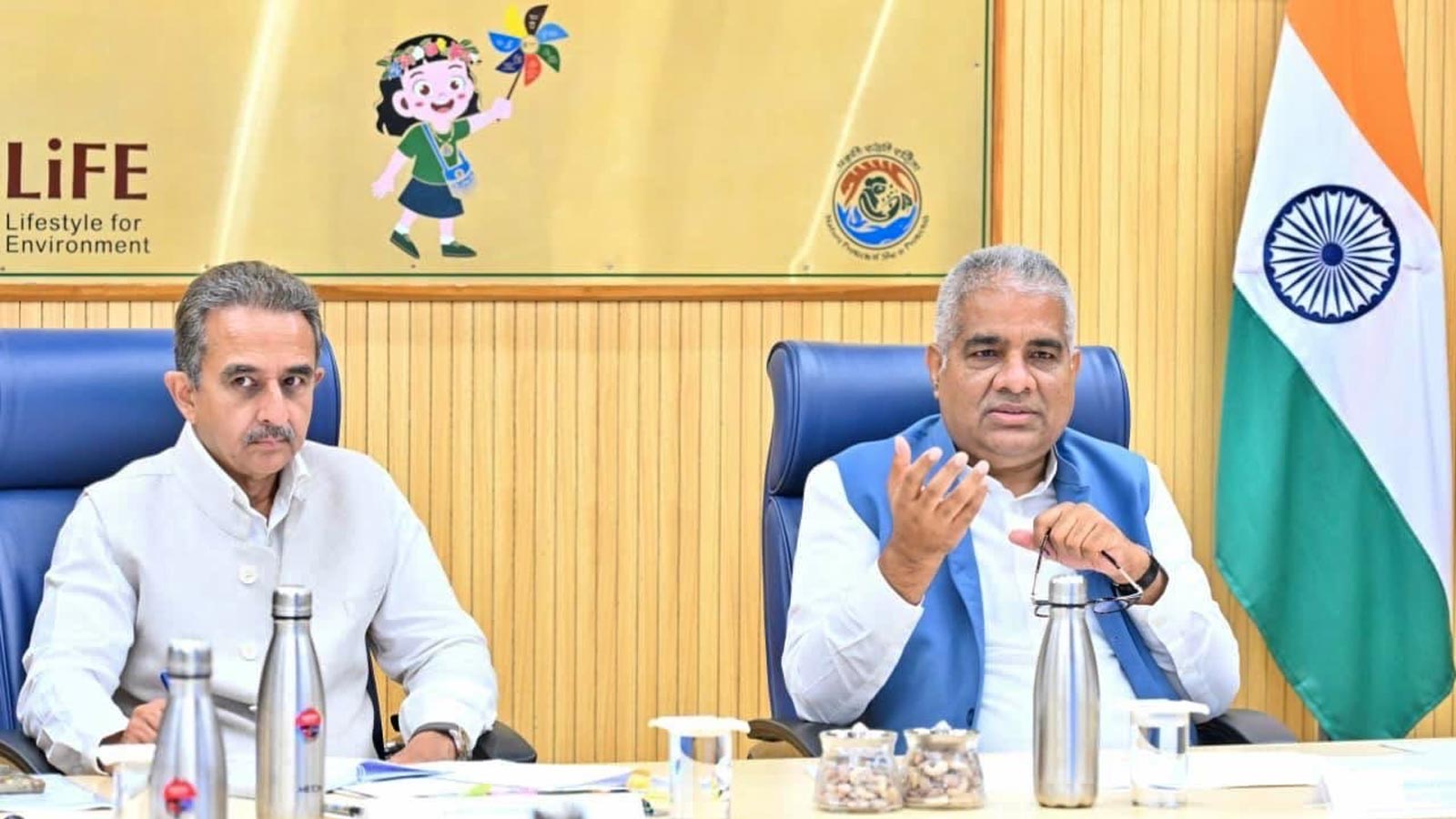
Union Environment, Forest and Climate Change Minister Bhupender Yadav on Thursday called for greater use of the latest technologies in assessing and monitoring India’s forest and tree resources while simultaneously strengthening indigenous capabilities and the capacity of forest personnel.
Yadav made the remarks while inaugurating a national workshop on ‘Leveraging Latest Technologies in Assessment of Forest and Tree Resources’, organised by the Ministry of Environment, Forest and Climate Change (MoEFCC) in New Delhi. Union Minister of State for Environment, Forest and Climate Change Kirti Vardhan Singh also attended the inaugural session.
The workshop brought together State Forest Departments, scientific institutions, scientists, technology experts and other stakeholders to examine technology-driven approaches to improve the assessment, monitoring and management of forest and tree resources.
Three technical sessions were held during the workshop, focusing on digitisation of forest boundaries, assessment of forest and tree cover, and estimation of carbon stock.
Addressing the gathering, Yadav said humans are not above nature and must respect it by working towards coexistence with the natural environment. He stressed that technology should be leveraged to strengthen the quality of data on natural resources, improve decision-making and accelerate India’s climate commitments, particularly through nature-based solutions.
The Minister highlighted that enhancing the carbon sink through forest and tree cover is India’s third Nationally Determined Contribution (NDC) target under the United Nations Framework Convention on Climate Change (UNFCCC).
He also underlined the important role of the Forest Survey of India (FSI) as a premier institution for forest conservation and documentation of the country’s green cover. India has been carrying out regular biennial assessments of its forest and tree resources through the FSI since 1987. The India State of Forest Report (ISFR) provides an important scientific basis for tracking changes in forest resources and supporting national as well as international reporting.
Yadav called for standardised parameters across institutions to facilitate coordinated action on forest conservation. He said compensatory afforestation should remain clearly aligned with preserving plantations and improving the quality of green cover rather than focusing only on increasing its extent.
The Minister also stressed the need to classify forest fire-prone areas based on the frequency of incidents and identify hotspots to enable targeted prevention measures. Highlighting the ecological importance of wetlands, he said these ecosystems are crucial for biodiversity conservation and maintaining ecological balance, and called for an appropriate balance among wetlands, woodlands and grasslands.
While encouraging the adoption of emerging technologies, Yadav emphasised that India must also build indigenous technological capabilities and strengthen the skills of forest personnel. He called for improvements in data quality and greater integration of field experience into a robust Standard Operating Procedure (SOP) for preparation of the ISFR.
Yadav said a stronger and more scientifically robust ISFR would provide a better foundation for forest conservation and management. He also said achieving India’s enhanced ambition of creating a 3.5–4.0 billion tonne CO₂-equivalent carbon sink by 2035 would require technological innovation supported by strong institutions, effective policies and active participation from communities and citizens.
The Ministry is providing technical and financial support to States and Union Territories to enhance forest and tree cover through initiatives including the Green India Mission, MISHTI, Nagar Van Yojana, Namo Van and Ek Ped Maa Ke Naam.
The workshop also discussed technologies and strategies that could be adopted and scaled up by strengthening institutional capacities, with the broader objective of improving forest governance, advancing climate action and ensuring sustainable management of India’s natural resources.


