







India is stepping up efforts to develop deep-sea mining capabilities as part of its strategy to secure critical mineral supplies and strengthen its position in the emerging Blue Economy.
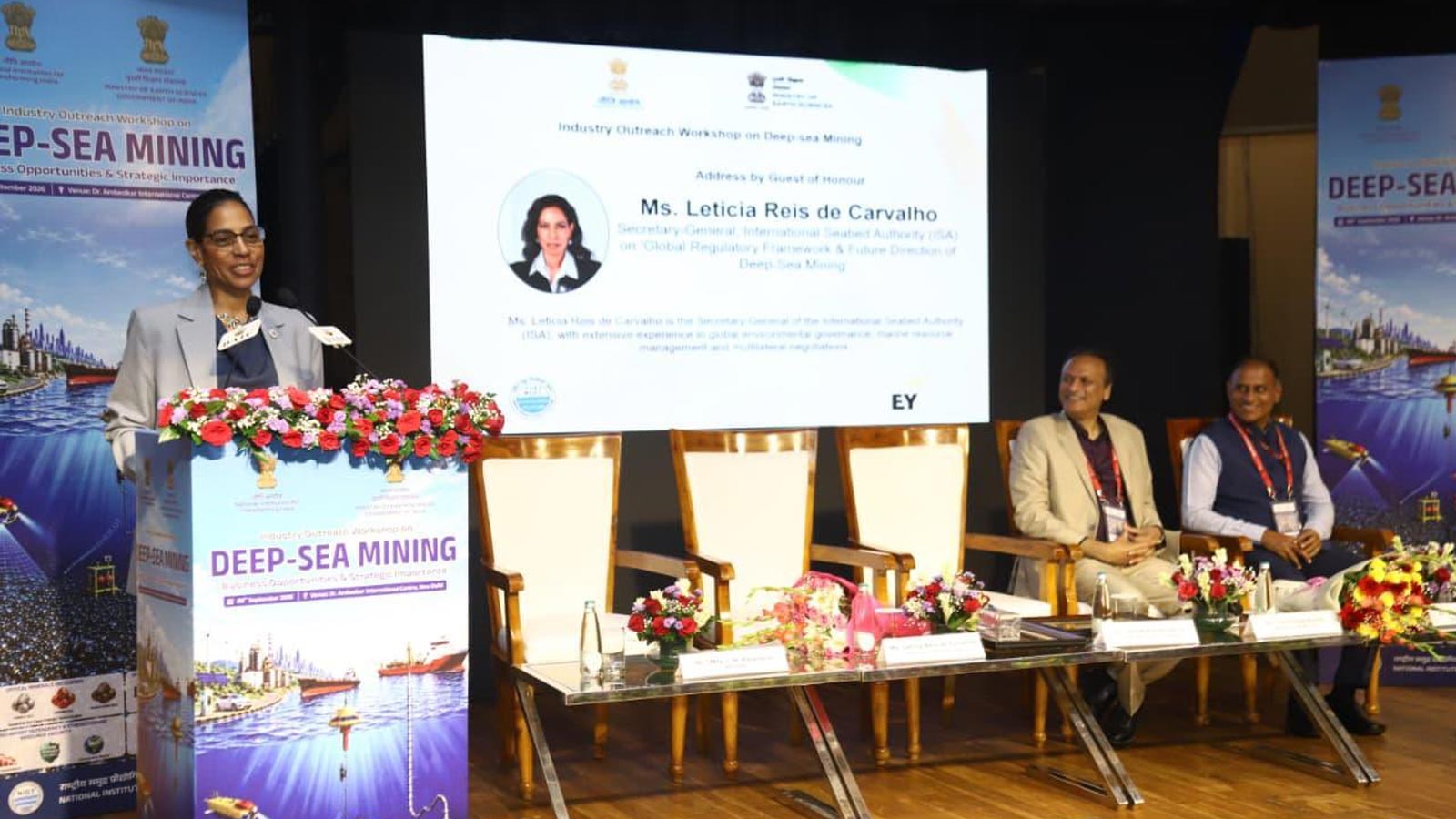
The Ministry of Earth Sciences (MoES) and the National Institute of Ocean Technology (NIOT), in association with knowledge partner EY and NITI Aayog, organised a high-level industry outreach workshop on “Deep Sea Mining – Business Opportunities and Strategic Importance” at the Dr Ambedkar International Centre in New Delhi.
The workshop brought together policymakers, regulators, technology developers, research institutions and financial leaders from India and abroad to explore opportunities for greater private-sector participation in deep-sea mining and the development of an integrated maritime industrial ecosystem.
Focus on critical mineral security
Deep-sea mining is gaining strategic importance as critical minerals such as nickel, cobalt, copper and manganese are essential for clean-energy technologies, advanced manufacturing, high-computing systems and electric mobility.
The government sees alternative sources of these minerals as important for strengthening India’s long-term economic and geopolitical security amid growing global demand and supply-chain uncertainties.
India has an exploration contract with the International Seabed Authority (ISA) covering 75,000 sq km in the Central Indian Ocean Basin (CIOB). The area is estimated to contain around 366-380 million tonnes of polymetallic nodules.
India is also the first country to hold two exploration contracts for polymetallic sulphides, including a recent agreement covering the Carlsberg Ridge.
Indigenous technology for operations at 5,000 metres
Under the ₹4,077-crore Deep Ocean Mission, India has been developing indigenous technologies for exploring and exploiting deep-sea resources.
NIOT has successfully demonstrated indigenous deep-sea mining crawler systems at depths exceeding 5,000 metres in the Indian Ocean. The achievement is seen as an important milestone in developing subsea engineering capabilities required for deep-sea operations.
The government is now looking at ways to translate these technological capabilities into a wider industrial ecosystem.
From exploration to mine-to-metal ecosystem
The workshop explored the potential for developing an integrated “mine-to-metal” value chain, with opportunities spanning offshore engineering, marine robotics, shipbuilding, metallurgy and downstream industries such as battery manufacturing.
The industry outreach initiative is intended to connect India’s scientific and technological capabilities with private-sector investment and commercial expertise.
It is expected to contribute to the development of future policy frameworks, bankable project roadmaps and an upcoming White Paper on Deep Sea Mining, which will provide a roadmap for greater industrial participation in the sector.
However, commercial mining of polymetallic nodules in international waters cannot begin until the Exploitation Code is finalised by the International Seabed Authority.
The government said the initiative is aimed at preparing India for the next phase of deep-sea resource development while strengthening critical mineral security, indigenous technology and the country’s broader Blue Economy ambitions.


