







Inside This Week’s Economic Brief
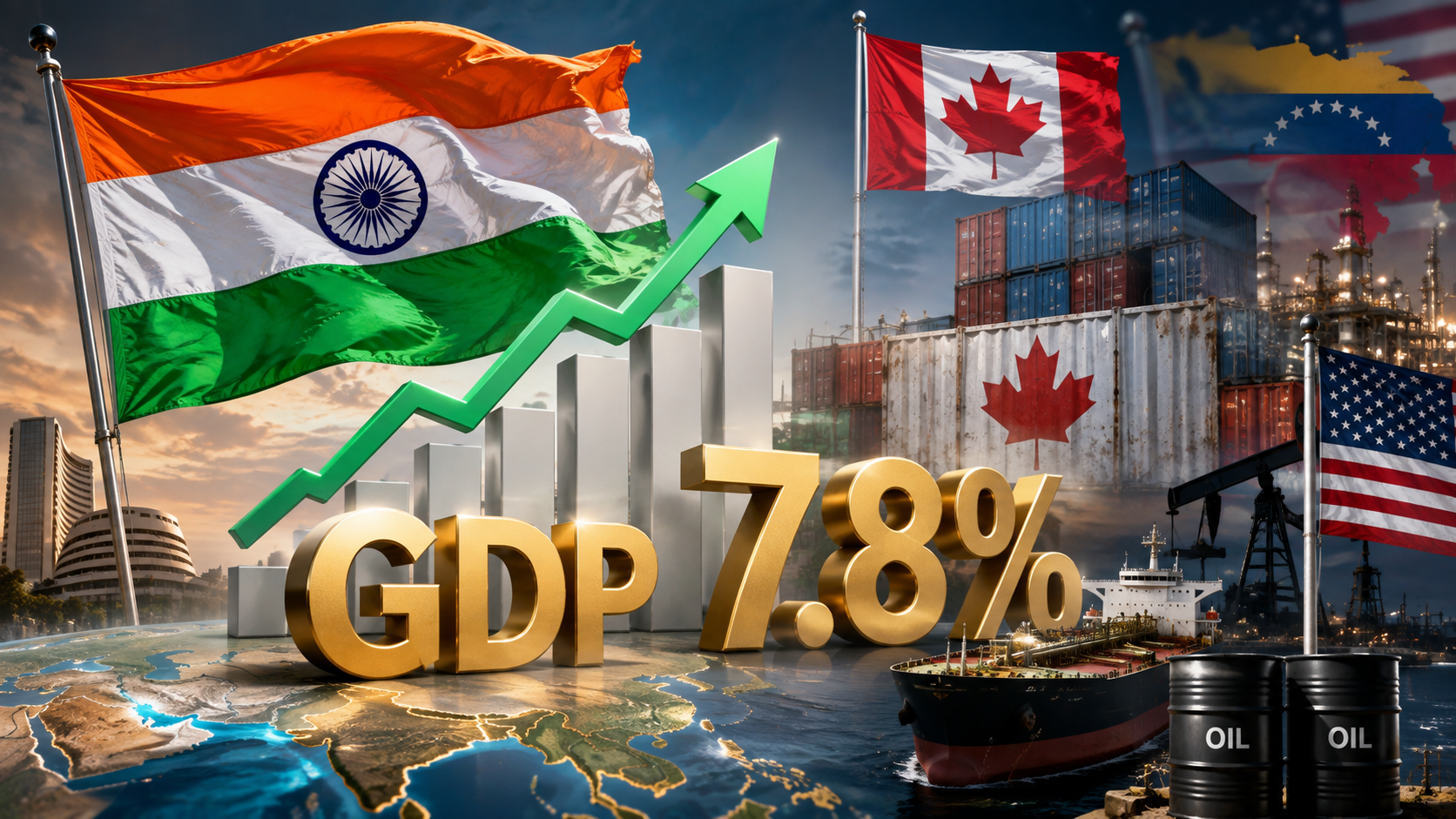
This week’s Economic Brief covers India’s 7.8% GDP growth under a new base year, Canada’s 50% counter-tariffs on the US, and a landmark US-Venezuela oil deal reshaping global energy ties.
This week’s edition of The Economic Brief on DD India examined three major stories: India’s strongest quarterly GDP growth in four years, Canada’s sharp escalation in its trade war with the United States, and a landmark oil deal reshaping US-Venezuela relations. The episode featured Commerce Minister Piyush Goyal, Deloitte India’s Dr. Rumki Majumdar, and economist Dr. Ashok Vishandas of the Indian Institute of Public Administration.
India Posts 7.8% GDP Growth Under New Base Year
India’s real GDP grew 7.8% in Q1 FY27 under the new series based on 2022-23, marking its strongest quarterly performance in four years. Key drivers include:
- Investment up 11.9%, signaling businesses expect demand to stay strong for several quarters.
- Consumption up 7.1%, driven by rising household spending, particularly on services.
- Exports up 12%, showing India gaining traction despite a weak global trade environment.
- Manufacturing up 9.2% and services up 10%, indicating broad-based growth rather than reliance on services alone.
- Capital goods output up 15.2%, a signal of rising future production and employment.
- Core industries (steel, cement, electricity, coal) up 5.4%, with industrial growth holding at 6.7% in July.
- Credit growth of over 20% in industry and 22.9% in services, reflecting strong business confidence.
Commerce Minister Piyush Goyal highlighted scorching double-digit growth in the auto sector, noting some electric vehicles now carry six-month waiting periods, alongside surging domestic steel demand. He pointed to long-term policies such as Semicon 2.0 and offshore energy initiatives, along with new trade deals including the UK CETA and the India-Israel agreement, as reinforcing India’s export competitiveness. The IMF has called India a global growth engine, while Japan’s credit rating agency upgraded India to A- and S&P reaffirmed its BBB rating.
Dr. Rumki Majumdar of Deloitte India said high-frequency indicators, including capex and electricity consumption, support the GDP figures, though she noted rural demand is moderating even as urban demand and government spending remain strong.
Dr. Ashok Vishandas welcomed the revised GDP methodology, which now uses a more robust double-deflator approach in line with developed economies. He expressed confidence that growth momentum will continue into the festive third quarter, potentially surpassing 7.8%, citing strong performance across passenger cars, tractors, and consumer durables.
Canada Escalates Trade War With 50% Counter-Tariffs
Canada will impose reciprocal tariffs of up to 50% on hundreds of American goods worth CA$27.6 billion starting September 8, matching earlier US duties dollar-for-dollar. The tariffs cover steel, aluminum, dairy, appliances, furniture, machinery, and even industrial robots and farm equipment. Ottawa has announced a $7.5 billion support package for affected workers and businesses. President Trump accused Canadian Prime Minister Mark Carney of rejecting a favorable deal for political reasons, while Canadian officials pointed to the country’s fastest G7 growth last quarter as evidence of resilience.
Dr. Vishandas warned that unilateral US trade policy risks undermining international credibility and could push both economies toward higher inflation and job losses, calling the approach ultimately counterproductive for Washington itself.
US Secures Major Access to Venezuela’s Oil Reserves
The United States will gain control over roughly one-fifth of Venezuela’s oil reserves — more than 65 billion barrels — under a new agreement President Trump has called the biggest oil deal in history. The deal is expected to draw over $100 billion in private investment and more than double Venezuelan oil production. North American Blue Energy Partners will hold 100-year concessions on 17 oil fields, with the US government taking a 35% stake and the right to purchase 20% of output at production cost. Chevron, Eni, and GE Vernova have also signed multi-billion-dollar deals covering oil exploration and grid repair. Washington expects production to top 2 million barrels per day by decade’s end, still below Venezuela’s historic peak of over 3 million.
Key Takeaways
India’s economy is showing broad-based, investment-led growth, backed by rising credit, strong industrial output, and improving sovereign credit ratings. Canada’s counter-tariffs mark a major escalation in North American trade tensions with implications beyond the continent. And the US-Venezuela oil deal is set to reshape global energy supply while deepening Washington’s strategic footprint in Latin America.


