







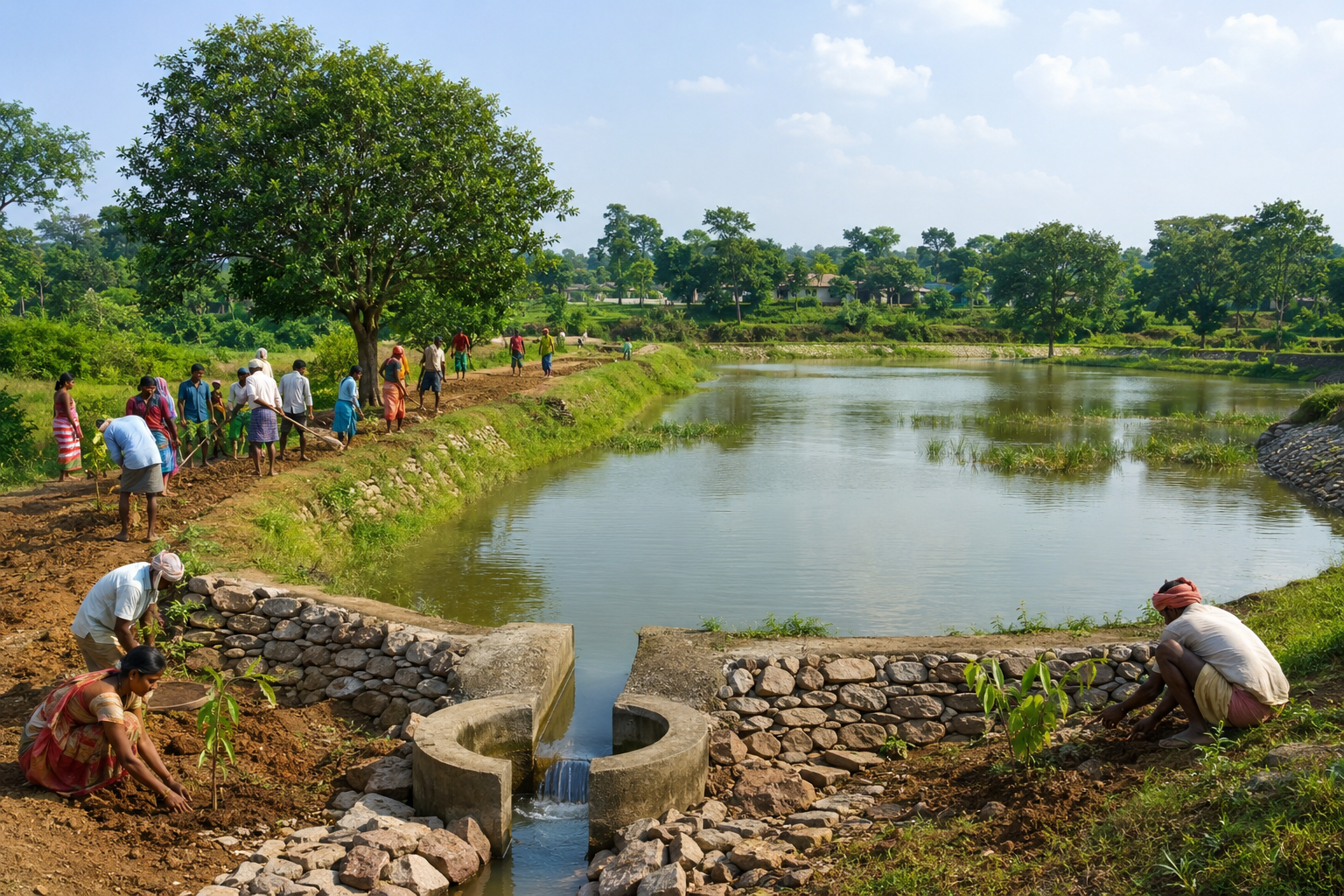
India’s efforts to strengthen water security through community participation have gained momentum under the Jal Sanchay Jan Bhagidari initiative, with more than 1.58 crore artificial groundwater recharge structures constructed across the country as of September 3, 2026.
The initiative, launched on September 6, 2024, seeks to promote groundwater recharge and water conservation through low-cost, locally appropriate measures, including the construction of recharge and storage structures and revival of defunct borewells.
The programme is guided by the 3Cs — Community, Corporate Social Responsibility (CSR) and Cost — and follows a Whole-of-Government and Whole-of-Society approach.
Under JSJB 1.0, more than 27 lakh structures were constructed by May 2025. JSJB 2.0, launched in June 2025, expanded the effort, with more than 1.5 crore groundwater recharge structures created by May 2026.
In June 2026, the initiative was integrated with the Jal Shakti Abhiyan: Catch the Rain campaign and renamed Jal Sanchay Jan Bhagidari: Catch the Rain (JSJB: CTR).
Centre-State cooperation on water conservation
Water conservation and community participation were among the key areas discussed at the Ministry of Jal Shakti’s Departmental Summit held in New Delhi on September 1 and 2.
The summit was the first in a series of departmental meetings aimed at strengthening cooperative federalism and Centre-State collaboration on water management.
Jal Sanchay Jan Bhagidari: Catch the Rain was one of four key thematic pillars at the summit, along with water infrastructure projects, sustainability of drinking water sources and rural water supply under Jal Jeevan Mission 2.0.
Prime Minister Narendra Modi, while emphasising the importance of public participation, suggested promoting ‘Jal Utsav’ to create greater awareness about water conservation.
He also stressed the need to strengthen water management and governance-related knowledge in universities and higher educational institutions. The Prime Minister called for structured inter-State study visits involving public representatives, officials and farmers to facilitate the sharing and replication of successful water conservation practices.
He further underlined the importance of robust water data governance, including systematic collection, management, analysis and use of water-sector data.
Local communities at the centre
The initiative draws on India’s long tradition of community-led water management, including the use of stepwells, tanks, ponds, johads and traditional irrigation systems.
In Chhattisgarh’s Korea district, farmers have voluntarily allocated five per cent of their agricultural land for recharge ponds and terraced pits under the Aawa Paani Jhoki movement.
More than 1,260 farmers have adopted the model and over 2,000 soak pits have been created. According to the government, groundwater levels rose by three to four metres in several villages, while springs were revived in 17 remote tribal hamlets.
The government provided technical assistance through micro-watershed mapping and hydrogeological assessments, while the initiative retained farmer ownership at its core.
Andhra Pradesh villages adopt water budgeting
In Prakasam district of Andhra Pradesh, villages including Murugummi, Marella and Thangella have adopted community-led measures to tackle erratic rainfall, declining groundwater levels and borewell failures.
Gram Sabhas, door-to-door campaigns, traditional Kalajatha performances and workshops were used to involve farmers, women, youth and local institutions in planning water conservation measures.
The villages adopted a ridge-to-valley approach to capture, store and recharge rainwater.
In Murugummi, 71 water conservation structures created around 8.11 lakh cubic metres of cumulative storage capacity and support protective irrigation across 264.5 hectares.
Marella has 53 structures with about 10.04 lakh cubic metres of cumulative storage capacity, while renovation of community ponds and tanks added nearly 5.95 lakh cubic metres of storage.
Thangella has 71 structures with around 5.89 lakh cubic metres of cumulative storage capacity. Revival of traditional water bodies added approximately 3.98 lakh cubic metres.
Together, the interventions have improved groundwater availability for around 5,900 people and supported agricultural and dairy livelihoods.
Odisha combines rooftop harvesting with aquifer recharge
In Odisha, the initiative has brought schools, colleges, government offices and other institutions into the water conservation effort.
Under the CHHATA Scheme, rainwater is harvested from rooftops, while the ARUA Scheme facilitates recharge from ponds and other water bodies into underground aquifers.
In Jajpur district, 117 recharge shafts were constructed under ARUA and 114 rooftop rainwater harvesting systems were installed under CHHATA between 2022-23 and 2025-26.
The interventions cover high-priority blocks including Korei, Binjharpur, Bari, Rasulpur, Dasarathpur and Jajpur.
In Cuttack district, 57 rooftop rainwater harvesting systems were established across government offices, educational institutions and public facilities. Another 35 recharge shafts were constructed in ponds and water bodies under ARUA.
Street plays, seminars and workshops involving self-help groups, students and Panchayati Raj Institutions have also been used to encourage public participation.
In Digapahandi in Ganjam district, where groundwater levels declined by one to three metres between 2020 and 2022, rooftop harvesting systems have been installed in government offices and schools to channel rainwater into recharge borewells. Assessments indicate improved post-monsoon groundwater recovery around intervention sites.
Building a culture of water conservation
The Jal Sanchay Jan Bhagidari initiative seeks to move beyond the creation of physical water conservation infrastructure by encouraging greater public ownership of water management.
By bringing together communities, Panchayats, government institutions and other stakeholders, the initiative aims to combine traditional water conservation practices with scientific planning and technical support.


