







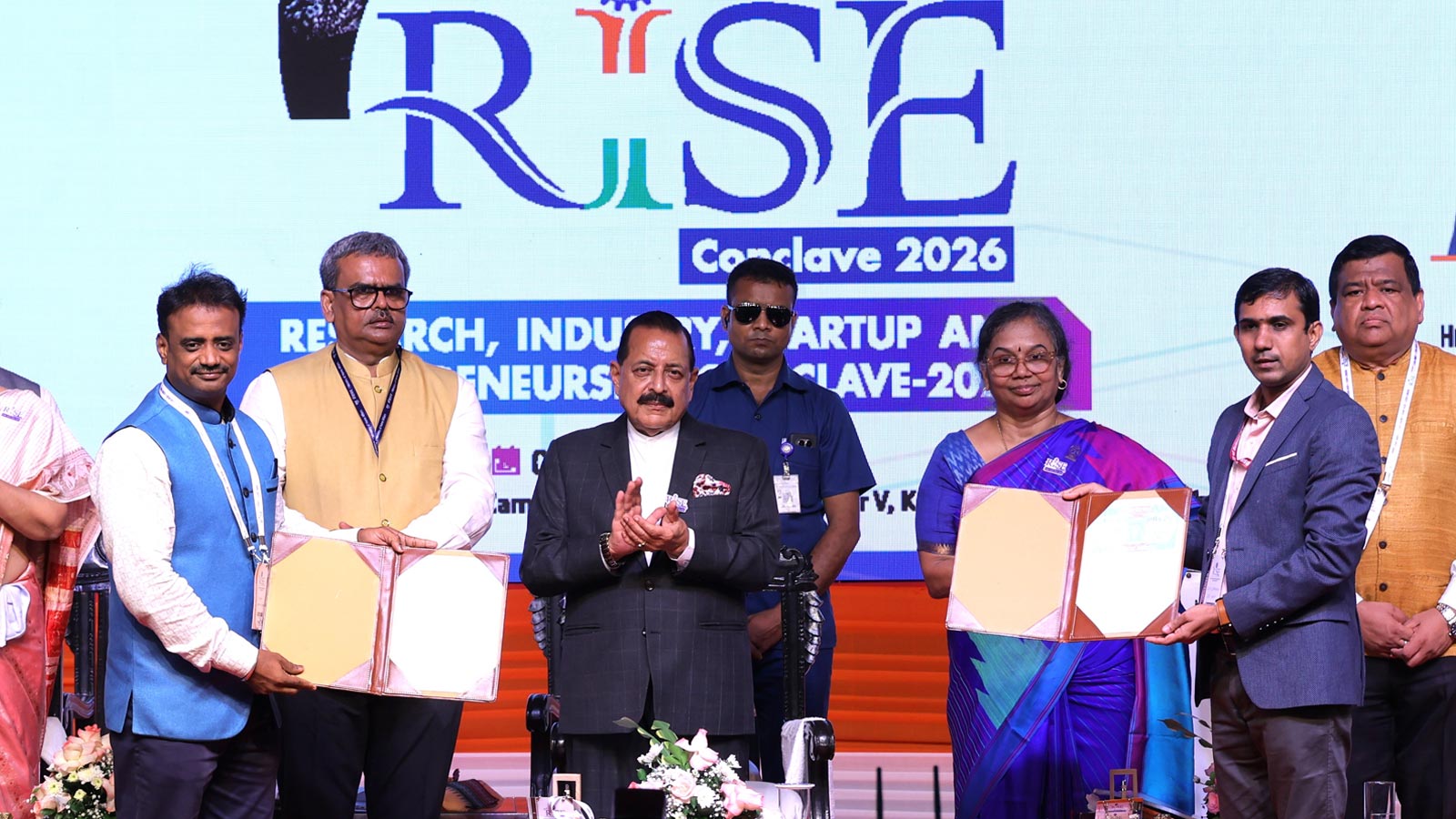
Union Minister of State for Science and Technology Jitendra Singh on Sunday called for expanding India’s rapidly growing startup ecosystem beyond metropolitan centres and strengthening collaboration among science, startups and industry to accelerate the journey of indigenous technologies from laboratories to the market.
Addressing the inaugural session of the sixth RISE Conclave 2026 in Kolkata, Singh said more than 50-60 per cent of India’s startups are based outside metropolitan cities, underlining the need to recognise the innovation potential of Tier-2 and Tier-3 cities.
He said young innovators from smaller cities are increasingly matching, and in some cases outperforming, their counterparts in major technology hubs. Scientific institutions and the innovation ecosystem, therefore, need to reach out to these innovators rather than expecting them to move to established centres, he added.
Singh said the RISE Conclave provides a platform for startups, researchers, industry representatives, mentors and government officials to interact and help move scientific research beyond laboratories towards entrepreneurship, technology transfer, commercialisation and wider societal applications.
He said Kolkata was a particularly appropriate venue for the conclave given the city’s rich legacy of scientific and academic excellence. Recalling the contributions of figures such as Dr Bidhan Chandra Roy, Prof U.N. Brahmachari, Sir C.V. Raman and Dr Syama Prasad Mukherjee, Singh said the present generation has a responsibility to build on Bengal’s scientific heritage and restore Kolkata’s position as a major centre of science and technology.
The minister said the government’s “Whole-of-Government” approach was increasingly evolving into a “Whole-of-Science” approach, bringing ministries, research institutions, academia and industry together. He said collaboration among CSIR laboratories and institutions such as IIT Kharagpur, IISER Kolkata and NIT Durgapur, along with organisations under the Department of Biotechnology, Department of Science and Technology, Department of Atomic Energy and Ministry of Earth Sciences, could create a strong knowledge corridor in eastern India.
Singh also highlighted the opening of sectors such as space, nuclear energy and biotechnology to greater private-sector participation, saying the move had created new opportunities for startups and businesses to contribute to national technology development.
He referred to the government’s ₹1 lakh crore Research, Development and Innovation Fund and the role of the Anusandhan National Research Foundation (ANRF) in promoting high-risk, high-reward research and stronger partnerships between academia, startups and industry.
Calling for greater industry participation, Singh urged businesses to adopt, finance and commercialise technologies developed in Indian laboratories. He said indigenous technologies could reach the market at scale only when industry sees commercial value and becomes an active partner in the innovation process.
The minister also stressed that the RISE platform should evolve into a continuous innovation ecosystem rather than remain confined to an annual event. He called for wider dissemination of scientific knowledge and technologies through languages and formats accessible to people across the country.
Singh said eastern India’s scientific, academic and industrial strengths could play a significant role in India’s technology-led growth. He identified sectors such as steel, aluminium, mining, jute, IT and software as potential partners for startups and research institutions in scaling up indigenous technologies.
He also called for greater use of artificial intelligence and digital technologies to enhance the capabilities of indigenous machines, optical networks and other technologies developed in Indian laboratories.
The minister said India’s progress in areas such as space, biotechnology, nuclear energy and the digital economy demonstrated the potential of closer government-industry-academia collaboration. The next phase of growth, he said, would require these partnerships to become deeper, broader and more sustained.
Singh said the vision of Viksit Bharat 2047 would require India to combine its scientific legacy with indigenous technology, entrepreneurship, modern manufacturing and strong industry partnerships. He described the RISE Conclave as a bridge between Bengal’s scientific heritage and the country’s emerging entrepreneurial ecosystem.
The two-day RISE Conclave, being held on September 6-7 at CSIR-Indian Institute of Chemical Biology in Salt Lake, Kolkata, is being organised jointly by CSIR-CGCRI, CSIR-IICB, CSIR-CMERI and CSIR-IMMT under the theme “Driving Innovation & Entrepreneurship for Viksit Bharat 2047”.
The conclave brings together startups, industry, academia, researchers, investors, incubators, MSMEs and policymakers. Around 150 startups, nearly 300 startup representatives and about 150 delegates from incubation and innovation centres are participating.
The event is centred on the “4M” framework – Minerals, Medicine, Materials and Machines – reflecting the complementary capabilities of the four participating CSIR laboratories.
The programme includes eight panel discussions involving 67 experts on subjects such as drug discovery and affordable healthcare, manufacturing and R&D for MSMEs, advanced materials, decarbonisation of steel and aluminium, critical minerals, science communication and opportunities for science-driven startups.
The conclave is also focused on technology commercialisation, with eight MoUs and four technology transfers, besides the launch of two products and inauguration of a facility. A Startup Exhibition and S&T Pavilion are providing platforms for entrepreneurs to showcase their technologies and connect with researchers, investors and industry representatives.


