







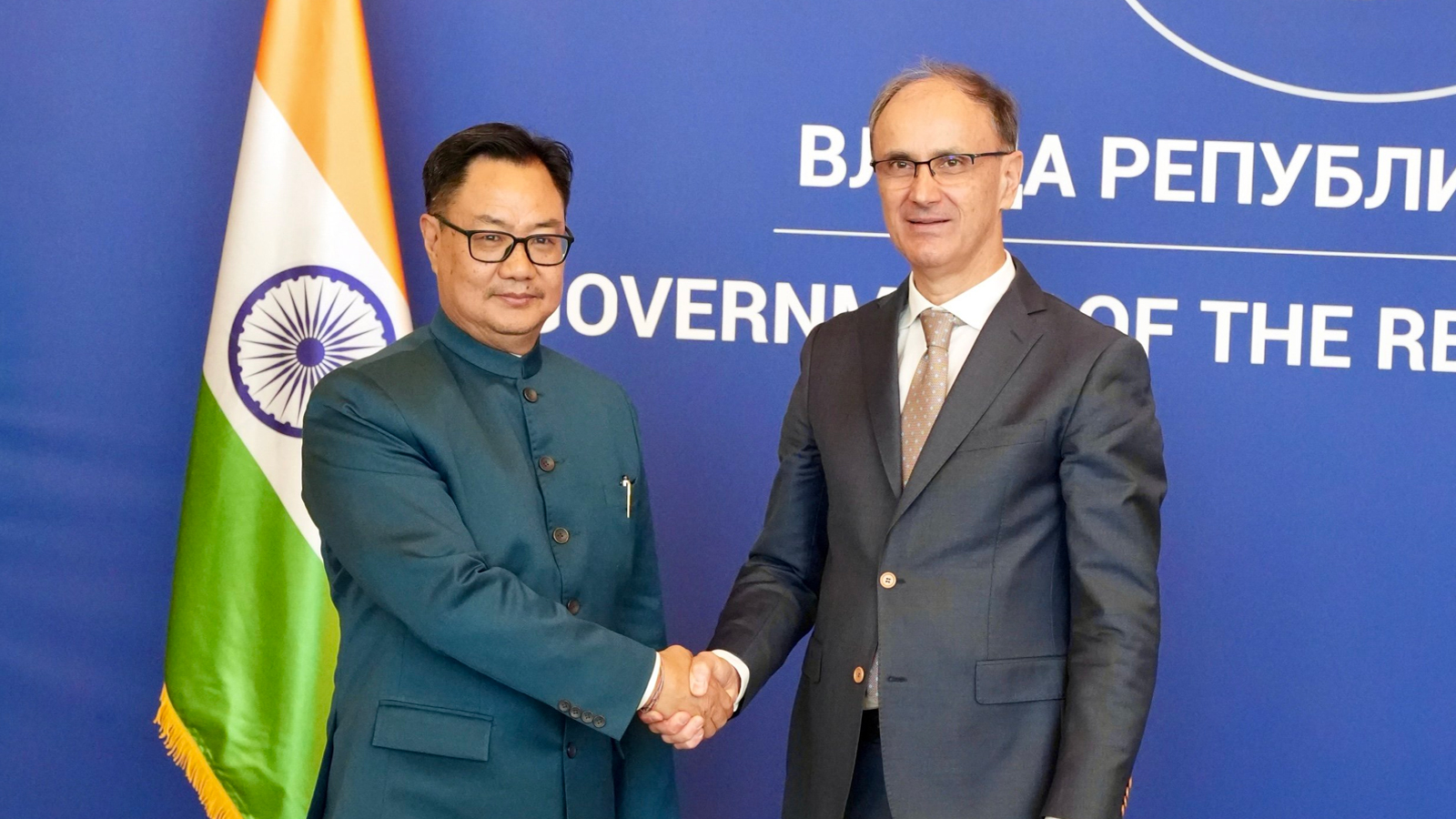
Union Minister for Parliamentary Affairs and Minority Affairs Kiren Rijiju met Serbian Prime Minister Duro Macut and Foreign Minister Marko Duric in Belgrade on Monday, holding discussions on further strengthening the longstanding and close ties between India and Serbia.
“Called on H.E. Đuro Macut, Prime Minister of the Republic of Serbia, at the Palace of Serbia in Belgrade. Exchanged warm greetings & views on further strengthening the close & enduring ties between India & Serbia, rooted in mutual respect, friendship & shared interests,” Rijiju said in a post on X.
Earlier in the day, Rijiju met Serbian Foreign Minister Marko Duric and reviewed the longstanding friendship between the two countries. The two sides also discussed prospects for deepening bilateral cooperation in areas of mutual interest.
“Had a warm & meaningful meeting with H.E. Marko Duric, Minister of Foreign Affairs of the Republic of Serbia, in Belgrade. Discussed the longstanding friendship between India & Serbia and exchanged views on further deepening bilateral relations & cooperation across areas of mutual interest,” said Rijiju.
Rijiju is leading the Indian delegation at the High-Level Commemorative Meeting marking the 65th anniversary of the First Conference of Heads of State or Government of the Non-Aligned Movement (NAM), being held in Belgrade from August 31 to September 1.
The meeting is being held under the theme, “The Legacy of Non-Alignment: Lessons for Today’s World.” According to the Ministry of External Affairs (MEA), the gathering commemorates the first NAM conference and provides an opportunity for participating countries to reflect on the movement’s continuing relevance.
India is a founding member of NAM, which brings together 121 developing countries. The MEA has said India remains committed to the principles and values of the movement.
As part of his engagements in Belgrade, Rijiju on Sunday paid floral tributes at the bust of Mahatma Gandhi and interacted with members of the Indian community. He appreciated their contribution towards strengthening India-Serbia relations.
During the interaction, Rijiju met members of the diaspora, including one who recalled coming to Serbia, then part of Yugoslavia, through an India-Yugoslavia exchange programme in 1966-67. Rijiju also interacted with children from the Indian community and discussed their cultural activities and the popularity of Indian food in the region.
Reflecting on the interaction, Rijiju said it had been an “emotionally charged” experience.
Rijiju also visited the Museum of Yugoslavia and the House of Flowers, the mausoleum of former Yugoslav President Josip Broz Tito. He said the visits provided an opportunity to gain insights into Yugoslavia’s political history, cultural heritage and Tito’s life and legacy.
(With IANS inputs)


