







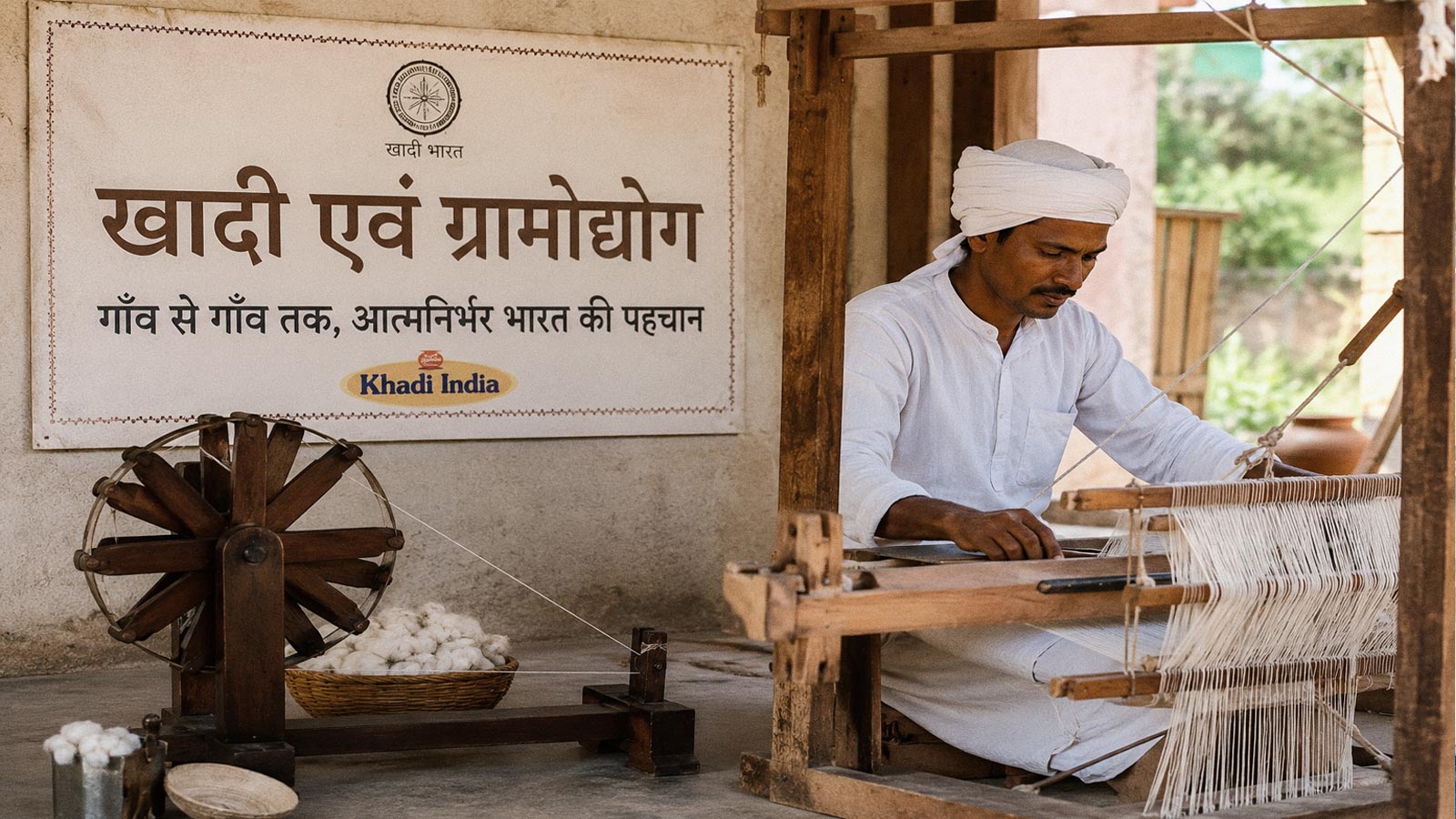
Traditional skills and locally available resources are emerging as the foundation for new rural enterprises, with the Khadi and Village Industries Commission (KVIC) supporting artisans and entrepreneurs through training, financial assistance, technology, improved tools and market support.
Under the Ministry of Micro, Small and Medium Enterprises (MSME), KVIC is implementing initiatives such as the Khadi Vikas Yojana (KVY), Gramodyog Vikas Yojana (GVY) and the Prime Minister’s Employment Generation Programme (PMEGP) to help traditional occupations evolve into sustainable businesses and sources of livelihood.
In Tamil Nadu’s Kanyakumari district, T. Ajin, who runs Marthandam Honey Products, has turned his expertise in beekeeping into a honey-based enterprise. His unit produces AGMARK-certified honey as well as honey blended with dry fruits.
Ajin has also extended his work beyond his own business by training farmers, particularly those from economically weaker sections and SC/ST communities, in modern beekeeping practices. He has participated in State, regional and district-level programmes and has shared his expertise through All India Radio and Doordarshan.
Another example is B. Sundaraj, who has built a village enterprise around vetiver. Through his Pure Health Herbal Agarbathi Unit, he manufactures agarbattis, herbal products, vetiver agarbattis and vetiver samburani.
With support under the Gramodyog Vikas Yojana during 2024-25, Sundaraj strengthened his manufacturing capabilities and expanded his product range, demonstrating how local resources and traditional knowledge can be combined with modern production to create viable businesses.
Similarly, M. Murugesan has developed an enterprise based on banana fibre. Under PMEGP, his Banana Fibre Fancy Articles Making Unit, operated through Om Banana Craft Private Limited, converts banana fibre into decorative and utility products.
His work has received Central and State government recognition, while exhibitions, awareness programmes and training initiatives have provided him platforms to promote his products and share his knowledge.
Honey Mission expands beekeeping opportunities
A key KVIC initiative supporting rural livelihoods is the Honey Mission, launched in 2017 to promote scientific beekeeping among farmers, tribal communities and unemployed youth.
Under the programme, beneficiaries receive training, bee boxes, live bee colonies and related toolkits, enabling them to take up beekeeping and develop it into a source of income.
According to KVIC, around 2.46 lakh bee boxes and bee colonies were distributed across the country between 2017-18 and 2025-26. The initiative contributed to around 5,500 metric tonnes of honey production during 2025-26.
The benefits of beekeeping extend beyond honey production. Bees play a crucial role in pollination, linking the activity with agriculture and biodiversity while potentially improving farm productivity.
Beekeeping is being undertaken across several states, including Tamil Nadu, Kerala, Karnataka, Andhra Pradesh, Telangana, Odisha and the northeastern states, providing livelihood opportunities to communities engaged in the activity.
KVIC’s interventions seek to build on these traditional strengths by combining skills and local resources with technology, finance, training and market access. The approach is helping rural entrepreneurs develop value-added products while creating employment and income opportunities within local communities.
The experiences of Ajin, Sundaraj and Murugesan highlight how traditional occupations can evolve into modern village enterprises, contributing to the broader rural entrepreneurship ecosystem and the government’s efforts to strengthen livelihoods in rural India.
For more information, KVIC has provided details on its official website (https://www.kvic.gov.in/kvicres/index.php).


