







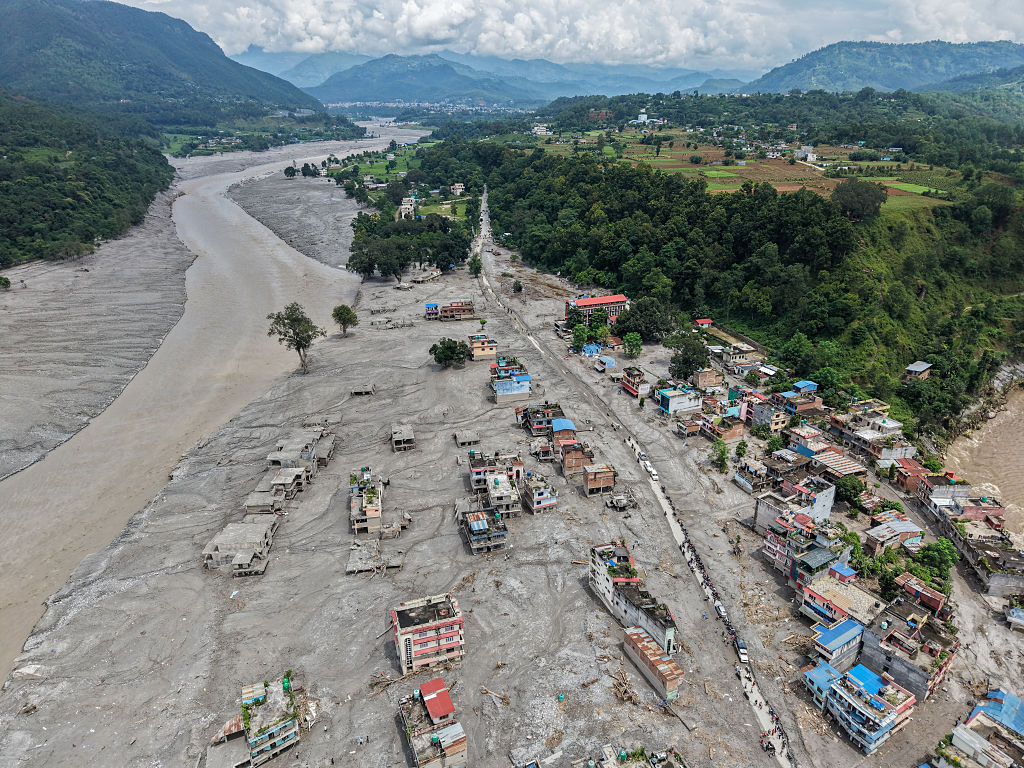
Hopes of finding more survivors among thousands still missing in Nepal were fading on Wednesday, but authorities believed that dozens of workers trapped in the tunnels of hydropower projects hit by the Himalayan catastrophe could still be alive.
A week after a glacier collapse in the Himalayas unleashed flash floods that devastated the mountainous nation, killing at least 1,114 people and leaving nearly 4,000 others missing, rescue operations were focused on the ruins of power plants where those trapped in tunnels could have managed to survive.
Authorities said powerhouses of hydroelectric plants have spaces and rooms for people to stay and rescuers are trying to reach them and look for survivors, with at least 639 people still missing, including those believed to be trapped in tunnels.
“We are very confident that they must be alive after one week because … they have food and water over there in the building,” Amhsu Kiran Shahi, a board member of the Nepal Electricity Authority, told Reuters.
The possibility of finding survivors elsewhere was fading, authorities said, but there was no let up in rescue operations as teams scoured the mountainside along the border with China where floods tore through towns and valleys.
“The hope of finding survivors is decreasing,” Phanindra Paudel, a senior official at Nepal’s National Emergency Operation Center (NEOC), said. “We pray and are hopeful. Hope is hope!”
HOPING TO FIND SURVIVORS INSIDE TUNNELS
Major rescue operations were underway or planned at tunnels at four projects and two of them with a total of nearly 100 people missing offered the strongest hopes of finding survivors because of the presence of air inside, Shahi said.
At Trishuli-3A, one of the two projects, officials believe there was a dry space inside and expected oxygen to be flowing through the tunnel, with pipes also being used to push oxygen inside, Shahi said.
Specialised rescue teams from India, China and the United States were involved in the tunnel rescue attempts.
Across the border in Tibet, China’s official toll has held steady since Sunday at 16 dead and 546 missing.
Those numbers were likely to be updated on Wednesday as China fully reopened the only road leading to the Gyirong border crossing into Nepal, allowing heavy machinery to reach the core disaster zone for the first time.
TIBET DISASTER ZONE BECOMES ACCESSIBLE
A large number of heavy machines had reached the site where a Chinese border inspection complex once stood, along with equipment to reinforce search operations, Chinese state broadcaster CCTV said.
Showing footage of rescue teams and excavators, CCTV said crews equipped with life-detection devices and search dogs had been deployed to the area.
Progress has been hampered by persistent rain and challenging terrain, as crews have to work in a narrow mountain gorge, hemmed in between unstable cliffs and a fast-flowing river.
China’s official toll of those missing includes 104 Indians, 49 Nepali citizens as well as 33 Latvians who are believed to be part of two tourist groups. Most Indians were part of groups visiting the Lake Mansarovar and Mount Kailash in Tibet, holy pilgrimage sites for Hindus.
Beijing will send more DNA identification experts and emergency supplies including Bailey bridges, mortuary refrigerators and communications equipment to Nepal to help with the rescue and relief efforts, the foreign ministry said on Wednesday.
CHILDREN WHO SURVIVED FEARFUL, ANXIOUS
Residents in Nepal’s affected areas walked around the remains of what were once bustling villages and towns, trying to salvage whatever they could of their belongings.
“My husband and I were able to escape safely. But we could not pick up anything,” Shanta Sunar, 45, a small shopkeeper and survivor from Nuwakot, said.
“We have lost whatever we had. But we are lucky nothing happened to us.”
Children in Nuwakot and Rasuwa areas are increasingly showing signs of psychological distress after witnessing the fury of the flood last week, international charity Save the Children said in a statement.
Many minors told Save the Children that they are fearful and anxious after witnessing wide-ranging horrors including school buses full of friends washed away, their homes submerged and everything they hold dear carried away by the waters, the charity said.
FOCUS ALSO ON REBUILDING, PM SHAH SAYS
Nepali Prime Minister Balendra Shah said the government, helped by foreign assistance, was restoring telecommunication, power supply and transport links through Bailey bridges, with 95% of telecom services restored in the affected areas by Tuesday.
The disaster has disrupted 431 megawatts of electricity generation capacity, he told parliament on Wednesday.
“This was one of the major disasters experienced by human civilisation,” Shah said. “As soon as information was received that the flood was approaching, our security personnel were deployed to warn local residents. Some of those personnel themselves went missing.”
-Reuters


