







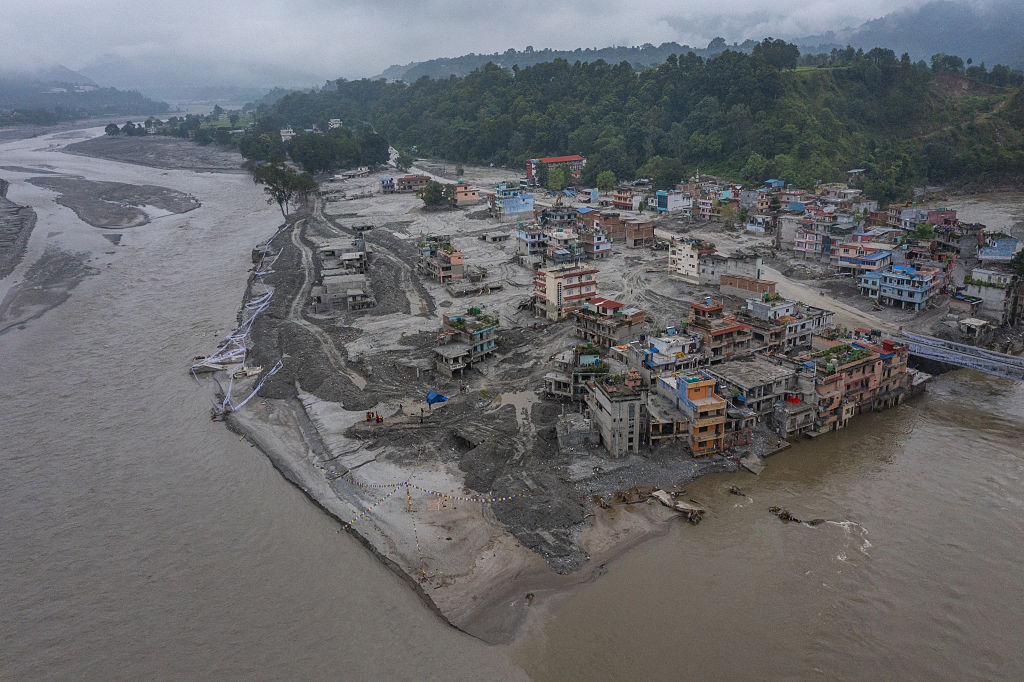
Nepal has formed a 15-member parliamentary special committee to study the devastating floods that struck areas along the Nepal-Tibet border and parts of the country on August 26.
At a meeting of the House of Representatives on Monday, Speaker Dol Prasad Aryal presented a proposal to form the 15-member committee to examine the impact of climate change on the Himalayas, climate justice and the Bhotekoshi-Trishuli disaster. The proposal was unanimously endorsed by the House.
“The devastating disaster that struck the Bhotekoshi-Trishuli river system has not only severely affected the lives, housing, transportation, energy, trade, agriculture and livelihoods of citizens in the affected areas, but has also completely destroyed the Trishuli region,” Speaker Aryal said.
“Its impact is not limited to the affected settlements, but has impacted supply chains, public services and economic activities. This incident has shown the need to prioritise immediate search and rescue, safe rehabilitation, sustainable reconstruction and future risk mitigation as national priorities,” he added.
Aryal said the impact of climate change in the Himalayan region, the condition of glacial rivers and lakes, changes in Himalayan watersheds and the safety of downstream areas needed to be addressed seriously in the wake of the disaster.
“The immediate causes of the disaster, the factors that are accelerating it, and the available scientific knowledge and expertise related to climate change are issues that need to be addressed,” Aryal said.
He added that addressing the causes of the disaster and tackling climate change would require placing the losses and damages suffered by affected communities at the centre of a comprehensive plan.
“For this, Nepal needs to develop a national vision based on scientific knowledge and take strong diplomatic initiatives on climate finance, adaptation technologies and international cooperation,” he said.
According to Aryal, the committee’s terms of reference include studying the impact of climate change on the Himalayan region and the Bhotekoshi flood in Rasuwa. It will also recommend measures for the rehabilitation of flood-affected citizens, sustainable reconstruction, disaster risk reduction, legal and institutional reforms, and climate justice.
The committee will review changes and risks related to Himalayan temperatures, snowfall, glaciers, glacial lakes and watersheds, and recommend measures to strengthen the country’s research system.
The committee comprises MPs Achyutam Lamichhane, Anushka Shrestha, Gangadevi Shrestha, Ganesh Parajuli, Dhananjay Regmi, Dhruva Raj Rai, Nisha Dangi, Pushparaj Kandel, Mohan Acharya, Mingma Gyabu Sherpa, Ramesh Kumar Malla, Ravindra Patel, Saraswati Lama, Sujata Tamang and Sita Thapaliya.
The committee has been given three months to submit its report. It will present its findings, identify issues requiring immediate attention and provide a roadmap for sustainable reconstruction, legal and institutional reforms.
The report will also include recommendations on the agencies responsible for implementation, timelines, required resources and monitoring indicators. The committee may submit interim reports or short-term recommendations on issues requiring immediate action, the Speaker said.
The floods struck riverside settlements in Rasuwa district on the morning of August 26 before rapidly affecting neighbouring areas, including Nuwakot and Dhading.
According to the latest figures cited in the report, more than 1,400 people have been killed, while over 6,000 remain unaccounted for.
Government forces mounted an intensive response in the immediate aftermath of the disaster. Security personnel from the Nepal Army, Nepal Police and Armed Police Force were mobilised in large numbers, with deployment peaking at more than 13,000 personnel.
Helicopter sorties prioritised the evacuation of critically injured people, pregnant women, children, elderly people and persons with disabilities.
The scale of the disaster is also reflected in the damage to infrastructure. Eight operational hydropower projects with a combined capacity of 281 MW and four projects under construction with a capacity of 388 MW were damaged, affecting 431.1 MW of generation capacity.
Major sections of the Galchhi-Betrawati-Rasuwagadhi road and the Prithvi Highway were destroyed or severely damaged. The disaster also damaged 48 suspension bridges and 31 motorable bridges.
Search operations for missing people are continuing, while unidentified bodies are being handled through scientific procedures, with DNA samples being preserved.
-ANI


