







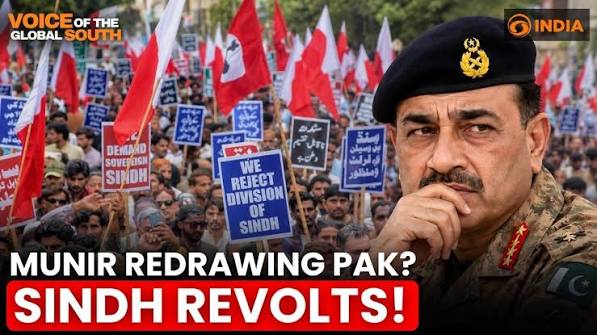
Sindh erupts in protest as the military-backed government plans to carve the province into smaller units
WATCH YOUTUBE VIDEO:
A major political showdown is shaking Pakistan. What started as a debate over administrative reform is now a full-blown constitutional standoff. The crisis is centred in Sindh province but its shockwaves are hitting the entire country. From the coastal megacity of Karachi to restive areas in Balochistan and the valleys of Pakistan-occupied Jammu and Kashmir, discontent is growing. Multiple protests are now testing the absolute authority of the military-backed government. This hybrid administration is led by the Chief of Defence Forces, Field Marshal Asim Munir.
The spark for this crisis? An aggressive push for new provinces. Interior Minister Mohsin Naqvi is leading the call. He argues that the old four-province system cannot handle a population of over 250 million people. His colleague, Planning Minister Ahsan Iqbal, has proposed a massive change. Iqbal wants to split the country into 12 to 15 new administrative units.
Now, there is no official map yet but political rumours are already flying. Speculation suggests carving up Punjab into regions such as South Punjab or Bahawalpur. More controversially, the plan could place Karachi, the capital of Sindh, under direct federal control from Islamabad. It could also further divide the remaining two provinces of Balochistan and Khyber Pakhtunkhwa.
Talk of a new 28th Constitutional Amendment is spreading fast, too. Reports say that the amendment aims to strip away Article 239, clause 4. Right now, that law protects the provinces. The federal government cannot alter provincial borders without a two-thirds majority vote from that specific provincial assembly. Removing this clause has turned the legal system into a fierce battlefield.
Public anger is boiling over. Throughout July and August, a sea of young demonstrators flooded the streets late into the night. Massive “Wahdat-i-Sindh” unity marches swept through major cities. Thousands filled the streets of Hyderabad, Karachi, Sukkur and Badin. The provincial pushback hit a peak on 3rd September. The Sindh Assembly unanimously passed a landmark resolution. The legislators completely rejected any proposal to alter the province’s centuries-old borders. The resolution, which acts as a pre-emptive veto against any attempt by Field Marshal Munir to change the status quo, has been formally sent to the President, the Prime Minister’s Office and both houses of Parliament. Sindh Chief Minister Murad Ali Shah made his stance clear: The historic identity of the province is non-negotiable. This fierce sentiment was echoed by fellow Pakistan Peoples Party figures.
The tension is triggering older political divides. Some groups are invoking the historical “Sindhudesh” movement. This movement calls for a fully independent Sindhi homeland, separate from Pakistan. However, talk of independence sparked chaos in the Singh legislature. Opposition M.Q.M. legislators protested by loudly chanting “Sindhudesh Na Manzoor”, meaning “Sindhudesh is unacceptable”. As things stand today, the main demand of this mass mobilisation remains clear: The people want to defend Sindh’s integrity within the Pakistani federation.
Critics of the plan to create smaller provinces warn that breaking up the province repeats a dark chapter of history. They compare the plan to the infamous “One Unit” scheme used from 1955 to 1970. Back then, the military establishment erased western provincial borders to centralise power. That move fuelled deep bitterness and ultimately led to the separation of Bangladesh.
This regional resistance comes at a terrible time for the military establishment. They are facing a multi-front crisis:
— First, Balochistan is dealing with sustained insurgent violence;
— second, Pakistan-occupied Jammu and Kashmir is seeing large-scale protests over economic rights and poor governance; and
— third, a major opposition campaign is running at the exact same time as the Sindh unity protests.
The Pakistan Tehreek-e-Insaf or P.T.I launched a massive five-day cross-provincial mobilisation from 3rd to 7th September. Khyber Pakhtunkhwa Chief Minister Sohail Afridi led the convoy. Defying heavy media clampdowns, the convoy travelled through Sindh. They rallied public support for nationwide protests. Their core demands? The immediate release and medical treatment of jailed former Prime Minister Imran Khan. The mobilisation ended with a massive rally right in Karachi.
These two movements are completely distinct in their origins. One defends Sindh’s borders while the other fights for the P.T.I. Fortunately, both have remained largely peaceful. Yet, they both reflect a deep, youthful anger against the current power structure … …
Unsurprisingly, domestic media coverage reveals a deeply fractured nation. The Dawn newspaper published extensive analyses. Their editorial warned the government not to drag the country into “another ugly crisis” without clear Constitutional backing. The Express Tribune and The News offered their own warnings. They said that treating Sindh as a laboratory for new administrative units will backfire. It risks turning a debate about governance into a dangerous, volatile ethnic identity crisis.
Pakistan’s military-backed leadership is now fighting fires on every front. They face a clear Constitutional veto from Sindh. They face ongoing insecurity in Balochistan. Unrest grips Pakistan-occupied Jammu and Kashmir. And a determined opposition is mobilising around Imran Khan. Will the push for new administrative units advance, stall, or break apart entirely? The answer will test the very survival of the federation and the ultimate authority of the establishment.
Ramesh Ramachandran is a senior consulting editor with D.D. India


